Top Large Language Models: What They Are & How to Choose

AI Tools for Large Language Models

Discover the best Large Language Models AI tools to enhance your productivity and creativity.

Page 4 of 7 • 75 total tools
Screenshot of Lettria

Lettria

Freemium

Lettria is an NLP platform built for software developers and knowledge workers. It combines Large Language Models (LLMs) with symbolic AI to overcome common challenges in extracting knowledge from text. The platform turns messy, unstructured documents into dependable information by understanding the connections between pieces of data within text. It focuses on sustainability, efficient resource use, explainability, data privacy, and transparency.

Large Language Models View Tool →
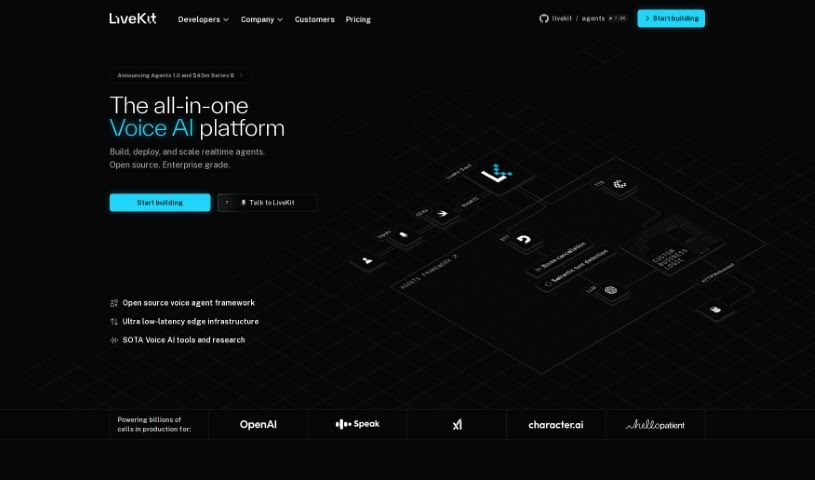
Screenshot of LiveKit

LiveKit

Freemium

LiveKit is a platform for real-time communication built on WebRTC. Through its KITT platform, it enables interactive, AI-powered conversations with ChatGPT, combining live voice and video with a user-friendly interface and dependable connectivity.

Large Language Models View Tool →
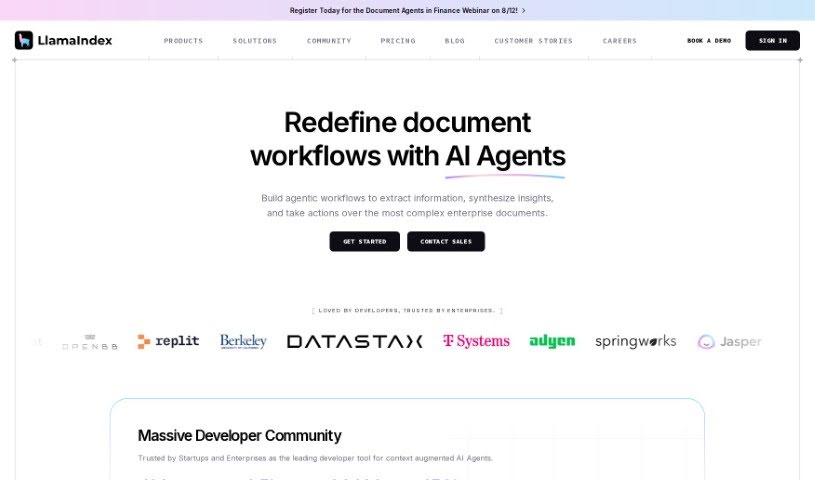
Screenshot of LlamaIndex

LlamaIndex

Freemium

LlamaIndex is a data framework for connecting your own data with large language models (LLMs). It acts as a bridge between data sources — APIs, PDFs, documents, SQL databases, and more — and LLM applications, so those applications can access and reason over your data. It serves both individual developers on GitHub and enterprises looking for a managed solution.

Large Language Models View Tool →
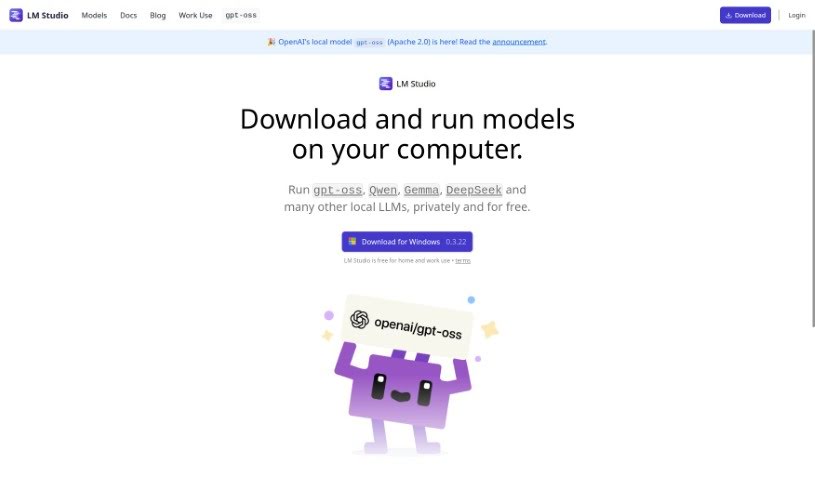
Screenshot of LM Studio

LM Studio

Freemium

LM Studio is a desktop app for discovering, downloading, and running local and open-source Large Language Models (LLMs). It supports any ggml-compatible model available on Hugging Face, works across multiple operating systems, and uses your computer's GPU when available to speed up model execution. Models run entirely offline, and you can interact with them through the built-in Chat UI or a local server with an OpenAI-compatible API.

Large Language Models View Tool →
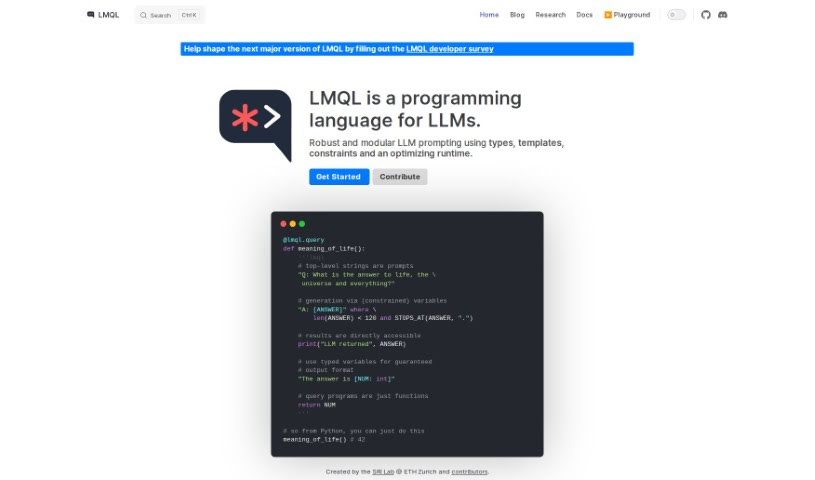
Screenshot of LMQL

LMQL

Freemium

LMQL (Language Model Query Language) is a programming language for interacting with language models. It provides a straightforward way to query these models, letting developers craft queries to extract specific information or generate exact outputs. The language supports querying model parameters, generating text, and completing prompts through a syntax accessible to programmers at any level of experience in natural language processing.

Large Language Models View Tool →
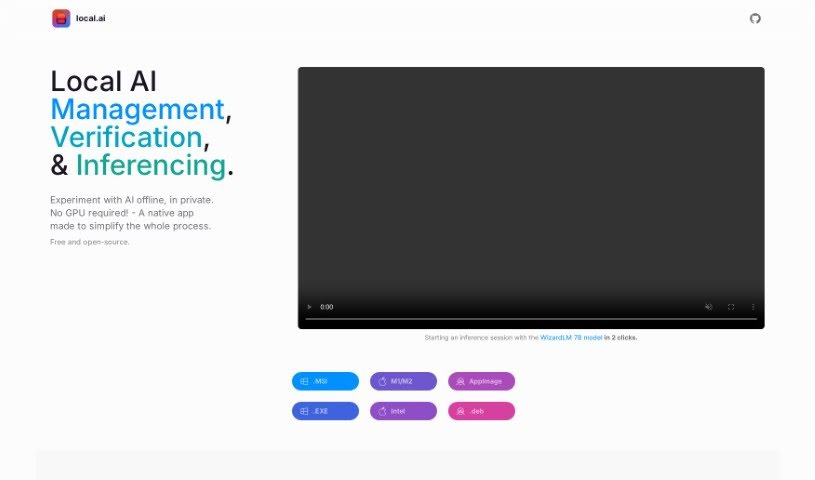
Screenshot of Local AI

Local AI

Freemium

Local AI Playground is a free, open-source native application for experimenting with AI models directly on your own computer. It requires no complicated technical setup and no dedicated GPU — inferencing runs on your CPU. The app is compact (under 10MB) and memory-efficient, and it works on Mac M2, Windows, and Linux (.deb).

Large Language Models View Tool →
Screenshot of Menteebot

Menteebot

Freemium

Menteebot is an AI-powered humanoid robot designed to move and interact with its surroundings in natural, human-like ways. It is built on Sim2Real learning techniques, allowing it to mimic natural walking and hand movements. It can map 3D spaces in real time, navigate complex environments, and use Large Language Models to understand its world and carry out tasks.

Large Language Models View Tool →
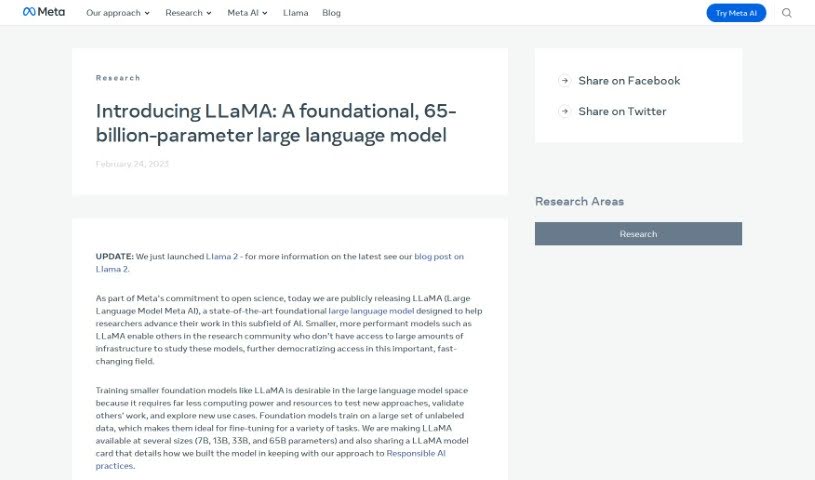
Screenshot of Meta LLaMA

Meta LLaMA

Freemium

Meta LLaMA is a tool developed by Meta Platforms, Inc., the company behind Facebook. It is designed for large-scale, multi-objective optimization — "Large-scale Markov Decision Process using Meta-optimizers." In practice, it uses machine learning models and advanced optimization techniques to handle complex decision-making processes with multiple goals. It is suited to problems too large or complicated for standard optimization methods, applying meta-optimization strategies across a range of applications and industries.

Large Language Models View Tool →
Screenshot of Missing Studio

Missing Studio

Freemium

Missing Studio is an open-source AI studio that provides the infrastructure to build and deploy generative AI applications ready for production. It includes a Universal API (called an AI Router), built-in API management, load balancing, automatic retries, and Semantic Caching, with a focus on both high performance and ease of use.

Large Language Models View Tool →
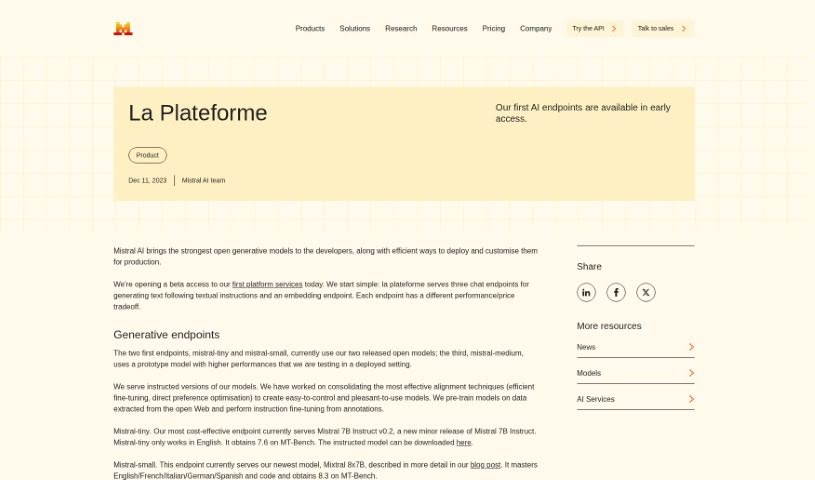
Screenshot of Mistral AI Mistral-medium

Mistral AI Mistral-medium

Freemium

Mistral-medium is a chat endpoint from Mistral AI, built for top-tier performance across a range of applications. It excels in English, French, Italian, German, Spanish, and coding tasks, and scored 8.6 on the MT-Bench evaluation. Mistral AI focuses on giving developers strong, open generative models that are easy to deploy and customize for production environments.

Large Language Models View Tool →
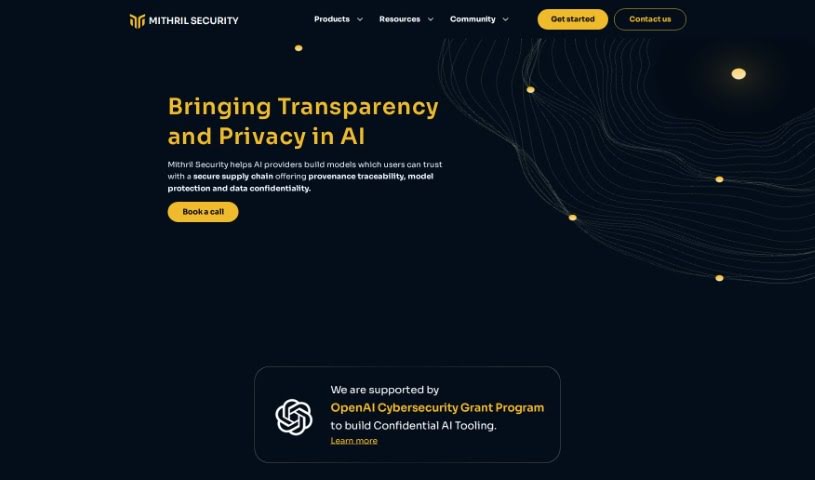
Screenshot of Mithril Security

Mithril Security

Freemium

Mithril Security provides a service designed to bring greater transparency and privacy to AI models. It offers a secure supply chain that includes provenance traceability, model protection, and data confidentiality.

Large Language Models View Tool →
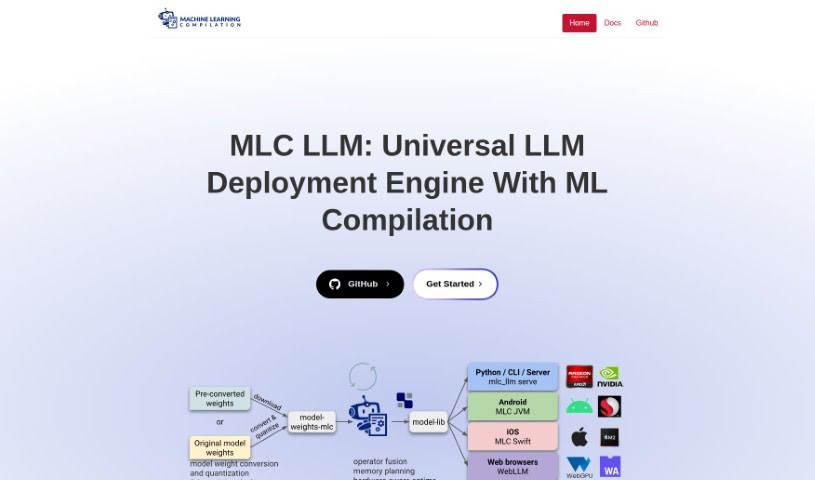
Screenshot of MLC LLM

MLC LLM

Freemium

MLC LLM is a machine learning compiler and high-performance deployment engine for running large language models (LLMs). Its goal is to make it possible for anyone to develop, fine-tune, and deploy AI models on their own devices and platforms. Code is compiled and run through MLCEngine, a unified LLM inference engine that offers an OpenAI-compatible API accessible from a REST server, Python scripts, JavaScript in the browser, or directly on iOS and Android devices.

Large Language Models View Tool →

About Large Language Models tools

Building an application with a large language model can feel equal parts exciting and overwhelming. Whether you’re trying to pick the right base model, connect private company documents to a chatbot, or figure out why your prompts fail in production, the technical landscape moves fast. (It’s easy to waste days tweaking system prompts and wrestling with vector databases.) Setting up custom workflows often turns a simple software idea into a complex infrastructure project.

The developer platforms and orchestration frameworks in this directory serve as specialized building blocks and testing environments. They help you connect data, monitor model behavior, and deploy reliable features without building everything from scratch.

Data Orchestration, Testing, and Inference

Connecting foundational models to your proprietary business data requires more than a standard API request. When you need a chatbot to read internal company files or search product catalogs, Retrieval-Augmented Generation (RAG) tools handle the heavy lifting. They split documents into searchable chunks, store them in vector databases, and pull relevant facts into the prompt automatically so the model gives accurate answers.

Evaluating model performance and tracking prompt quality becomes far easier, too. When you update a system prompt or switch model providers, figuring out whether your changes actually improved response quality takes systematic testing. LLM evaluation and tracing tools log user interactions, flag incorrect responses, and benchmark output quality across different versions before you launch changes to production.

Managing local inference and model hosting saves computing costs while keeping sensitive data private. Running every user request through cloud APIs gets expensive fast as your user base grows. Modern serving engines and local runtime tools let you host open-weight models on your own servers, giving you complete control over data privacy and system latency.

Key Capabilities to Look For:

  • Vector database and RAG integration: Frameworks that connect foundational models to custom documentation, internal databases, and external APIs.
  • Prompt evaluation and testing platforms: Tools that let you test prompt variations, benchmark accuracy, and track model responses in real time.
  • Local inference and model serving: Applications that allow you to host open-weight models on private servers to reduce API costs and protect privacy.
  • Observability and session tracing: Systems that log latency, track token costs, and pinpoint errors across complex, multi-step agent workflows.
  • Dataset curation and fine-tuning: Software that helps clean training data, gather user feedback, and fine-tune smaller models for specialized tasks.

Building reliable LLM applications will always depend on solid software engineering, thoughtful UX design, and careful human oversight. Frameworks can route prompts, store document vectors, and track token costs, but choosing what problems are worth solving rests with your team. Letting smart developer tools handle orchestration and model monitoring simply frees you up to build great user experiences.

Explore the LLM frameworks below to find the right fit for your tech stack.

The Best AI Large Language Models

  1. Ollama: for building custom chatbots
  2. OpenAI Chat Playground: for creating personalized chatbot responses.
  3. LM Studio: for trying out LLMs locally
  4. Sapling: for better customer interactions through automation
  5. Chatx: for advanced text generation prompts.
  6. Snowflake: for customer support analytics powered by LLMs
  7. Llama Index: for custom chatbots that can retrieve knowledge
  8. AlphaSense: for automating market analysis with AI
  9. Tavily: for researching new developments in AI linguistics
  10. Addy AI: Fine-tunes large language models on your own private data.
  11. Langfuse: for making LLM responses more accurate
  12. AnythingLLM: for chatbots used in customer support
  13. LiveKit: for AI-powered voice interfaces for LLMs
  14. Vellum AI: for prompt engineering for complex questions
  15. Gpt4All: for chatting with your local files for insights
New tools, in your inbox.

Weekly picks of the best AI tools we've researched and added — no spam, unsubscribe anytime.

Join 25,000+ AI enthusiasts. No spam, unsubscribe anytime.