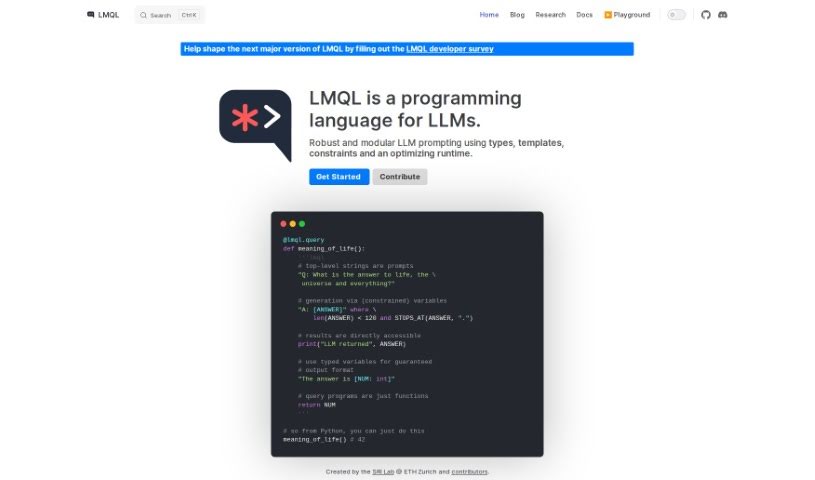
Screenshot of LMQL

LMQL

Discover LMQL, a powerful programming language for interacting with Language Models (LMs). Learn its features, how to use it effectively in 2025, and how it stacks up against other programming tools.

Screenshot

What is LMQL?

LMQL, which stands for Language Model Query Language, is a specialized programming language designed specifically for interacting with Language Models (LMs). It provides a smooth and efficient way to query and work with these models, helping developers make the most of them for all sorts of applications. With LMQL, you can easily craft queries to pull out specific information or generate the exact outputs you’re looking for from language models. The language offers a wide range of capabilities, like querying model parameters, generating text, and completing prompts, all through a user-friendly and intuitive syntax. This makes it accessible for programmers at any level of experience in natural language processing. Some of LMQL’s standout features include its compatibility with various language models, such as GPT-3 and GPT-4, allowing developers to tap into different model strengths depending on their project needs. Plus, LMQL incorporates optimization techniques to speed up query performance, cut down on latency, and ensure interactions with language models run smoothly. Beyond just being a programming language, LMQL also offers a complete ecosystem. This includes tools, libraries, documentation, tutorials, and a lively community ready to support developers, offering valuable insights and help. Whether you’re building chatbots, creating content, analyzing data, or working on other LM-related projects, LMQL simplifies how you interact with language models. It opens up new avenues in AI development and helps you get the most out of these powerful tools.

Who created LMQL?

LMQL was developed by the SRI Lab at ETH Zurich, along with contributions from others. It’s a robust programming language built for interacting with Language Models (LMs), empowering developers to query and manipulate them efficiently for a variety of applications. LMQL features a user-friendly syntax that makes tasks like querying model parameters and generating text straightforward, making it accessible to programmers of all skill levels. Its flexibility means it works well with different language models, including GPT-3 and GPT-4. It also provides optimization techniques to improve performance and offers a supportive ecosystem with tools, libraries, documentation, tutorials, and an active community to assist developers with their projects.

What is LMQL used for?

  • Content Generation: Creating written material.
  • Data Analysis: Examining and interpreting data.
  • Querying model parameters: Asking for specific settings or configurations of a model.
  • Generating text: Producing written content.
  • Completing prompts: Finishing user-provided text inputs.
  • Working with various language models: Such as GPT-3 and GPT-4.
  • Optimizing query performance: Making requests to the model faster and more efficient.
  • Reducing latency: Minimizing delays in responses.
  • Supporting developers: Providing tools and libraries to help them build.
  • Offering resources: Including documentation, tutorials, and examples.
  • Empowering AI solutions: Building things like chatbots, content generators, and data analysis tools.
  • Enhancing AI development: Opening up new possibilities in the field.
  • Making LLM code portable: Automatically adapting code to work across different backends.
  • Revolutionizing workflows: Streamlining processes in chatbots, content creation, and data analysis.
  • Simplifying interaction: Making it easier to communicate with language models.
  • Unleashing potential: Helping users get the most out of language models for diverse applications.

Who is LMQL for?

  • Developers: Anyone who writes code.
  • Natural Language Processing Professionals: Experts in how computers understand and process human language.

How to use LMQL?

To get the most out of LMQL, here’s a straightforward approach:

  1. Understand Its Purpose: Remember, LMQL is a programming language specifically designed for interacting with Language Models (LLMs). It lets you query and manipulate these models efficiently.
  2. Use Query Functions: Write queries to pull out specific information or generate desired outputs from your language models. LMQL offers various functions for tasks like checking model parameters, generating text, and completing prompts.
  3. Leverage Model Flexibility: Take advantage of LMQL’s compatibility with different language models, like GPT-3 and GPT-4. This lets you pick the best model for whatever you’re trying to do.
  4. Apply Optimizations: Use LMQL’s built-in optimization techniques to improve how quickly your queries run, reduce delays, and ensure your interactions with language models are smooth.
  5. Explore the Ecosystem: LMQL isn’t just a language; it’s a whole ecosystem. It provides tools, libraries, documentation, tutorials, and a helpful community to support your work.
  6. Consider Use Cases: LMQL can really change how you approach tasks like building chatbots, creating content, or doing data analysis by making interactions with language models much simpler.
  7. Implement with Python: Build your prompts and generate text using Python’s control flow and string interpolation. This makes the process intuitive, whether you’re a seasoned programmer or new to natural language processing.

By following these steps, you can effectively use LMQL to improve your AI development process and truly unlock the power of language models.

Related AI Tools

Discover more tools in similar categories that might interest you

Stay Updated with AI Tools

Get weekly updates on the latest AI tools, trends, and insights delivered to your inbox

Join 25,000+ AI enthusiasts. No spam, unsubscribe anytime.