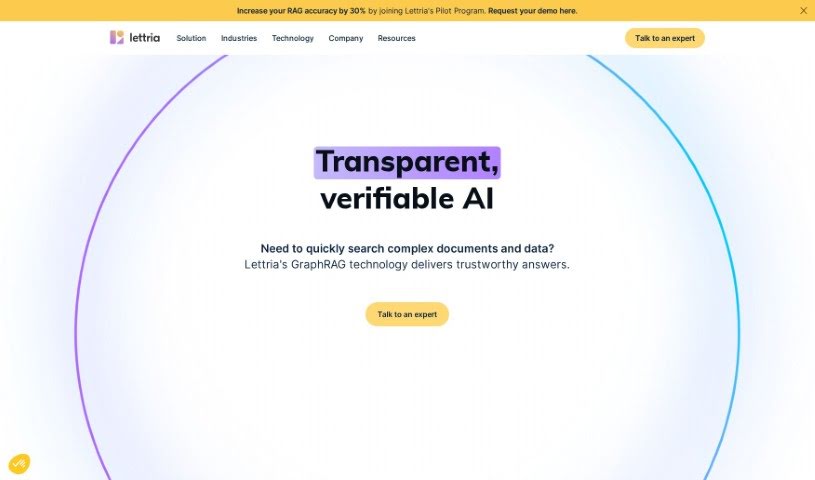
Screenshot of Lettria

Lettria

Discover what Lettria is and how to use it effectively in 2025. We'll explore its features and see how it stacks up against other Software Development Tools.

Screenshot

What is Lettria?

Lettria is a sophisticated NLP platform built for software creators and anyone who works with a lot of information. It cleverly combines the power of Large Language Models (LLMs) with symbolic AI to get past the usual hurdles in extracting knowledge. Essentially, Lettria helps you take any messy, unstructured document and turn it into dependable information. It does this by understanding the intricate connections between different pieces of data within text. The platform tackles some of the toughest challenges in Natural Language Processing, focusing on making things sustainable, using resources wisely, explaining how it gets its results, keeping data private, and being transparent.

Lettria’s NLP platform is built on three main ideas:

  1. Creating focused models: We build smaller, specialized models for specific tasks using graph-based techniques.
  2. Easy access to powerful tools: We make high-powered text processing and analysis available through a simple, no-code platform.
  3. Leveraging advanced tech: We use cutting-edge NLP and cloud computing power to analyze text quickly, accurately, and in large volumes, which helps with scaling and customization.

The goal here is to overcome the limitations of LLMs and help bridge the gap between different organizations. We’re actively working on projects that cut down the effort needed for NLP tasks while boosting the chances of success.

Lettria draws on a huge database of over 800,000 words, a detailed ontology, smart ways to handle words with multiple meanings, our own unique models, and crucial user feedback to support its NLP projects. We’re really committed to making powerful technologies like language models and NLP accessible to everyone, while also encouraging teamwork and new ideas in this field.

The people behind Lettria – Charles Borderie, Marian Szczesniak, and Victor de La Salmonière – have solid experience in starting businesses, developing AI, and working with technology. Many users trust Lettria because they want to keep control of their data and get better results than other NLP solutions, using our suite of APIs. Lettria is aiming to create a new way of doing NLP by combining linguistic databases, LLMs, and open-source technologies to change how text is processed across all sorts of industries.

Who created Lettria?

Lettria was started by three individuals who saw the huge potential of artificial intelligence to really transform how businesses operate. Charles Borderie, one of the founders, is a serial entrepreneur who has consulted in both Europe and the Americas. Marian Szczesniak is an AI expert and developer who really knows her way around NLP applications. And Victor de La Salmonière is an engineer with a passion for DevOps, data science, and development.

The company’s main focus is using natural language processing technologies to help organizations pull out useful insights from their data. They also aim to make powerful technologies like language models and NLP easy for a wide range of users to access and work with.

What is Lettria used for?

  • Cleaning up text
  • Mining text for insights
  • Classifying text
  • Crafting prompts
  • Improving ontologies
  • Turning text into graphs
  • Creating private GPT instances
  • Using GraphRAG (Retrieval Augmented Generation with Graphs)

Who is Lettria for?

  • Software Builders
  • Knowledge workers

How to use Lettria?

To get the most out of Lettria, here’s a simple guide:

  1. Jump onto the Platform: Head over to Lettria’s platform. You’ll find features for cleaning text, mining it for information, classifying it, and even for prompt engineering.
  2. Getting Started: The best way to begin is by taking those messy, unstructured documents you have and turning them into valuable, organized information using Lettria Knowledge Studio. You can understand how different pieces of information relate to each other within your text through smart modeling.
  3. Boosting Your NLP Projects: Lettria is designed to be efficient, focusing on task-specific models and graph-based techniques. The platform makes powerful text processing and analysis tools easy to access, even if you don’t have a deep technical background.
  4. Handling LLM Challenges: Lettria helps you navigate the difficulties that can come with Large Language Models (LLMs). It works on making NLP projects less of a burden, increasing your chances of success, and offering ways to visualize your data using a knowledge-graph approach.
  5. Drawing on Experience: Lettria uses a large linguistic database, a detailed ontology, its own proprietary models, smart ways to handle words with multiple meanings, and insights from user research to create innovative NLP solutions.
  6. Working Together and Innovating: We believe in collaboration. Lettria brings together business experts, real-world use cases, and advanced technology in a smooth, no-code platform. This makes it easier to apply NLP in practical, industrial settings.
  7. Expert Team and Advisors: Lettria is supported by experienced advisors in the AI/NLP field who help guide its innovative strategies and ongoing developments.

By following these steps, you can really make the most of Lettria’s features and capabilities to improve your NLP projects, making them both effective and efficient.

Related AI Tools

Discover more tools in similar categories that might interest you

Stay Updated with AI Tools

Get weekly updates on the latest AI tools, trends, and insights delivered to your inbox

Join 25,000+ AI enthusiasts. No spam, unsubscribe anytime.