Top Large Language Models: What They Are & How to Choose

AI Tools for Large Language Models

Discover the best Large Language Models AI tools to enhance your productivity and creativity.

Page 2 of 7 • 75 total tools
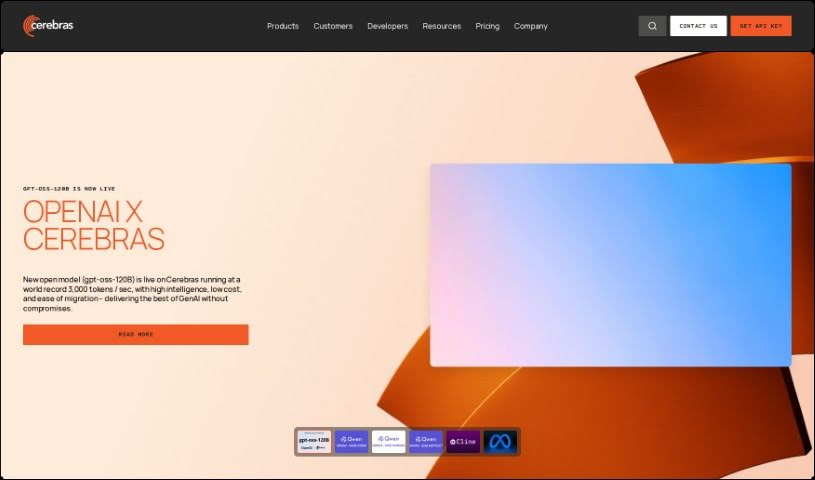
Screenshot of Cerebras-GPT

Cerebras-GPT

Freemium

Cerebras-GPT is a foundational language model built on Cerebras' Wafer Scale Cluster system, which allows training AI models with trillions of parameters on a single AI accelerator. Training models at this scale normally requires thousands of GPUs and a team of hardware experts. With Cerebras-GPT, models like Llama 3.1-405B can be trained with fast speeds and record-setting performance in frontier model development, making large-scale language model training more efficient.

Large Language Models View Tool →
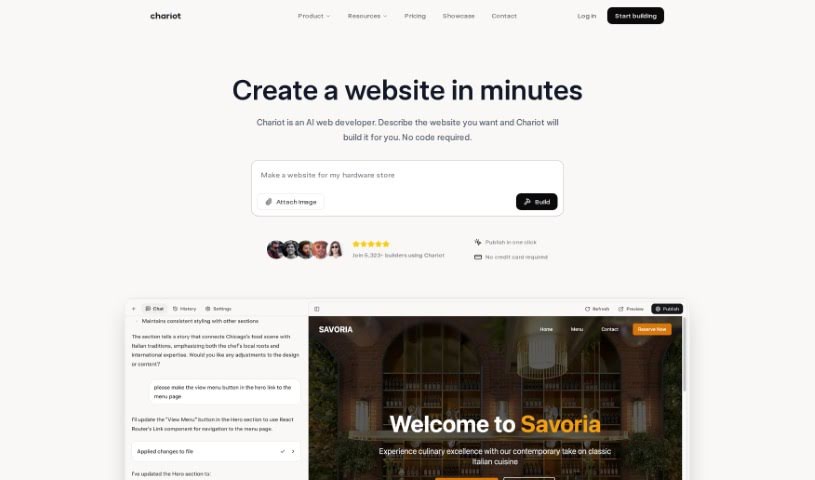
Screenshot of Chariot AI

Chariot AI

Freemium

Chariot AI is an API tool built for developers who want to add natural language capabilities to their own applications. It supports models such as GPT-3.5 and GPT-4 and handles the core work of building with language models: model configuration, embeddings, streaming responses, conversation handling, and chunking of large texts.

Large Language Models View Tool →
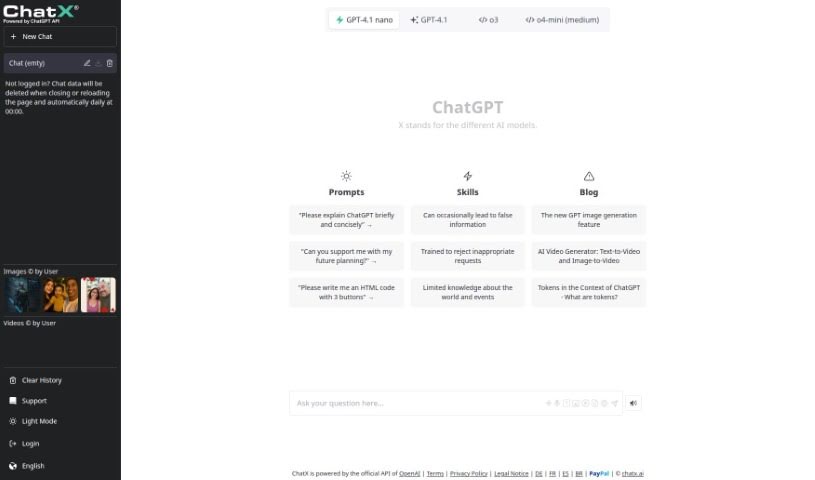
Screenshot of Chatx

Chatx

Freemium

Chatx is a free marketplace for generative AI prompts. It collects prompts for popular platforms including ChatGPT, DALL·E, Stable Diffusion, and Midjourney, covering text generation, image creation, and everyday tasks like brainstorming gift ideas. The goal is to make quality prompts accessible, whether you are new to AI or an experienced user looking to improve your results.

Large Language Models View Tool →
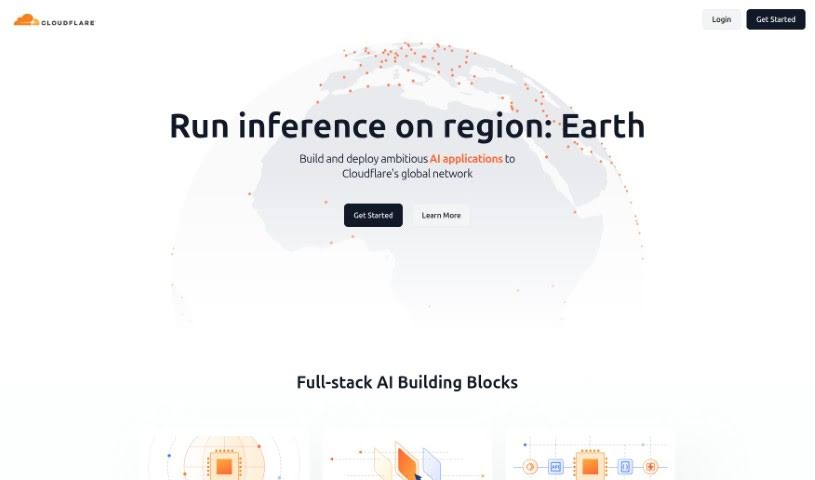
Screenshot of Cloudflare

Cloudflare

Freemium

Cloudflare + AI lets you run fast, low-latency AI inference using pre-trained machine learning models directly on Cloudflare Workers, deployed across Cloudflare's global network.

Large Language Models View Tool →
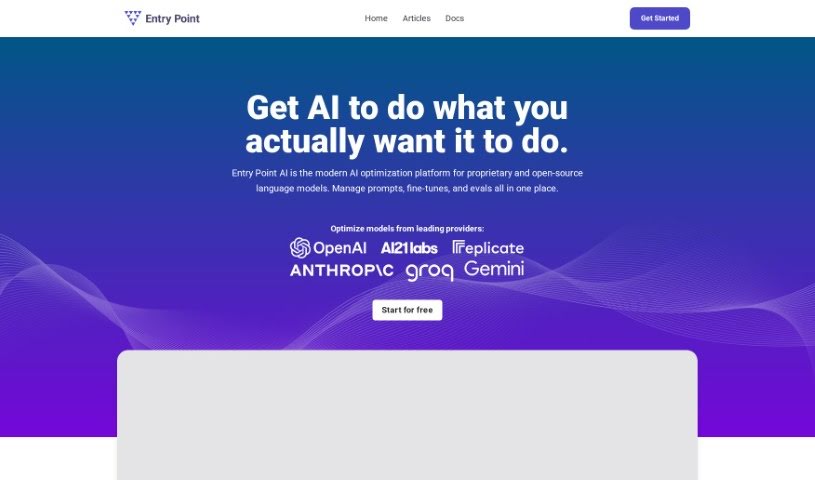
Screenshot of Entry Point AI

Entry Point AI

Freemium

Entry Point AI is a no-code platform for training, managing, and testing custom large language models (LLMs). You can upload data, adjust training settings, and evaluate model performance through a straightforward interface. It supports fine-tuning models from major providers like OpenAI, along with prompt engineering and retrieval-augmented generation (RAG).

Large Language Models View Tool →
Screenshot of Falcon LLM

Falcon LLM

Freemium

Falcon LLM is a suite of generative AI language models developed by Abu Dhabi's Technology Innovation Institute (TII). The lineup includes Falcon 180B, 40B, 7.5B, and 1.3B, with Falcon 180B as the flagship: a 180-billion-parameter model trained on 3.5 trillion tokens.

Large Language Models View Tool →
Screenshot of Float16

Float16

Freemium

Float16.cloud is a platform that makes AI accessible as a service. It offers a range of models, including SeaLLM-7b-v2, Typhoon-7b, OpenThaiGPT-13b, and the upcoming SQLCoder-7b-2. These models support tasks like chat, text completion, sentiment analysis, named entity recognition (NER), and RAG (retrieval-augmented generation). Float16 works across different platforms, costs less than using OpenAI, and doesn't lock you into a single provider, giving you flexibility.

Large Language Models View Tool →
Screenshot of Gemini Pro Vs Chat Gpt

Gemini Pro Vs Chat Gpt

Freemium

Gemini Pro vs. ChatGPT is a comparison tool that lets you enter a prompt and see responses from both Gemini Pro and ChatGPT at the same time. It also shows performance metrics for each model's answer, making it easy to evaluate how the two leading AI models handle the same request.

Large Language Models View Tool →
Screenshot of Genia

Genia

Freemium

Genia is a platform founded by Miten Jain. The company focuses on giving healthcare professionals clear, actionable insights for precision medicine, using smart algorithms and advanced bioinformatic solutions. Its goal is to enable personalized treatments based on the analysis of genetic data.

Large Language Models View Tool →
Screenshot of Ggml.ai

Ggml.ai

Freemium

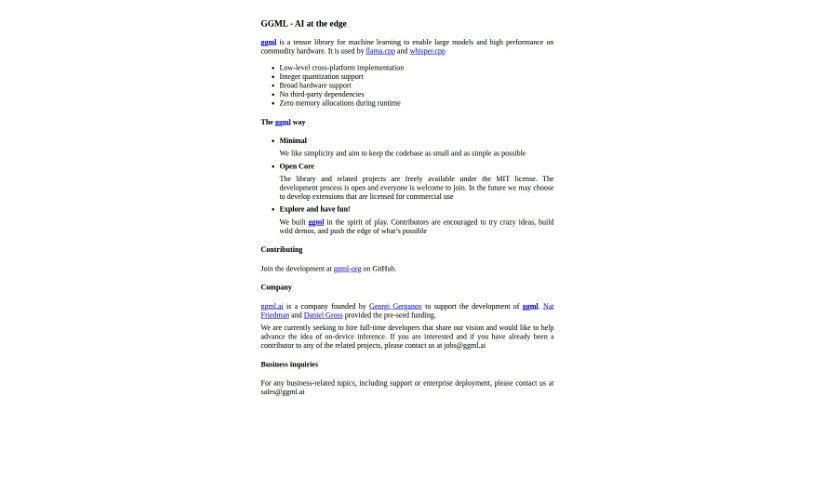
GGML.ai is a C-based tensor library for machine learning that makes it possible to run large AI models on regular hardware, without specialized equipment. It supports 16-bit float and integer quantization for more efficient model execution, along with automatic differentiation and optimization tools like ADAM and L-BFGS.

Large Language Models View Tool →
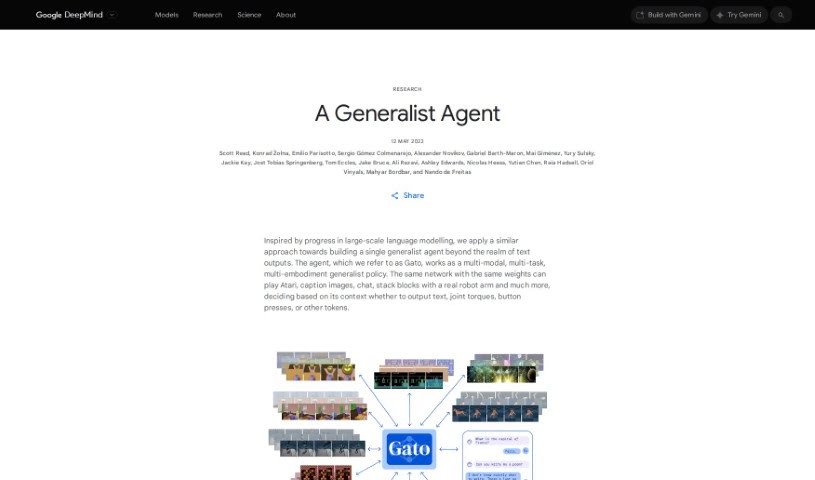
Screenshot of Google DeepMind

Google DeepMind

Freemium

Google DeepMind, exemplified by models like Gato, is a flexible AI system designed to handle a wide variety of tasks across different domains. It is a single, adaptable policy model that can play games, write text, control physical systems like robot arms, and interact in many other ways. What makes a generalist agent like Gato notable is its ability to manage multiple objectives across different types of information, all guided by context. By using the same network and weights for all these tasks and environments, Gato points toward a single system that can tackle many challenges effectively.

Large Language Models View Tool →
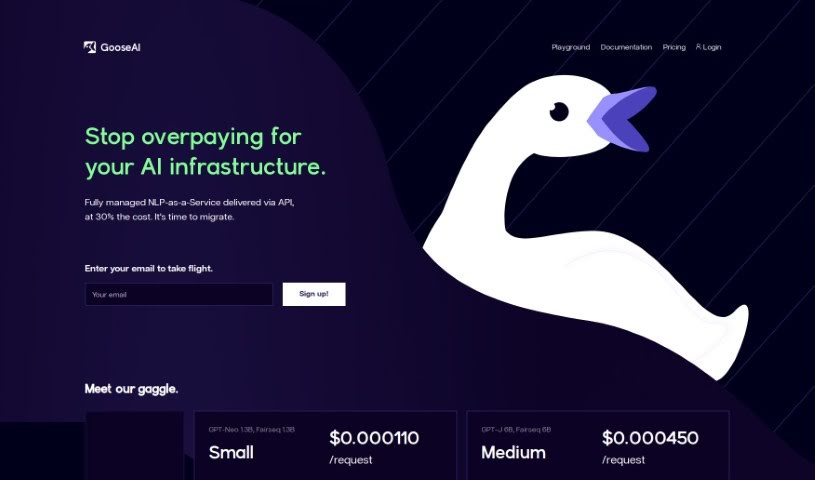
Screenshot of GooseAI

GooseAI

Freemium

GooseAI is a fully managed NLP-as-a-Service platform accessed through an API. It provides cost-efficient access to AI models like GPT-Neo and Fairseq, with users often seeing savings of up to 70% compared to other providers. The platform is built for fast performance, with industry-leading generation speeds, and switching from another provider typically requires changing only a single line of code. Planned additions include text classification and question-answering features.

Large Language Models View Tool →

About Large Language Models tools

Building an application with a large language model can feel equal parts exciting and overwhelming. Whether you’re trying to pick the right base model, connect private company documents to a chatbot, or figure out why your prompts fail in production, the technical landscape moves fast. (It’s easy to waste days tweaking system prompts and wrestling with vector databases.) Setting up custom workflows often turns a simple software idea into a complex infrastructure project.

The developer platforms and orchestration frameworks in this directory serve as specialized building blocks and testing environments. They help you connect data, monitor model behavior, and deploy reliable features without building everything from scratch.

Data Orchestration, Testing, and Inference

Connecting foundational models to your proprietary business data requires more than a standard API request. When you need a chatbot to read internal company files or search product catalogs, Retrieval-Augmented Generation (RAG) tools handle the heavy lifting. They split documents into searchable chunks, store them in vector databases, and pull relevant facts into the prompt automatically so the model gives accurate answers.

Evaluating model performance and tracking prompt quality becomes far easier, too. When you update a system prompt or switch model providers, figuring out whether your changes actually improved response quality takes systematic testing. LLM evaluation and tracing tools log user interactions, flag incorrect responses, and benchmark output quality across different versions before you launch changes to production.

Managing local inference and model hosting saves computing costs while keeping sensitive data private. Running every user request through cloud APIs gets expensive fast as your user base grows. Modern serving engines and local runtime tools let you host open-weight models on your own servers, giving you complete control over data privacy and system latency.

Key Capabilities to Look For:

  • Vector database and RAG integration: Frameworks that connect foundational models to custom documentation, internal databases, and external APIs.
  • Prompt evaluation and testing platforms: Tools that let you test prompt variations, benchmark accuracy, and track model responses in real time.
  • Local inference and model serving: Applications that allow you to host open-weight models on private servers to reduce API costs and protect privacy.
  • Observability and session tracing: Systems that log latency, track token costs, and pinpoint errors across complex, multi-step agent workflows.
  • Dataset curation and fine-tuning: Software that helps clean training data, gather user feedback, and fine-tune smaller models for specialized tasks.

Building reliable LLM applications will always depend on solid software engineering, thoughtful UX design, and careful human oversight. Frameworks can route prompts, store document vectors, and track token costs, but choosing what problems are worth solving rests with your team. Letting smart developer tools handle orchestration and model monitoring simply frees you up to build great user experiences.

Explore the LLM frameworks below to find the right fit for your tech stack.

The Best AI Large Language Models

  1. Ollama: for building custom chatbots
  2. OpenAI Chat Playground: for creating personalized chatbot responses.
  3. LM Studio: for trying out LLMs locally
  4. Sapling: for better customer interactions through automation
  5. Chatx: for advanced text generation prompts.
  6. Snowflake: for customer support analytics powered by LLMs
  7. Llama Index: for custom chatbots that can retrieve knowledge
  8. AlphaSense: for automating market analysis with AI
  9. Tavily: for researching new developments in AI linguistics
  10. Addy AI: Fine-tunes large language models on your own private data.
  11. Langfuse: for making LLM responses more accurate
  12. AnythingLLM: for chatbots used in customer support
  13. LiveKit: for AI-powered voice interfaces for LLMs
  14. Vellum AI: for prompt engineering for complex questions
  15. Gpt4All: for chatting with your local files for insights
New tools, in your inbox.

Weekly picks of the best AI tools we've researched and added — no spam, unsubscribe anytime.

Join 25,000+ AI enthusiasts. No spam, unsubscribe anytime.