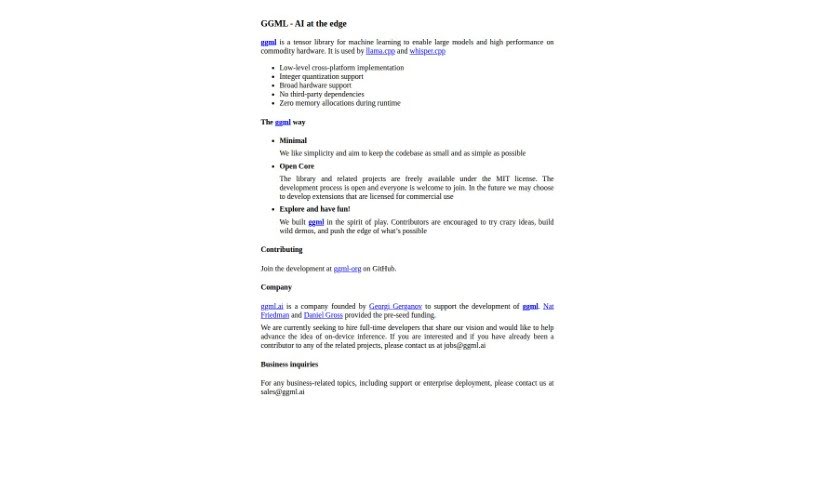
Screenshot of Ggml.ai

Ggml.ai

Discover Ggml.ai, a powerful AI technology for on-device inference. Learn about its features, how it compares to other Software Development Tools, and get practical tips for using it effectively in 2025.

Screenshot

What is Ggml.ai?

GGML.ai is a really cool AI technology that brings powerful machine learning right to your devices, thanks to its innovative tensor library. It is a way to run big AI models smoothly on regular hardware, meaning you don’t need super specialized equipment to use advanced AI. What makes GGML.ai stand out? It supports things like 16-bit float and integer quantization, which helps models run more efficiently. It also has automatic differentiation and optimization tools like ADAM and L-BFGS. Plus, it’s specifically optimized for Apple Silicon and x86 architectures. For web applications, it even supports WebAssembly and WASM SIMD, with no runtime memory allocations and no outside dependencies, making on-device inference super efficient.

You can see GGML.ai in action with projects like whisper.cpp, which is great for speech-to-text, and llama.cpp, which handles large language models really well. The team behind it encourages contributions through an open-core model (under the MIT license) and is looking for full-time developers who are passionate about on-device AI to join them.

Basically, GGML.ai is all about pushing AI forward at the edge, keeping things simple, open, and encouraging everyone to explore and innovate together in the AI community.

Who created Ggml.ai?

Meet the Founder and the Company Behind ggml.ai:

Georgi Gerganov is the brilliant mind behind ggml.ai. He’s leading the charge in AI technology, particularly in making on-device inference a reality. The company has received early support from investors like Nat Friedman and Daniel Gross. Their main focus is building a C-based tensor library for machine learning that’s designed to handle large models and perform exceptionally well on a variety of hardware, with a special emphasis on optimizing for Apple Silicon. They really value community input, so they encourage contributions to their codebase and operate with an open-core development model under the MIT license.

What is Ggml.ai used for?

GGML.ai is incredibly versatile and powers some exciting projects:

  • Speech-to-Text: Projects like whisper.cpp use it to provide excellent speech-to-text solutions.
  • Large Language Models: It’s used in projects like llama.cpp for efficient inference of Meta’s LLaMA large language model.
  • Apple Silicon Optimization: It’s specifically tuned to work best on Apple Silicon hardware.
  • Web Applications: It supports WebAssembly and WASM SIMD, bringing machine learning capabilities to web applications.
  • High Performance: whisper.cpp and llama.cpp really show off its high-performance inference capabilities.
  • Faster Processing: It offers efficient processing and lower latency, especially on Apple devices.
  • Clean Code: You won’t find third-party dependencies, which keeps the codebase clean and manageable.
  • Better Interaction: It supports guided language output, which really helps improve how humans and computers interact.
  • Efficient On-Device AI: It’s a minimal and efficient solution for running AI directly on your device, with zero runtime memory allocations and no external dependencies.
  • Open Development: It follows an open-core development model under the MIT license, welcoming community involvement.
  • Commodity Hardware Power: It makes it possible to use large models and perform high-performance computations on standard, everyday hardware.
  • Broad Architecture Support: It’s optimized for both Apple Silicon and x86 architectures.
  • Web ML: It enables web applications to use machine learning through WebAssembly and WASM SIMD.
  • Streamlined Inference: It presents a minimal, efficient solution for on-device inference, free from runtime memory allocations and third-party dependencies.
  • Speech Solutions: It provides speech-to-text solutions, exemplified by whisper.cpp.
  • LLM Efficiency: It focuses on efficiently inferring large language models, as seen with llama.cpp.
  • Community Driven: It encourages contributions to its code and operates on an open-core model.
  • C Language Focus: It’s optimized for the C programming language and supports 16-bit float and integer quantization.
  • Advanced Features: It includes automatic differentiation and built-in optimization algorithms like ADAM and L-BFGS.
  • Human-Computer Interaction: It offers guided language output support to enhance how humans and computers communicate.

Who is Ggml.ai for?

GGML.ai is a fantastic tool for anyone working with machine learning, especially those focused on edge computing. This includes:

  • Developers
  • Data scientists
  • AI researchers
  • AI engineers
  • Machine learning engineers
  • Software engineers

If you’re in any of these roles, you’ll likely find GGML.ai incredibly useful.

How to use Ggml.ai?

Ready to dive into ggml.ai? Here’s a simple guide to get you started:

  1. Grasp the Fundamentals: First things first, get to know ggml.ai. It’s a tensor library for machine learning, built to run large models efficiently on standard hardware. Understanding this core concept is key.
  2. Explore Its Features: Dive into what makes it special! Take advantage of its C language foundation, its optimization for Apple Silicon, and its support for WebAssembly and SIMD, which are great for web applications.
  3. Check Out Related Projects: See ggml.ai in action! Projects like whisper.cpp are fantastic for speech-to-text, and llama.cpp is excellent for working with Meta’s LLaMA large language model.
  4. Join the Community: Want to help it grow? You can contribute to the codebase of ggml.ai projects. If you’d like to support the developers directly, you can also sponsor them financially.
  5. Learn About the Company: Get to know ggml.ai itself. It was founded by Georgi Gerganov and has support from Nat Friedman and Daniel Gross. They’re actively looking for full-time developers who are as excited about on-device inference as they are.
  6. Get in Touch: For business inquiries, feel free to reach out to [email protected]. If you’re interested in contributing or exploring job opportunities, you can contact [email protected].
  7. Have Fun with It!: Most importantly, embrace the spirit of innovation and experimentation that the ggml.ai community encourages. Play around, try new things!

By following these steps, you’ll be well on your way to effectively using ggml.ai in your machine learning projects. For even more details, you can always refer to the uploaded file “ggmlai.pdf”.

Related AI Tools

Discover more tools in similar categories that might interest you

Stay Updated with AI Tools

Get weekly updates on the latest AI tools, trends, and insights delivered to your inbox

Join 25,000+ AI enthusiasts. No spam, unsubscribe anytime.