We’ve all come across text that feels distinctly mechanical. It uses identical sentence lengths over and over, relies on predictable transition words, and sounds technically correct yet completely devoid of personality. As more people use generative AI to speed up early drafts, this flat, formulaic tone has become a common issue across blogs, emails, and essays.
AI humanizers are built to fix that robotic flow. They don’t just swap out a few words with random synonyms. Instead, they rephrase sentences, adjust speech rhythms, and vary word choices so your content reads naturally.
How Humanizing Tools Restructure Text
Language models generate text based on statistical probability, which creates a smooth, highly predictable rhythm. Human writing, by contrast, is naturally irregular. We mix brief statements with detailed explanations, inserting casual phrasing, parenthetical notes, and varied vocabulary that machines rarely choose on their own.
An AI humanizer scans machine-generated drafts to break up those monotonous patterns. It restructures formulaic paragraphs, replaces repetitive transition phrases, and varies sentence length while keeping your core message intact.
For creators, marketers, and students, these tools turn rough AI outlines into engaging drafts that feel approachable. They can also help reduce false flags on AI detection platforms, though results vary depending on the specific detector and subject matter.
Common Use Cases
Polishing blog posts and marketing copy is one of the most popular applications. A generic draft from a chatbot can feel dry to readers. Running that text through a humanizing editor softens stiff phrasing, giving your content a warmer, more relatable tone.
Students and researchers use these tools to clean up initial draft outlines. While software shouldn’t replace original thought or thorough research, it helps rephrase awkward sentence structures and eliminate repetitive phrasing during early edits.
For non-native English speakers, humanizers offer a helpful way to learn natural phrasing. Writing grammatically correct sentences is one thing, but making them sound natural to native readers is another. These tools act as instant proofreaders, pointing out rigid phrasing and offering smoother alternatives.
Features Worth Looking For:
- Tone and register controls: Settings that let you choose between casual, professional, academic, or creative modes depending on your audience.
- Meaning preservation: Engines built to edit sentence structure without altering underlying facts or arguments.
- Sentence-level editing: Features that highlight specific passages so you can accept, reject, or adjust individual rewrites manually.
- Pattern detection checks: Tools designed to identify and break up predictable mathematical phrasing before you publish.
- Batch processing: Options to upload full documents or multi-page drafts for quick editing.
While rephrasing software cleans up awkward syntax and mechanical flow, it works best when paired with your own input. Adding personal anecdotes, real-world examples, and your distinct opinion remains the best way to make any piece of writing stand out.
Take a look through the tools below to find the right rephrasing assistant for your editing workflow.
The Best AI Humanizers
- Humanize Ai: Great for making business emails clearer.
- Stealthwriter: Perfect for crafting relatable brand stories.
- Humanize: Helps you create authentic content easily.
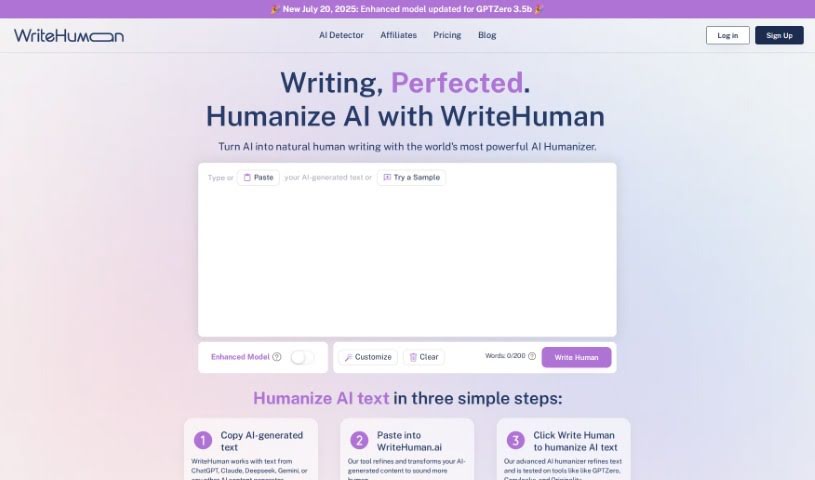
- WriteHuman: Transforms AI text into relatable prose.
- Humanize AI: Ideal for writing marketing copy that connects.
- Humbot: Creates engaging articles that feel personal.
- Bypass GPT: Gives AI texts a human-like tone.
- Phrasly: Boosts the quality of chatbot conversations.
- Humanize AI Text: Makes marketing emails more engaging.
- StealthGPT: Crafts conversational responses that feel human.
- AI Text Converter: Enhances brand voice through content humanization.
- AI To Human Text Converter: Improves the readability of technical documents.
- Bypass AI: Turns AI text into engaging prose.
- Aihumanizer.ai: Transforms AI text into engaging content.
- AI Humanize: Helps you write SEO-friendly blog posts.