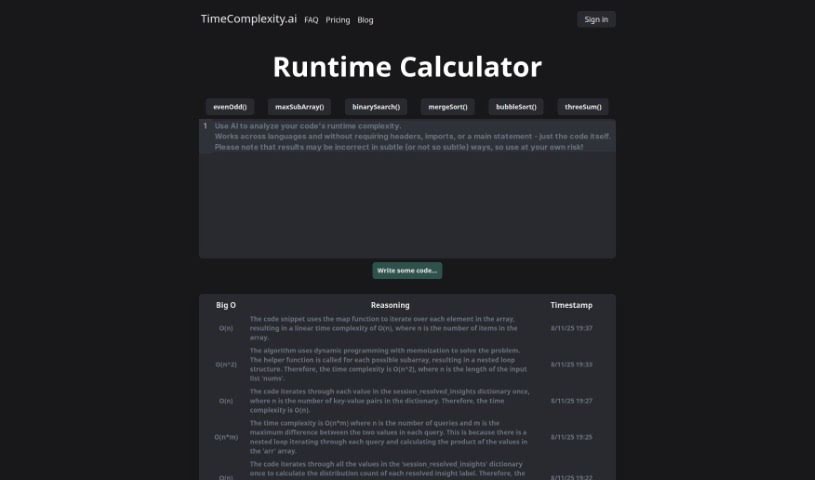
Screenshot of Timecomplexity.ai

Timecomplexity.ai

Discover Timecomplexity.ai in 2025! Learn what this AI tool is, how to use it effectively, and how it stacks up against other programming tools. We'll cover its features and benefits for students, developers, and researchers.

Screenshot

What is Timecomplexity.ai?

TimeComplexity.ai is a really neat AI-powered tool, brought to life by @jparismorgan and designed by @baileybrooks. Its main job is to figure out how long your code will take to run – essentially, its runtime complexity. It’s pretty versatile, supporting a bunch of popular programming languages like Python, C++, C, Java, Javascript, and Go. This means you can easily check how efficient your algorithms are. What’s cool is that it can even analyze pseudocode or code snippets that aren’t quite finished yet, and it presents the results using the standard Big O notation, which makes it super easy to understand. Whether you’re a student just starting out, a seasoned developer, or a researcher digging into algorithms, TimeComplexity.ai can really speed things up by giving you instant complexity assessments. Plus, they’ve got extra help available with a blog and an FAQ section. The interface is really easy to use, and the pricing is straightforward, making it a go-to choice for anyone wanting to get a handle on runtime complexity.

Who created Timecomplexity.ai?

TimeComplexity.ai was actually created by @jparismorgan, and the website itself was designed by @baileybrooks. This platform offers a smart AI tool that can analyze how long code takes to run, supporting a wide range of programming languages like Python, C++, Java, and many others. It’s designed to be a really efficient solution for students, developers, and researchers, giving them quick assessments of complexity using the familiar Big O notation.

What is Timecomplexity.ai used for?

  • Runtime Calculator: You can instantly figure out your code’s runtime complexity, presented in Big O notation.
  • Multilanguage Support: It’s great for analyzing code written in various languages, including Python, C++, and Java.
  • Partial Code Analysis: Don’t worry if your code snippet isn’t complete; this tool can still handle it.
  • Educational Resource: There’s a blog for deeper dives into the topic and a comprehensive FAQ to help answer your questions.
  • User-Friendly Interface: It’s designed for easy sign-in and straightforward code analysis, making the whole process smooth.

Who is Timecomplexity.ai for?

  • Students: Perfect for those learning the ropes of algorithm efficiency.
  • Developers: Helps you fine-tune your codebase for better performance.
  • Researchers: A valuable tool for exploring the intricacies of computational complexity.

How to use Timecomplexity.ai?

Using TimeComplexity.ai is pretty straightforward. Here’s a quick guide:

  1. First, head over to the TimeComplexity.ai website.
  2. You can sign in to get more features. Anonymous users get 20 free queries daily, while signed-in users get 50. If you need unlimited access, the Pro plan is just $5 a month.
  3. Next, just paste your code snippet into the tool. It supports many languages like Python, C++, Java, and more.
  4. Hit the “Calculate” button to see the analysis of your code’s runtime complexity.
  5. You’ll get the results right away in Big O notation, making them easy to understand.
  6. Feel free to check out the blog for more insights or the FAQ section if you need help with anything.
  7. Remember, it’s handy for analyzing code that might be partial or incomplete.
  8. The interface is really user-friendly, so you’ll have a seamless experience.
  9. You can use TimeComplexity.ai for all sorts of things – whether you’re studying algorithm efficiency, trying to optimize your code, or researching computational complexity.

By following these steps, you can really make the most of TimeComplexity.ai’s AI capabilities to understand how efficient your code is.

Related AI Tools

Discover more tools in similar categories that might interest you

Stay Updated with AI Tools

Get weekly updates on the latest AI tools, trends, and insights delivered to your inbox

Join 25,000+ AI enthusiasts. No spam, unsubscribe anytime.