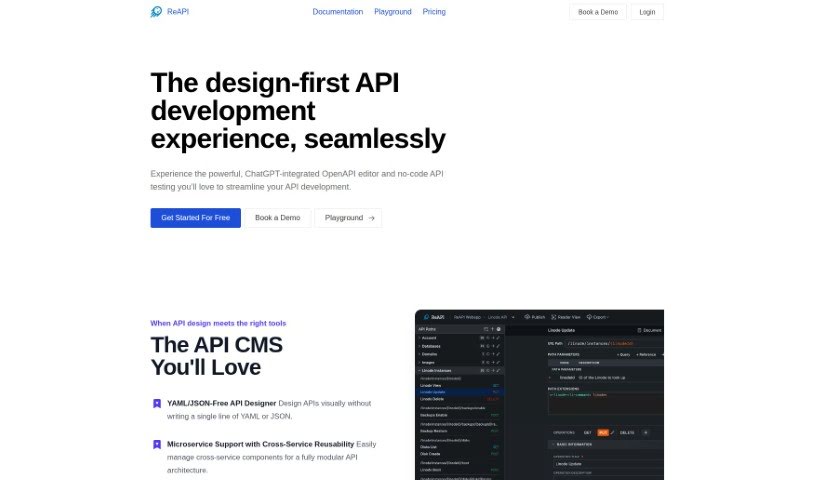
Screenshot of Reapi

Reapi

Discover what Reapi is and how to use it effectively in 2025. We'll explore its features and see how it stacks up against other Software Development Tools.

Screenshot

What is Reapi?

ReAPI is a really handy tool designed to make API development, documentation, and testing much smoother. It uses AI to speed up the whole API creation process, improving lots of different parts of it. You get a great visual editor that makes working with YAML much simpler. Plus, it automatically creates schemas, examples, and descriptions for you. It’s also built for teamwork, letting you share easily and set up specific permissions for different people. ReAPI even works with ChatGPT to automate tasks and keep your documentation consistent.

What’s more, ReAPI makes it easy for your team to collaborate. You can share things internally and set up custom permissions so everyone has the right access. It also handles versioning for your projects. You’ll find features like automatic test case generation, a visual editor for creating detailed API documentation, and the ability to publish your documentation publicly through an external API gallery.

Who created Reapi?

Reapi was actually developed with AI-powered features to help streamline API development. It first came out on January 21, 2024. The specific founder and company details aren’t shared in the information I have. Basically, Reapi makes API documentation simpler. It has a great visual editor that cuts down on YAML complexity and connects with ChatGPT. This connection helps it automatically generate schemas, examples, and descriptions, all aimed at producing documentation that’s both high-quality and looks good.

What is Reapi used for?

Reapi helps with a bunch of things, including:

  • Automatically creating schemas
  • Automatically creating examples
  • Automatically creating descriptions
  • Automatically generating request bodies and parameters
  • Automatically creating test cases based on your design details
  • Improving API design by integrating with ChatGPT
  • Assisting with debugging APIs
  • Making collaboration between team members easier
  • Allowing internal sharing for team collaboration
  • Setting up custom permissions for workspace collaboration
  • Automatically generating API documentation
  • Enhancing API design through ChatGPT integration
  • Automatically creating test cases
  • Debugging APIs with its advanced features
  • Facilitating collaboration among team members
  • Customizing the format and schema template
  • Keeping references consistent within your documentation
  • Supporting versioning at the project level
  • Automatically generating schemas, examples, and descriptions
  • Publishing to a public API gallery
  • Automatically generating schemas, examples, descriptions, and request bodies
  • Creating automated test cases based on design metadata
  • Setting up custom permissions at the workspace level
  • Supporting versioning at the project level
  • Publishing externally to a public API gallery
  • Maintaining consistency in referencing within the documentation
  • Making API development efficient with a ‘write once, refer everywhere’ approach
  • Providing debugging help with its sophisticated feature
  • Debugging
  • Offering collaboration tools
  • Integrating with ChatGPT
  • Providing AI-powered API documentation
  • Testing
  • Using a visual editor for creating API documents
  • Automated schema generation
  • Ensuring consistent referencing
  • Customizing Format and Schema Template components
  • Automatically generating schemas, examples, descriptions, request bodies, and parameters
  • Debugging assistance with a sophisticated feature
  • Generating documentation automatically from debugging JSON data
  • Promoting efficient API development with the ‘write once, refer everywhere’ principle
  • Customizing format and schema template components
  • Achieving swift and high-quality API design
  • Customizing format and schema templates
  • Ensuring consistency in referencing within documentation
  • Fostering collaboration between team members
  • Helping with API debugging
  • Versioning at the project level
  • Automatically generating schemas, examples, and descriptions for API documentation
  • Achieving swift and high-quality API design by automatically generating request bodies and parameters
  • Facilitating API debugging with a sophisticated debugging feature
  • Improving collaboration and teamwork for code-first teams
  • Supporting internal sharing and customizable permissions for efficient teamwork
  • Managing different versions of API projects with project-level versioning
  • Sharing API documentation publicly via an external publishing feature to a public API gallery
  • Efficiently maintaining consistent referencing within documentation
  • Customizing format and schema template components for tailored API documentation

Who is Reapi for?

Reapi is a great tool for:

  • API Developers
  • Software developers
  • Technical Writers
  • QA/Test engineers
  • Project managers
  • API Developers
  • Technical writers
  • Software developers
  • Quality assurance testers
  • QA testers
  • Anyone collaborating on API projects
  • Software Architects

How to use Reapi?

To get the most out of ReAPI, here’s a simple guide:

  1. Get to Know ReAPI: First off, understand that ReAPI is an AI tool built to make your API development, documentation, and testing processes much smoother.
  2. Create Your API Documentation: You can use ReAPI’s visual editor to easily handle YAML complexities. It also uses ChatGPT to automatically generate schemas, examples, and descriptions for you.
  3. Explore What It Offers: Take some time to check out ReAPI’s main features. This includes collaboration tools, the ability to publish to a public API gallery, customizable parts like Format and Schema Template, and ways to keep your references consistent for easier reuse.
  4. Integrate with ChatGPT: ReAPI works with ChatGPT to help improve your API design. It automates the creation of important things like schemas, examples, and descriptions, which really boosts the quality of your documentation.
  5. Keep Things Consistent: Use ReAPI’s ‘Reference Decorator’ to precisely control your content. This ensures your references are accurate and you don’t have any unnecessary repetition throughout the documentation.
  6. Collaborate and Manage Permissions: Make good use of ReAPI’s collaborative workspace. It lets team members work together efficiently, and you can set up custom permissions—like admin, editor, or reader roles—to manage who can access and edit what.
  7. Versioning and Publishing: Take advantage of ReAPI’s project-level versioning to manage different versions of your projects smoothly. Then, use the external publishing feature to share your API documentation with everyone through the API gallery.
  8. Benefit from Automation: ReAPI’s automated features for documentation are a big help. They cover generating schemas, examples, descriptions, request bodies, parameters, and test cases, making the whole process quicker and more accurate.
  9. Debug and Generate Test Cases: You can use ReAPI’s advanced debugging feature to refine your APIs right alongside your documentation. Plus, it can automatically generate test cases based on your design details, ensuring thorough testing.
  10. Use the Visual Editor: Make the most of the user-friendly visual editor in ReAPI. It helps you create detailed and pleasant API documentation, getting rid of YAML complexities for a faster, more accurate workflow.

By following these steps, you’ll be able to use ReAPI effectively to optimize your API development, documentation, and testing.

Related AI Tools

Discover more tools in similar categories that might interest you

Stay Updated with AI Tools

Get weekly updates on the latest AI tools, trends, and insights delivered to your inbox

Join 25,000+ AI enthusiasts. No spam, unsubscribe anytime.