10Web
Web Development Website Builders
Learn more
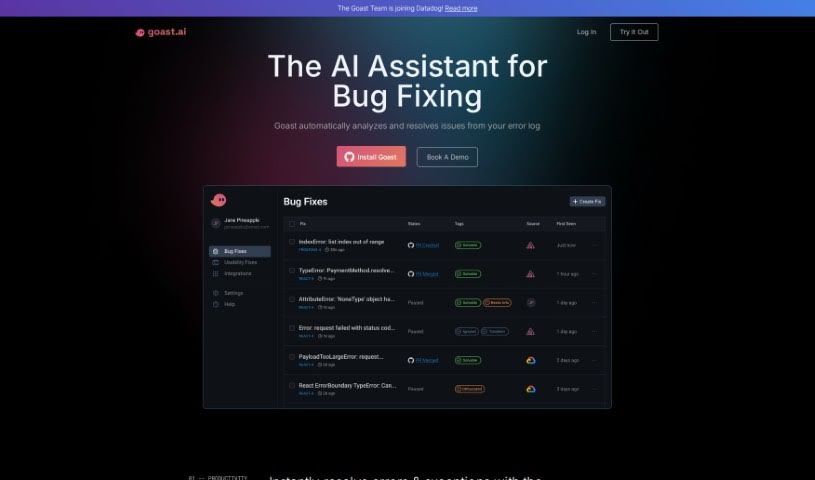
Discover Goastvs, an AI coding assistant that fixes errors, generates pull requests, and integrates with observability tools like Sentry and Datadog. Learn
Goastvs is a coding productivity tool that automates many development tasks. It offers instant error fixes, AI-generated pull requests, and a deep understanding of your entire project. It can suggest code, find and fix bugs, resolve merge conflicts, and integrate external code. Goastvs works with popular frameworks and languages including React, Flutter, TypeScript, Go, JavaScript, and Python. Users report coding faster and reducing manual work with the tool. Note that Goastvs is still in Beta, so it has some limitations—particularly with certain languages and framework dependencies. It requires tokens to use and may not always grasp complex requirements. Despite these caveats, its goal is to streamline the coding process and improve efficiency for development teams. It also handles backend infrastructure configuration and supports all major coding frameworks. You can watch the AI fix a real product in real-time, and it helps categorize incidents using AI. It connects to your error monitoring platform and can send fixes automatically as pull requests to your repositories. You can also refine pull requests based on feedback and sort issues by impact and severity. It even offers proactive fixes for issues you haven’t noticed yet. Access is available from wherever you work, and you can simply ask Goast to fix specific issues. It’s a broad toolkit for reducing repetitive coding work and speeding up development cycles. For teams shipping quickly, that combination of automation and context awareness is the core value proposition. It aims to cut down the time between discovering a bug and shipping the fix. The tool is designed to fit into existing workflows rather than replace them. Overall, Goastvs positions itself as an AI pair that handles the busywork so developers can focus on harder problems. Its Beta status is worth keeping in mind when evaluating it for critical production workflows, but the feature set is already substantial for teams willing to try it. As with any early-stage tool, testing it on lower-risk projects first is a sensible approach before rolling it out more widely across your engineering organization. That way you can evaluate its accuracy and fit on your own codebase before committing to it as part of your standard workflow. It’s a practical way to de-risk adoption while still capturing the productivity gains the tool promises. Teams that rely heavily on observability tooling will likely find the integrations especially useful since Goast can pull context directly from those platforms. This makes root-cause analysis faster and reduces the back-and-forth typically needed to reproduce and diagnose errors. For teams without such tooling, the value may be lower since the AI has less context to work from. Evaluating your existing stack is therefore a good first step before adopting Goastvs. If your team already uses Sentry, Datadog, or BugSnag, the integration path is straightforward and the onboarding effort is minimal. If not, you may still benefit from the core bug-fixing and PR-generation features, though the experience will be less automated. Either way, the tool is worth a trial for teams looking to reduce time spent on debugging and routine fixes. Its pricing is token-based, so costs scale with usage. This makes it easy to start small and expand as you see value. Check the website for current pricing details. The founders have positioned the product around speed: faster time-to-resolution and more accurate fixes are the stated goals. Early adopters seem to agree that it delivers on that promise for common error classes. More complex, architectural bugs remain a challenge for any automated tool, and Goastvs is no exception. Setting realistic expectations will lead to a better experience with the product. Use it for the routine work and keep humans in the loop for the hard problems. That hybrid approach is where the tool shines today. As the product matures out of Beta, its capabilities are likely to expand, but even now it offers meaningful time savings for everyday debugging tasks. For engineering teams under pressure to ship, that alone can justify giving it a try. Its compatibility with major languages and frameworks means most teams can adopt it without changing their stack. That low-friction adoption path is a practical advantage worth noting. Combined with its automation features, Goastvs is a solid option for teams looking to boost coding productivity with AI assistance. Its focus on real-world workflows—error triage, PR generation, and observability integration—sets it apart from more generic coding assistants. For teams already invested in those workflows, it’s a natural fit worth evaluating. As always, test it against your own codebase to see how well it handles your specific error patterns and frameworks before making it a standard part of your toolchain. That hands-on evaluation will tell you more than any review can. Start with a small project, measure the time saved on bug fixes, and decide from there whether it earns a place in your team’s workflow. That measured approach is the best way to assess any AI developer tool, including this one. Its Beta status means features and pricing may change, so keep an eye on updates from the team as the product evolves. Staying informed will help you get the most value from the tool over time. Overall, Goastvs is a promising option for teams seeking AI-powered bug-fixing help. Its combination of automation, integrations, and broad language support makes it a practical choice for many development teams today. Give it a try and see how it fits into your workflow. You may find it saves meaningful time on routine fixes. That’s the core promise, and for many teams, it delivers. Evaluate it on your own terms and decide if it’s right for your team. The tool is available now, and getting started is straightforward. Visit the website to learn more and sign up. Good luck with your evaluation, and happy coding. We hope this overview helps you decide whether Goastvs belongs in your toolkit. Thanks for reading, and best of luck with your projects. Goastvs may be exactly the productivity boost your team has been looking for. Only you can decide, but now you have the facts to make an informed choice. That’s the goal of this overview. We hope it helped. If you have questions, the Goastvs team is reachable through their website. They’re responsive and happy to help new users get started. That’s a good sign for any early-stage tool. Reach out and see for yourself. The team’s responsiveness is a positive signal for a Beta product. Don’t hesitate to contact them with questions about your specific use case. They can tell you whether Goastvs is a good fit before you invest time in setup. That kind of direct support is valuable when adopting new developer tooling. Take advantage of it. It costs nothing to ask, and it could save you significant setup time. A quick conversation with the team is often the fastest way to evaluate fit. Do that first, then run a trial on a real project. That two-step approach is the most efficient path to a decision. Good luck.
Related
Discover more tools in similar categories
Weekly picks of the best AI tools we've researched and added — no spam, unsubscribe anytime.
Join 25,000+ AI enthusiasts. No spam, unsubscribe anytime.