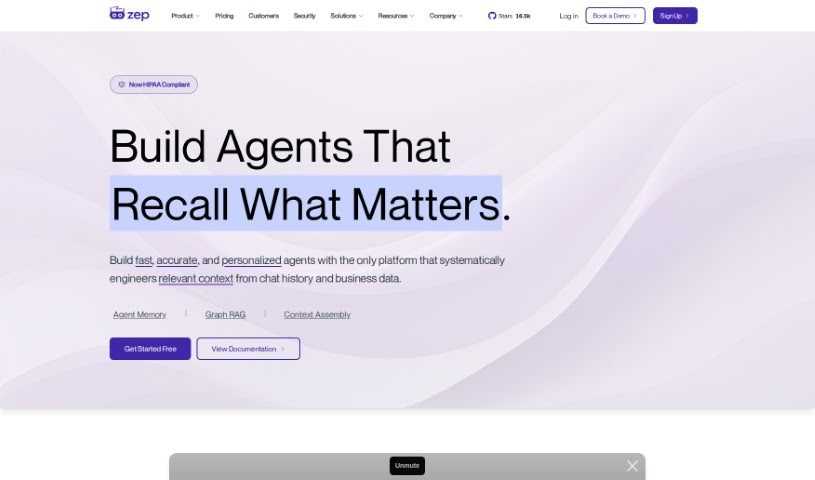
What is Zep?
Zep is an open-source platform that gives you fast, scalable building blocks for applications using Language, Learning, and Memory (LLM) models. What’s really neat is that it lets you move from early prototypes to production-ready applications without having to rewrite any code. Zep offers handy features like remembering past conversations, classifying dialogues, pulling out specific data, and much more. Plus, it all runs faster than what you’d typically get from the big LLM providers. You can easily set up vector search for finding things based on meaning, filter your results using metadata, and use the output from named entity extraction and intent analysis. Zep also supports privacy rules, automatically creates embeddings, remembers chat history, and offers archival and enrichment capabilities, making it a super flexible tool for deploying LLM applications.
Who created Zep?
Zep was actually built by an open-source community and first launched on May 19, 2023. It’s designed to provide fast and scalable building blocks specifically for applications that deal with Language, Learning, and Memory (LLM). The platform really focuses on making sure things are privacy-compliant and offers components for memory, search, and enrichment, all without you needing to rewrite your code. This means you can smoothly transition your projects from prototypes to production-ready applications using Zep’s features. Think things like vector search, memory archival, and enrichment functions. Zep also helps with keeping records for compliance and managing how users interact with your application.
What is Zep used for?
- It helps you meet records retention requirements by archiving every user message and AI response.
- It makes it easy for you to manage your users and their chat sessions.
- Zep works with many languages and frameworks, including Python, TypeScript, LangChain, and LlamaIndex.
- You’ll find comprehensive documentation and an open-source SDK to help you integrate it into your LLM applications.
- It lets you do vector searches for finding information semantically within chat histories and documents.
- You can filter search results using metadata and use the output from named entity extraction and intent analysis.
- It offers automatic embedding, either with local, low-latency models or by letting you bring your own vectors (BYOV).
- Zep supports chat history memory, archival, and enrichment functions.
- It allows you to fill prompts with relevant chat history and automatically enrich messages, which is great for building powerful tools for agents.
- Zep assists in complying with corporate and regulatory mandates for keeping records, including privacy rules like CCPA and GDPR.
Who is Zep for?
- Developers
- Software engineers
- Data scientists
- Chatbot developers
- AI researchers
- Linguists
- Compliance Officers
How to use Zep?
To get the most out of Zep, here’s a simple breakdown of how to use it:
- Get to Know the Platform: First off, Zep is an open-source platform built for Language, Learning, and Memory (LLM) applications. It provides fast and scalable building blocks for these kinds of projects.
- Key Features to Note: Zep offers components for managing memory, performing searches, and enriching data. You can conduct semantic searches across chat histories and documents, filter results using metadata, and use named entity extraction and intent analysis.
- Creating Personalized Experiences: Zep makes it possible to build personalized user experiences. You can create low-latency agents that pull up relevant facts from past chat conversations.
- Extracting Structured Data: You can quickly and accurately pull structured data from chat messages. This is super useful for things like running business processes, building user profiles, filling out API calls, and completing forms.
- Classifying Dialogues: The tool can instantly classify conversations based on what the user intends and how they’re feeling. This helps segment users and trigger events without slowing anything down.
- Managing Users and Chats: Zep treats users and chat sessions as core elements, which really simplifies how you interact with LLM applications.
- Staying Compliant with Privacy: Zep helps you follow privacy regulations like CCPA and GDPR. You can archive messages, handle data removal requests, and meet your records retention obligations.
- Integrating Zep: Zep supports various languages and frameworks, such as Python, TypeScript, LangChain, and LlamaIndex. It also comes with comprehensive documentation and an open-source SDK, making integration straightforward.
By following these steps, you can really make the most of Zep’s capabilities. It’s designed for fast, efficient deployment of LLM applications, with a strong focus on privacy compliance and making that move from prototypes to production-ready applications as smooth as possible.