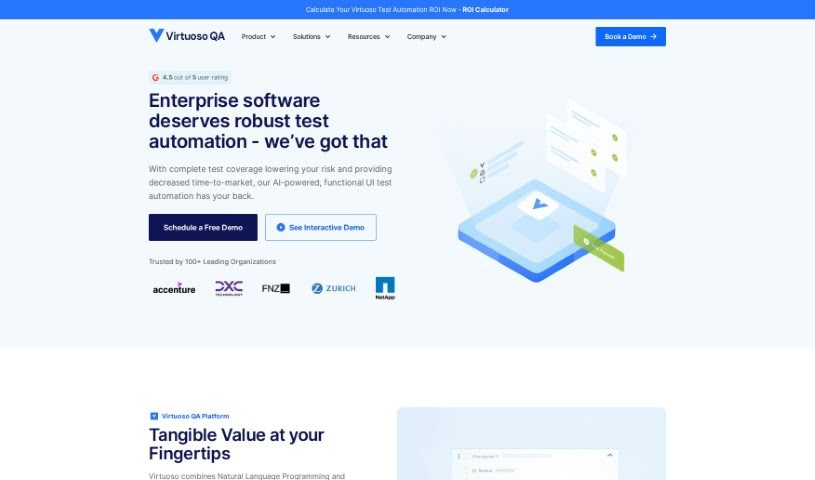
What is Virtuoso QA?
Virtuoso QA is a really advanced tool for automating QA testing. It uses Natural Language Programming (NLP), AI, and machine learning to create tests that can fix themselves and scale up easily. This means testers can write test cases, scenarios, and define conditions using everyday language. You don’t need to be a coding expert anymore, making test case development much more straightforward and accessible for everyone. Plus, Virtuoso QA works with Robotic Process Automation (RPA), so it can interact with all sorts of applications, systems, and environments. This allows for really thorough end-to-end QA automation. The tool’s self-healing feature is pretty neat too – it automatically spots and adjusts to changes, which keeps your tests reliable even when things are constantly shifting. And if you’re working on big testing projects, Virtuoso QA is built to handle it, offering scalability across different platforms, devices, and setups to ensure you get complete test coverage.
Who created Virtuoso QA?
Virtuoso was actually started by three people: Adil Mohammed, Hugo Farinha, and Andrew Doughty. They were really passionate about making low-code/no-code test automation software more efficient, especially as more companies started working in the cloud. The CEO of Virtuoso is Derren Nisbet. He’s leading the team as they work to redefine test automation, focusing on cloud-based solutions and making sure everyone can use them easily.
What is Virtuoso QA used for?
Virtuoso QA is incredibly versatile and can help with a lot of different testing needs:
- Automating Repetitive Tasks: It takes over those tedious, repeated jobs so you don’t have to.
- Streamlining Testing Processes: It makes your entire automated testing workflow much smoother.
- Faster Test Coverage: You can achieve comprehensive test coverage more quickly, which helps you see a return on investment sooner.
- Reducing Risk & Boosting Quality: By automating testing, you can better manage risks and significantly improve the overall quality of your software.
- Saving Time & Increasing Agility: Automating those repetitive tasks frees up your team, saving valuable time and allowing you to respond faster to market changes.
- Unlocking Real Business Value: Automation isn’t just about efficiency; it’s about delivering tangible business benefits.
- Empowering Your Team: It boosts your team’s capabilities, increasing both speed and scale through user-friendly, low-code test automation.
- Easier Test Maintenance: With self-healing tests, keeping your test suite up-to-date becomes much less of a chore.
- Smarter Test Data: AI assistance helps generate test data and provides useful journey summaries.
- End-to-End Testing: It combines functional testing with API and visual regression capabilities for a complete picture.
- Cross-Browser Testing: Run your tests across different browsers to ensure broad compatibility and efficiency.
- Hyperautomating Testing: It uses NLP, ML, and RPA for testing that’s faster and more thorough.
- Browser-Based Application Testing: It’s perfect for testing applications that run in a web browser.
- Testing Diverse Systems: You can test front-end websites as well as backend systems like SAP S/4hana, Salesforce, ServiceNow, and many others.
- API Testing in Journeys: It handles API testing seamlessly within your functional test flows.
- Leveraging NLP, AI, and ML: It uses these advanced technologies specifically for QA automation.
- Robustness in Dynamic Environments: Its self-healing capability ensures tests remain stable even when the application changes.
- Scalable Deployment: It’s designed to scale your automated QA testing processes effectively.
- Natural Language Interpretation: It understands and uses human language for creating test cases.
- Automating Test Execution: It handles the execution of your test cases efficiently.
- Interacting with Various Systems: It can connect with a wide range of applications and environments.
- Comprehensive Coverage, Faster: Get full test coverage more quickly, optimizing your ROI.
- Risk Mitigation: It helps reduce risks and improve quality.
- Time Savings & Agility: Automate tasks to save time and be more agile.
- Easier Maintenance: Self-healing tests simplify upkeep.
- AI for Data & Summaries: Use AI for test data generation and journey summaries.
- End-to-End Capabilities: Combine functional, API, and visual regression tests.
- Cross-Browser Execution: Test on various browsers, OS, and devices.
- Early Testing: Build complete tests from wireframes or requirements to test earlier and more.
- Hyperautomation: Use NLP, ML, and RPA for advanced automation.
- Testing Broadly: Test any browser-based app, front-end websites, and backend systems like SAP S/4HANA, Salesforce, ServiceNow, etc.
- Natural Language Tests: Write automated tests using plain human language with NLP.
- Freeing Up QA: Automate testing to let QA focus on strategic tasks and lower system failure risks.
- Focus on Innovation: Automate repetitive tasks to boost innovation and speed up time-to-market.
- API & Service Level Testing: Automate API tests within functional journeys and for service level checks.
- Self-Healing Scripts: Provide self-healing capabilities for your test scripts.
- Handling Large Projects: Scale to manage big testing projects across platforms, devices, and configurations.
- User-Centric End-to-End Tests: Combine functional, API, and visual regression tests for a complete user experience.
- Platform for Hyperautomation: Use NLP, ML, and RPA together for test hyperautomation.
- Optimized ROI: Achieve comprehensive test coverage faster, improving your return on investment.
- Testing Backend Systems: Test systems like SAP S/4HANA, Salesforce, ServiceNow, and more.
- Strategic QA Focus: Automate testing to free QA for strategic tasks and reduce failure risks.
- CI/CD Regression: Enable regression packs via CI/CD for specific industries like insurance brokerage and reinsurance.
- Productivity Gains: Deliver 8x productivity improvement and a 90% reduction in test maintenance for a major software vendor.
- Agility & Innovation: Achieve time savings, market agility, and focus on innovation by automating repetitive tasks.
- Healthcare Automation Example: Automate 6,000 journeys, requiring only 4.5 person days per release for a leading healthcare services company.
- Low-Code Empowerment: Empower talent and increase speed and scale with low-code test automation.
- Reduced Maintenance: Implement self-healing tests to cut down maintenance effort.
- AI for Extensions: Use AI to generate test data, journey summaries, and create JavaScript extensions.
- Full End-to-End: Combine functional tests with API and visual regression capabilities for complete end-to-end tests.
- Browser App Testing: Test applications that run in a browser.
- Backend System Testing: Test backend systems like SAP S/4hana, Salesforce, ServiceNow, etc.
- Service Level Testing: Perform service level testing.
- Freeing QA: Allows QA professionals to focus on more strategic tasks.
- Agility & Time-to-Market: Enhances agility and reduces the time it takes to get products to market.
- Combined Testing: Integrates functional tests with API and visual regression capabilities.
- User-Centric Testing: Provides full, user-centric, end-to-end testing.
Who is Virtuoso QA for?
Virtuoso QA is a great fit for several groups:
- Quality Assurance Professionals: If you’re in QA, this tool can significantly enhance your work.
- Software Developers: Developers can also use it to ensure code quality.
- Test Automation Professionals: It’s designed for those specializing in automating tests.
- QA Teams: Teams can collaborate and streamline their testing efforts.
- Enterprise Organizations: Companies with large-scale, demanding testing needs will find it particularly valuable.
- Test Automation Engineers: This is a core tool for your role.
- Automation Engineers: If you focus on automation, Virtuoso is relevant.
- Automation Testers: It directly supports your testing activities.
How to use Virtuoso QA?
Getting started with Virtuoso is pretty straightforward. Here’s a quick rundown:
- Understand Virtuoso: First off, remember that Virtuoso is a modern QA automation testing tool. It uses NLP, AI, and machine learning to offer tests that are self-healing and can scale up easily. It’s all about making testing more accessible.
- Testing with Virtuoso: You can use Virtuoso for a wide range of testing types. This includes functional, end-to-end, UI, regression, integration, visual, and exploratory testing. It’s not just for front-end websites either; it works great with backend systems like SAP S/4HANA, Salesforce, and ServiceNow.
- It’s Easy to Use: Virtuoso is designed to be intuitive. You can start writing automated tests right away, even from day one. They offer support through onboarding teams, documentation, and helpful videos to guide you.
- API Testing: Virtuoso also lets you test APIs. You can do this within your functional test flows or by setting up service level tests where you pass inputs between different API calls.
- Key Features: Some of the standout features include its self-healing capabilities, which means tests can adapt to changes automatically. It also integrates smoothly with various applications and can interact with different systems and environments, making it perfect for comprehensive end-to-end QA automation.
- Scalability: If you have big testing projects, Virtuoso is built to handle them. It scales effortlessly across multiple platforms, devices, and configurations, ensuring you achieve thorough test coverage.
So, to sum it up, Virtuoso is a really powerful tool. It brings together NLP, AI, and machine learning to give you a solution for QA automation testing that’s not only self-healing and user-friendly but also highly scalable.