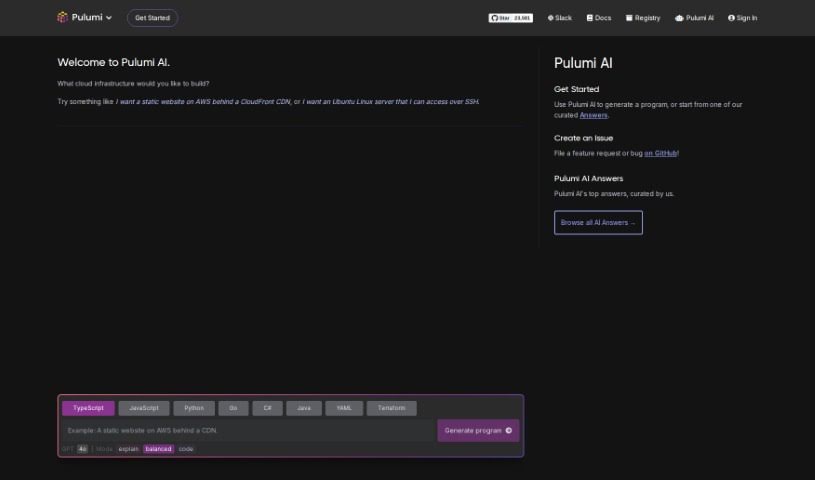
Screenshot of Pulumi

Pulumi

Discover what Pulumi is and how to use it effectively in 2025. We'll explore its features and see how it stacks up against other code generation tools.

Screenshot

What is Pulumi?

Pulumi is an experimental feature that lets you generate Pulumi infrastructure-as-code programs simply by chatting with an AI. You can find this AI through a chat widget right on the website. Just describe the infrastructure you’re planning to build, and the AI will whip up the code for you in languages like TypeScript, Python, Java, C#, Go, F#, VB, and YAML. Once the code is generated, you can tweak it however you like and then deploy it using the simple command ‘pulumi up’. Even though this tool is still in its early stages and web-based, it really shines with its real-time interactive coding and conversational prompts for building cloud infrastructure.

Who created Pulumi?

Pulumi was actually created by Joe Duffy. The company itself officially launched on June 18, 2024.

What is Pulumi used for?

  • It generates code just by you describing what you need in plain language.
  • It makes building cloud infrastructure interactive and straightforward.
  • You can easily modify the code that gets generated.
  • It helps you create new Pulumi projects from scratch.
  • It handles the deployment of your generated code.
  • You get real-time interactive coding experiences.
  • It’s super quick for generating code.
  • It offers conversational prompts, which is a nice change from traditional coding methods.
  • It supports a wide range of programming languages.
  • You get a chance to try out the CLI version before committing.

Who is Pulumi for?

  • Software developers
  • Cloud Engineers
  • DevOps Engineers
  • Infrastructure Engineers
  • System Administrators
  • IT professionals
  • Software developers (again, it’s that useful!)
  • Cloud Engineers (yes, you too!)
  • DevOps engineers (we see you!)
  • Infrastructure Engineers (essential for your work)
  • System Administrators (streamline your tasks)
  • IT Operations Managers (gain better oversight)
  • Site Reliability Engineers (enhance system stability)

How to use Pulumi?

To get the most out of Pulumi, here’s a simple step-by-step guide:

  1. Describe Your Infrastructure: Start by using the web-based chat widget on the Pulumi AI website. Just tell it in natural language what kind of infrastructure you’re aiming to build.
  2. Pick Your Programming Language: Pulumi AI is pretty flexible and supports several languages, including TypeScript, Python, Java, C#, Go, F#, VB, and YAML. Go ahead and choose the one you’re most comfortable with for code generation.
  3. Let Pulumi AI Generate Code: Once you’ve described what you need, Pulumi AI will automatically generate the infrastructure code for you in the language you selected.
  4. Deploy Your Code: You can deploy the code you’ve generated by simply running the ‘pulumi up’ command. This command is what actually applies the changes you’ve made to your infrastructure code.
  5. Adjust Your Infrastructure: Need to make changes? You can modify your cloud infrastructure as you go by making conversational adjustments throughout the process.
  6. Explore the Pulumi AI CLI: If you’re looking for a truly interactive, real-time building experience, definitely check out the Pulumi AI CLI. It offers a more hands-on way to build your cloud infrastructure.
  7. About Cookies: Just a heads-up, Pulumi AI uses cookies to make your browsing experience better. If you’re not comfortable with that, you can always choose to decline cookie usage.
  8. Give it a Test Drive: Before you fully dive in, it’s a great idea to test Pulumi AI using its web-based version. This lets you see firsthand how code is generated and get a feel for interacting with the tool before you commit.

Following these steps should help you use Pulumi effectively for all your infrastructure-as-code projects.

Related AI Tools

Discover more tools in similar categories that might interest you

Stay Updated with AI Tools

Get weekly updates on the latest AI tools, trends, and insights delivered to your inbox

Join 25,000+ AI enthusiasts. No spam, unsubscribe anytime.