What is NeRF Studio?
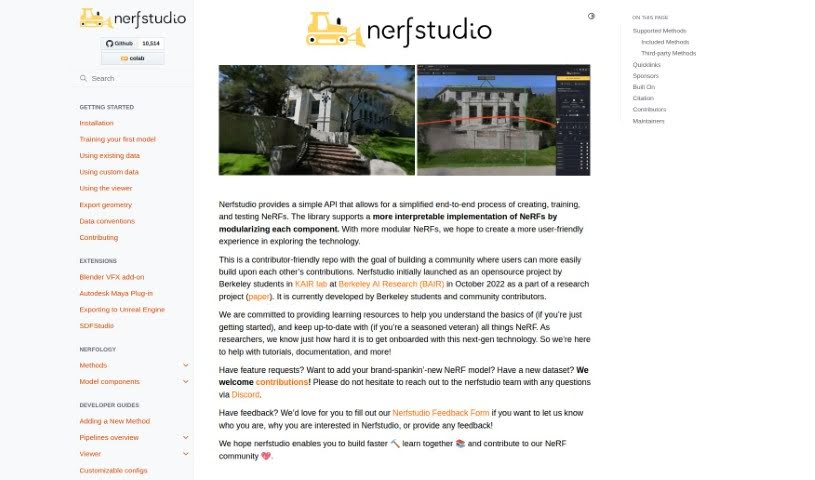
NeRF Studio is a flexible framework that came out of the KAIR lab at Berkeley AI Research (BAIR) in October 2022. It was built by students there and offers a simpler way to create, train, and test Neural Radiance Fields (NeRFs). The main idea behind NeRF Studio is to make NeRF technology much easier for everyone to use and explore by breaking down each part into its own module. This design really aims to build a community where people can share their work, learn from each other, and help improve NeRF technology together.
Who created NeRF Studio?
Nerfstudio started as an open-source project in October 2022, created by students at Berkeley in the KAIR lab at Berkeley AI Research (BAIR). Today, it’s kept up-to-date by Berkeley students and contributors from the wider community, with Brent Yi being one of the key developers. Thanks to its modular design, Nerfstudio offers a really user-friendly way to create, train, and test Neural Radiance Fields (NeRFs).
What is NeRF Studio used for?
NeRF Studio is a versatile tool used in many areas of NeRF research and application. Here are some of the key projects and methods it supports:
- LERF: Language Embedded Radiance Fields, which connects language to 3D scenes.
- Nerfbusters: This helps remove those ghostly artifacts you sometimes see in NeRFs captured casually.
- NeRFPlayer: It allows for 4D Radiance Fields by streaming feature channels, making dynamic scenes possible.
- Tetra-NeRF: This method represents Neural Radiance Fields using tetrahedra, offering a different approach to scene representation.
- PyNeRF: Pyramidal Neural Radiance Fields, which uses a pyramid structure for NeRFs.
- SeaThru-NeRF: Specifically designed for subsea scenes, this NeRF method handles underwater environments.
- Zip-NeRF: This uses an anti-aliased, grid-based approach for Neural Radiance Fields.
- NeRFtoGSandBack: A tool for converting between NeRF and Gaussian Splatting (GS) formats, letting you get the best of both worlds.
- OpenNeRF: Focuses on OpenSet 3D Neural Scene Segmentation, meaning it can segment scenes even with unknown object categories.
- BioNeRF: Biologically Plausible Neural Radiance Fields for View Synthesis, exploring how biological systems might process visual information.
- Nerfacto: This is the recommended method within NeRF Studio, as it cleverly integrates multiple existing methods into a single, powerful approach.
Who is NeRF Studio for?
NeRF Studio is a fantastic resource for anyone working with or interested in Neural Radiance Fields. It’s particularly useful for:
- Nerf Developers: Those building and extending NeRF technology.
- Computer Graphics Specialists: Professionals focused on visual rendering and scene creation.
- 3D Artists: Creatives looking to incorporate advanced rendering techniques into their workflow.
- Machine Learning Engineers: Individuals applying ML to graphics and vision problems.
- Research Scientists: Those conducting cutting-edge research in AI and computer vision.
- Researchers: Academics and industry professionals exploring new frontiers.
- Developers: Anyone building applications that could benefit from 3D scene representation.
- Contributors: People who want to help improve and expand the NeRF Studio framework.
How to use NeRF Studio?
Getting started with NeRF Studio is straightforward. Just follow these steps:
- Getting Started: First, take a quick tour to get a feel for the basics. Then, install the framework to familiarize yourself with its core structures.
- Nerfology: Want to really understand the tech? Dive into our educational guides and interactive notebooks. They break down each component in detail, making complex ideas easy to grasp.
- Developer Guides: If you’re looking to build your own NeRFs, these guides are for you. Learn how to construct, train, and debug your models. You’ll also find out how to set up a model pipeline, use the viewer effectively, and create custom configurations.
- Supported Methods: Explore the wide range of methods available. This includes popular ones like Nerfacto, Instant-NGP, NeRF, Mip-NeRF, and TensoRF, as well as Splatfacto. You can also work with third-party methods such as BioNeRF and SIGNeRF.
NeRF Studio makes exploring NeRF technology much easier because it breaks down all the components into modules. You can even contribute to the community by adding new methods or models! The framework comes with an easy-to-use config system, and if you ever have questions or feedback, the nerfstudio team is available on Discord to help.
Just a reminder, NeRF Studio is a modular framework for Neural Radiance Fields, developed by students at Berkeley’s KAIR lab. You can cite the framework in your work as “Nerfstudio: A Modular Framework for Neural Radiance Field Development” (published in the ACM SIGGRAPH 2023 Conference Proceedings).