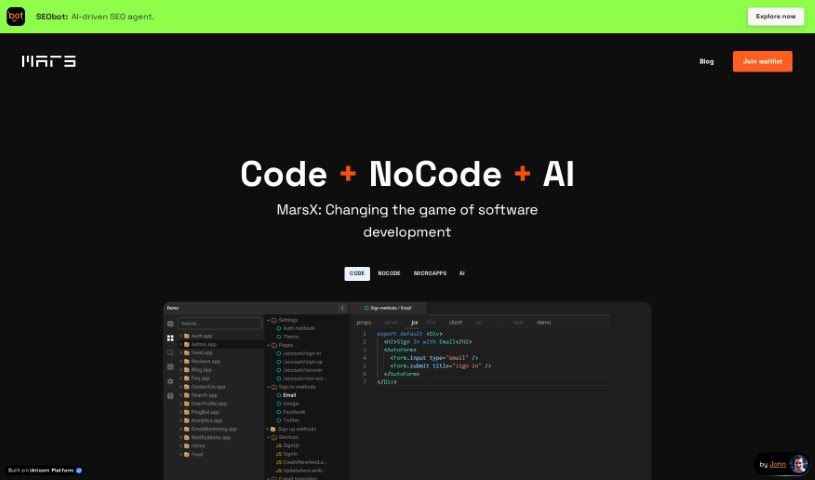
Screenshot of MarsX

MarsX

Discover what MarsX is and how to use it effectively in 2025. We'll explore its features and see how it stacks up against other Software Development Tools.

Screenshot

What is MarsX?

MarsX is a platform that brings together code, no-code, and AI capabilities. It’s designed to help you build web and mobile applications using what they call micro-apps. The cool part is you can switch between coding and no-code interfaces, giving you a lot of flexibility. What really sets MarsX apart from older coding methods is how it simplifies development. By focusing on full-stack micro-apps, it means developers need to write significantly less code. You can use these micro-apps for all sorts of things, like creating NFT marketplaces, social networks, peer-to-peer marketplaces, video streaming portals, and photo-sharing apps, among many others.

MarsX comes packed with features to help you out. You’ll find tools for content management, administration, building dashboards, email marketing, sending push notifications, and handling localization. Plus, there are plenty of app templates for different needs, and you can choose from various database options like Mongo, Dynamo, or SQL. Integrating with external services is also straightforward. Since MarsX is open-source, you get access to all the micro-apps, and you can create, use, and share them freely. The platform also supports custom roles and permissions, and you can set up authentication using email, mobile, social logins, or your own custom methods. Connecting to your own custom domains is also an option. On top of that, MarsX offers continuous integration and deployment, cloud deployment choices, and really solid support through chat, a community forum, a knowledge base, and email.

Who created MarsX?

MarsX was actually created by John Rush, who is both the Founder and CEO of the company. MarsX itself is a US-based company, and it’s powered by a really diverse team. These folks come from all sorts of backgrounds – entrepreneurial, product development, education, corporate experience, and even mentoring and coaching. The company’s main goal is to shake things up in how startups and innovative products are created. They’re doing this by offering a free, low-code platform that lets people build web and mobile apps using micro-apps. They’re big believers in remote work and often have openings for talented people in areas like design, development, finance, operations, and sales and marketing.

What is MarsX used for?

  • Setting up user authentication
  • Building NFT marketplaces
  • Creating e-commerce marketplaces
  • Developing social networks
  • Acting as a no-code builder
  • Managing collections of items
  • Creating peer-to-peer marketplaces
  • Building video streaming portals
  • Making photo-sharing apps
  • And a whole lot more with various purpose-built micro-apps

Who is MarsX for?

  • Designers
  • Developers (especially JavaScript)
  • CFOs
  • COOs
  • Sales and marketing professionals

How to use MarsX?

To get started with MarsX, here’s a simple breakdown of the steps:

  1. Understanding MarsX: First off, MarsX is a free, low-code platform. It’s designed to help developers build web and mobile applications using micro-apps. You get the best of both worlds with both a code and a no-code interface, which really makes development flexible.
  2. Building Applications: You’ll start by accessing Mars IDE. This is a full-stack, web-based IDE where you can build your applications. You can use JavaScript, and if you prefer, TypeScript too. For managing your projects, you can use Git Version Control right within the IDE.
  3. Micro-Apps: Take advantage of the wide variety of pre-built micro-apps available. They cover many different needs, like content management, administration tasks, building dashboards, email marketing, sending push notifications, setting up e-commerce, handling payments, and much more.
  4. Customization: MarsX really lets you customize both the micro-apps and the entire platform to fit exactly what you need. Developers can easily tweak and adjust the default settings to make sure they align perfectly with their project requirements.
  5. Deployment Options: You have a lot of flexibility here. You can run MarsX on your own servers, your local machine, or even a closed network. Mars also offers cloud hosting, which makes deploying your apps super convenient.
  6. Security and Compliance: MarsX takes security seriously. It has built-in features that are designed to meet GDPR requirements. Importantly, you keep ownership of your data, which stays within your database, giving you full control over data management and compliance.
  7. Support and Resources: You’re not alone with MarsX! There are various support options available, including chat support, community forums, access to a knowledge base, and email support. Plus, MarsX offers personalized onboarding and training to help you get up to speed.
  8. Continuous Improvement: The platform is always getting better. External developers are constantly working on MarsX, adding new features and fixing bugs. They’re dedicated to creating high-quality micro-apps, which means there’s always ongoing innovation and support within the platform.

By following these steps, you can really make the most of MarsX to build powerful, customizable web and mobile applications efficiently, all while having the backing of a lively developer community.

Related AI Tools

Discover more tools in similar categories that might interest you

Stay Updated with AI Tools

Get weekly updates on the latest AI tools, trends, and insights delivered to your inbox

Join 25,000+ AI enthusiasts. No spam, unsubscribe anytime.