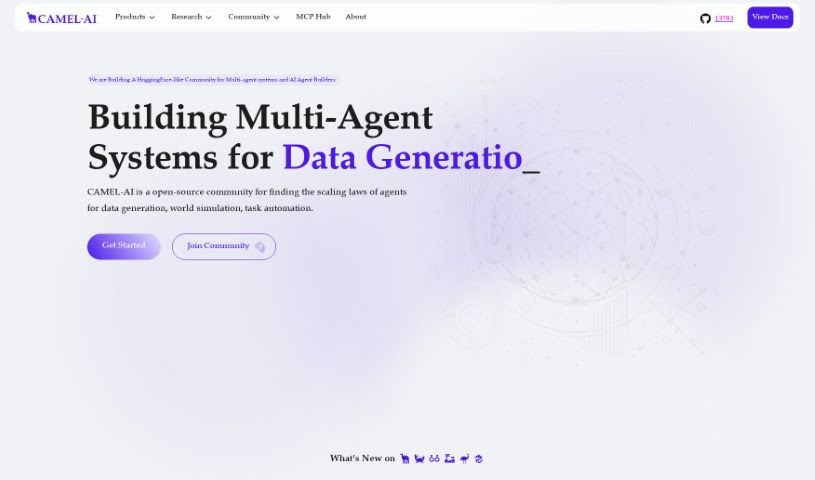
Screenshot of Camel AI

Camel AI

Discover Camel AI, the first LLM multi-agent framework, and learn how to use it effectively in 2025. We'll explore its features and see how it stacks up against other Software Development Tools.

Screenshot

What Exactly is Camel AI?

Camel AI is the very first framework built around Large Language Models (LLMs) that uses multiple agents working together. It’s also an open-source community focused on understanding how these agents scale. Essentially, it’s designed for building systems where several AI agents collaborate to generate data, automate tasks, or even simulate entire worlds. This makes Camel AI particularly handy if you need to create synthetic data, which is super useful for training and fine-tuning chatbots or customer service agents. The framework really lets you dive into studying agents that can act and communicate autonomously. For instance, it can be used for tasks like generating phishing emails or even developing cyber bugs. What’s really key to Camel AI is its approach to prompt engineering, especially how it handles the initial ‘inception prompting’ process.

Who’s Behind Camel AI?

Camel AI was developed by Guohao Li. He’s a big believer in how multi-agent systems can help us get past the usual limitations we see in AI today. You can find out more on their website, camel-ai.org, which is indeed the first LLM multi-agent framework dedicated to exploring how agents scale.

How Can You Start Using Camel AI?

Getting started with Camel AI is pretty straightforward. Here’s a simple breakdown of how to make the most of it:

  1. Head to the Official Website: Your first stop should be CAMEL-AI.org. It’s the best place to catch the latest updates and get all the official info on how to use the tool.
  2. Dive into the Resources: Once you’re there, take a look at their resources. Things like release notes and guides, such as the “Getting Started with Agent Tool Usage - CAMEL 101,” are excellent for getting a feel for what the tool can do.
  3. Check Out the GitHub Repository: For a deeper dive, the Camel AI GitHub repository is a treasure trove. You’ll find detailed research materials there, and often, step-by-step instructions on how to use the tool effectively.
  4. Explore Use Cases: Seeing how others have used Camel AI in the real world is super helpful. Checking out successful implementations will give you a clear idea of its practical applications and what you can achieve with it.
  5. Leverage External Resources: Don’t forget to look beyond Camel AI itself. Websites like Log10 can offer valuable insights, especially for understanding AI accuracy and different applications.

By following these steps, you’ll be well on your way to really understanding Camel AI and how you can use its capabilities efficiently for your own projects or research.

Related AI Tools

Discover more tools in similar categories that might interest you

Stay Updated with AI Tools

Get weekly updates on the latest AI tools, trends, and insights delivered to your inbox

Join 25,000+ AI enthusiasts. No spam, unsubscribe anytime.