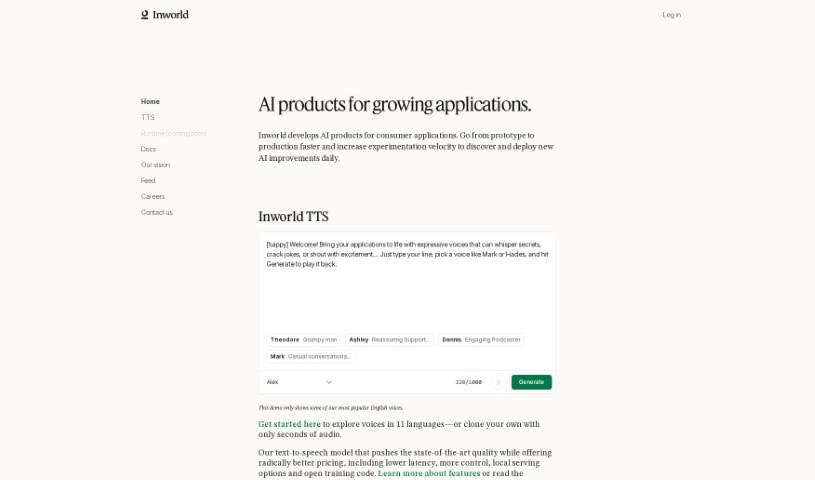
Screenshot of Inworld AI

Inworld AI

Discover what Inworld AI is and how to use it effectively in 2025. We'll explore its features and see how it stacks up against other game development tools.

Screenshot

What is Inworld AI?

Inworld AI is a platform that gives game developers AI characters designed specifically for games. These aren’t just simple characters; they’re built using advanced AI, like natural language processing models, machine vision, and speech-to-text. The goal is to make them act and interact like real people, capturing the dynamic and social side of human conversation. You’ll find features like real-time generative AI, a character engine that makes AI expressive and multimodal, and something called a “contextual mesh” to keep characters consistent with your game’s world or brand. Plus, they offer APIs to make integration easier, all aimed at making your game’s player interactions much richer.

The Inworld AI engine itself is a collection of machine learning and character AI models. They’re designed to mimic human gestures, speech, emotions, and even memory, all while keeping things safe. This means you can create AI NPCs that have much more advanced thinking, perception, and behavior than what we’re used to. They are “agentic AI” – characters that can actively guide, challenge, or entertain players. By using this AI technology, Inworld aims to boost player engagement, help increase revenue, and improve the core gameplay loops. Essentially, they’re giving developers tools to simplify game design and make player experiences in the gaming world truly stand out.

Who created Inworld AI?

Inworld AI was founded by Kylan Gibbs, Ilya Gelfenbeyn, and Michael Ermolenko. Kylan Gibbs is the CEO and Co-Founder, Ilya Gelfenbeyn serves as the Executive Chairman and CSO, and Michael Ermolenko is the CTO and Co-Founder. This team is packed with experts in conversational AI and generative models, and they’ve got a solid track record of launching successful ventures in the AI industry.

What is Inworld AI used for?

  • Powering gameplay: It brings experiences to life.
  • Streamlining game development: Unlock productivity with AI-generated game assets.
  • New gameplay mechanics: Deliver fresh ways to play with AI logic engines.
  • Deeper player connections: Create meaningful interactions and offer new gameplay strategies.
  • Real-time adaptation: Get mechanics that change based on player decisions.
  • Beyond NPCs: Use agentic AI for companions that act on their own or intelligent crowds.
  • Player input reaction: Characters respond to what players do in real-time for personalized gameplay.
  • LiveOps support: Manage player experiences effectively.
  • Streamlining creative process: Use AI-assistive features for game narratives and content.
  • Fine-tuning AI: Train AI agents using annotations, reinforcement learning, and log reviews to match your preferences and game lore.
  • Dynamic NPCs: Create non-player characters that feel alive.
  • Evolving worlds: Build worlds that change as players interact with them.
  • Simplifying game design: Make the design process smoother.
  • Future-proof AI: Establish a solid AI infrastructure for the long run.
  • Player behavior analysis: Understand players to personalize their gaming.
  • AI-generated assets: Streamline development by creating assets with AI.
  • AI logic engines: Deliver new gameplay mechanics.
  • Player experience management: Support a LiveOps pipeline.
  • Agent training: Fine-tune AI agents for specific game needs.
  • Generative Tools: Streamline development and boost productivity with AI-generated assets.
  • NEO NPCs: Create deep player connections and emergent storytelling.
  • Real-time adaptation: React to player inputs for personalized gameplay.
  • LiveOps pipeline support: Manage player experiences as content evolves.
  • Player engagement: Drive engagement and revenue with AI NPCs.
  • Creative process streamlining: Use AI for narratives, dialogue, voices, and character creation.
  • AI agent fine-tuning: Train agents with annotations and reinforcement learning.
  • Asset management: Host game assets from a central place.
  • Inworld Core: Get custom solutions for enterprise-ready AI infrastructure.
  • Generative Tools: Streamline game development.
  • Neo NPCs: Create deep player connections.
  • Dynamic Agents: Guide, challenge, and entertain players.
  • Real-Time Adaptation: React to player inputs in real-time.
  • Player Management: Support the LiveOps pipeline.
  • Developer-facing AI: Streamline the creative process.
  • Content Creation: Use AI-assistive features.
  • Fine Tuning: Train AI agents based on preferences and game lore.
  • Asset Management: Host game assets and link data to design workflows.
  • Models & Microservices: Power gaming experiences.
  • Player Management: For LiveOps pipeline.
  • Real-Time Adaptation: For personalized gameplay.
  • Dynamic Agents: For autonomous companions and intelligent crowds.
  • Content Creation: AI-assistive features.
  • Fine Tuning AI agents: Through annotations and reinforcement learning.
  • Asset Management: For game assets.
  • AI Infrastructure: With custom solutions.
  • Inworld Voice: For expressive and natural voice AI.

Who is Inworld AI for?

  • Game developers
  • AI engineers
  • Game Designers
  • Content creators
  • Developers
  • Asset managers
  • AI developers
  • Narrative designers

How to use Inworld AI?

To get started with Inworld AI, here’s a simple breakdown:

  1. Understand the Features:
    • Inworld AI offers NPCs with advanced thinking, perception, and behavior. They adapt in real-time to player actions, help manage players for LiveOps, and create more engaging game loops.
  2. Developer Platform:
    • Head over to the Inworld Platform to build characters with unique personalities and awareness of their surroundings. You can use real-time generative AI, a character engine for expressive AI, and the contextual mesh to keep characters consistent with your game’s world or brand.
  3. Models & Microservices:
    • Use our models and microservices to power your games. You can incorporate senses to understand player behavior, use builders to streamline development with AI-generated assets, and implement systems for new gameplay mechanics.
  4. Partners & Experiences:
    • Check out partnerships like Neo NPCs, which help create deep player connections and innovative gameplay strategies. See how Inworld works with studios like Ubisoft to improve NPC reasoning and perception.
  5. Content Creation:
    • Take advantage of developer-facing AI to simplify creative processes. You’ll find AI-assistive features for game narratives, dialogue, voices, and character creation.
  6. Fine Tuning:
    • Use annotations, reinforcement learning, and log reviews to fine-tune and train your AI agents. This helps them match your specific preferences and game lore.
  7. FAQs:
    • Got questions? We’ve got answers! Find out about creating avatars, how AI characters work, supported languages, and the details of our character AI engine.

By following these steps, you can effectively use Inworld AI’s features to boost player engagement, increase replayability, and make your game development process smoother with advanced AI technologies.

Related AI Tools

Discover more tools in similar categories that might interest you

Stay Updated with AI Tools

Get weekly updates on the latest AI tools, trends, and insights delivered to your inbox

Join 25,000+ AI enthusiasts. No spam, unsubscribe anytime.