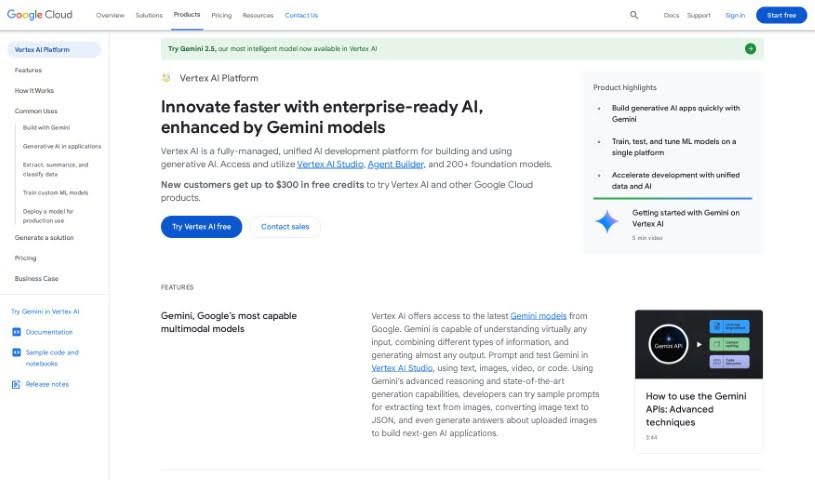
What is Google Vertex AI?
Google Vertex AI is a central hub designed to speed up how you build and manage artificial intelligence models. It gives you all the tools you need for every part of the machine learning process, from getting your data ready to training and then putting your models to work. With Vertex AI, you can even use AutoML to create custom models without needing to be a deep machine learning expert. The platform also includes MLOps features, which really help streamline how you manage and keep an eye on your models. By bringing all these AI tasks together in one place, Google Vertex AI makes it much simpler to develop and actually use machine learning models, helping businesses tap into AI’s power more efficiently.
Who created Google Vertex AI?
Google Vertex AI first arrived on January 20, 2022. It’s a machine learning platform built to help people get AI models out there and keep them running smoothly. Google, the big tech company we all know, is the force behind Google Vertex AI. While we don’t have specific details on who exactly founded it, Google is definitely the main driver behind this innovative AI platform.
What is Google Vertex AI used for?
Vertex AI is pretty versatile. You can use it for things like:
- Summarizing, categorizing, and pulling information from text, with help from generative AI.
- Training your own custom ML models, with guides and documentation available for custom training.
- Building and training ML models even if you don’t have a lot of technical know-how, thanks to AutoML.
- Getting your ML models ready to make predictions, either in batches or in real-time, using the Vertex AI Model Registry and its prediction service.
- Making better business decisions by using Vertex AI’s advanced capabilities.
- Cutting down on operational costs by automating tasks, using pre-built models, and making workflows smoother.
- Creating better customer experiences by using advanced AI technologies.
- Automating your machine learning tasks with the tools Vertex AI provides.
- Helping people who aren’t technical experts by offering automated machine learning and pre-built models.
- Working with structured data for tasks like classification, regression, and making recommendations.
Who is Google Vertex AI for?
This platform is designed for a wide range of professionals, including:
- Data Scientists
- Machine Learning Engineers
- Business Analysts
- Software Developers
- AI Researchers
- Product Managers
- DevOps Engineers
- Marketing Analysts
- Operations Managers
- Healthcare Analysts
How to use Google Vertex AI?
Ready to dive in? Here’s a straightforward way to get started with Google Vertex AI:
- Set up your Google Cloud project: First things first, you’ll need to create a new Google Cloud project or pick an existing one in the Google Cloud Console. This is where you’ll manage your Vertex AI work.
- Turn on the right APIs: In the Google Cloud Console, make sure to enable the Vertex AI API, along with any other APIs your specific project might need.
- Get your data ready: Organize your data carefully. It needs to be in the correct format for both training your models and for making predictions later on.
- Build your model: Now, use the tools within Vertex AI to build and train your machine learning model. If you want to speed things up or don’t have deep ML expertise, the AutoML features are great for automated model training.
- Deploy your model: Once your model is trained and you’re happy with how it performed during evaluation, it’s time to deploy it on Google Cloud. This makes it ready to start generating predictions.
- Keep an eye on it and manage it: It’s important to monitor how your model is performing, manage the resources it uses, and make adjustments or improvements as needed.
- Connect with other Google Cloud services: Don’t forget you can link Vertex AI with other Google Cloud services like Dataflow or BigQuery. This can really boost your machine learning workflows.
- Stay secure and compliant: Always make sure you’re putting the right security measures in place and following all the data protection rules throughout your project.
- Fine-tune and scale up: Keep optimizing your models to perform better and make sure they can handle more as your needs grow.
By following these steps, you’ll be well on your way to using Google Vertex AI effectively for all your machine learning projects.