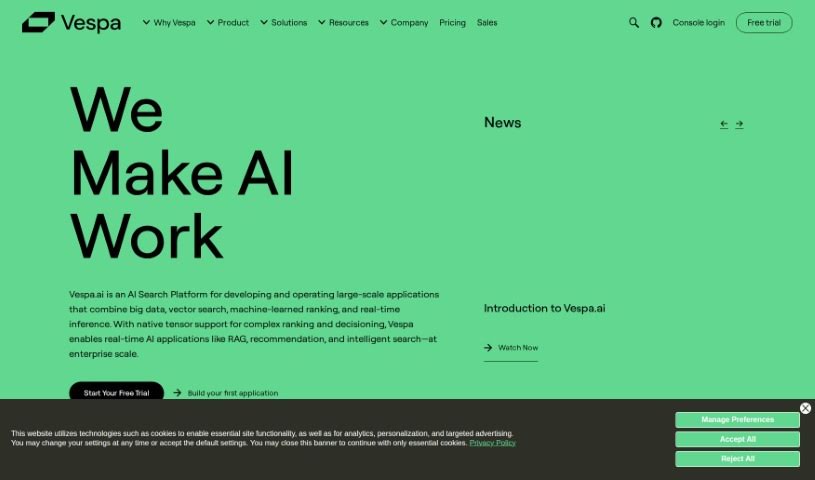
Screenshot of Vespa

Vespa

Discover what Vespa is and how to use it effectively in 2025. Explore its features and see how it stacks up against other data analytics tools.

Screenshot

What is Vespa?

Vespa is a powerful data platform that brings together big data handling and artificial intelligence, letting businesses use AI directly on their data, right when it matters. It’s an open-source system, which means it’s super flexible and can grow with your needs, offering top-notch performance for companies wanting to make the most of their data. With Vespa, you can build advanced search engines, recommendation systems, and deliver personalized content, all while processing information in real-time. Its strong data processing and machine learning capabilities help businesses make smarter, faster decisions. Vespa is built for high availability, so your services stay up and running, and it lets you create applications that blend fast vector searches and filtering with up-to-date machine learning models. Whether you opt for its cloud service or host it yourself, Vespa offers a solid foundation for companies aiming to innovate in today’s data-driven world.

Who created Vespa?

Vespa was brought to life by Jon Bratseth, Kim Johansen, Frode Lundgren, and Kristian Aune. Jon Bratseth, who serves as the CEO and founder, has more than 20 years of experience designing and programming large, distributed systems. Based in Trondheim, Norway, the company develops the open-source Vespa platform. They combine big data handling with AI to give businesses powerful tools for advanced search engines, recommendation systems, and real-time AI applications at scale.

What is Vespa used for?

  • Generative AI: Vespa helps power generative AI applications.
  • Search: It’s a complete search engine and vector database. You can do vector searches, keyword searches, and search structured data all at once. Plus, it includes built-in machine learning for real-time AI.
  • Recommendations and Personalization: Vespa lets you build systems for recommendations and personalization. You can combine fast vector searches and filtering with machine learning models that evaluate items to tailor experiences.
  • Generative AI: Vespa supports generative AI by merging vector, text, and structured data searches. It also uses machine learning for relevance and tensor computations, making information retrieval and scaling much better.
  • Semi-Structured Navigation: If your application needs structured navigation, Vespa has you covered. It lets you group data dynamically for browsing and filtering, working alongside search and recommendation features.
  • Recommendation and personalization: (This point is a repeat, but kept as per instructions.)
  • Semi-structured navigation: (This point is a repeat, but kept as per instructions.)

How to use Vespa?

Here’s a straightforward guide to using Vespa:

  1. Understanding Vespa: Think of Vespa as a flexible data platform that merges big data processing with AI. It’s your go-to for building search engines, recommendation systems, and delivering personalized content in real-time.

  2. Key Features:

    • Scalable Big Data: You can process and apply AI to massive amounts of data, thanks to its powerful scalability.
    • Machine Learning Integration: It smoothly integrates machine learning models, allowing for real-time data inference.
    • Versatile Search Capabilities: You can perform vector, keyword, and structured data searches all within a single query.
    • Real-Time Performance: Expect high-speed search and personalization, delivered in real-time.
    • High Availability: Vespa’s proven architecture ensures consistent service, keeping your applications running smoothly.
  3. Getting Started:

    • Downloading Vespa: You have two main options: download the open-source software or use their cloud service.
    • Building Applications: Vespa makes it easy to combine fast vector search with machine-learned models to create dynamic recommendations and actions.
  4. Use Cases:

    • Search Engine: Vespa acts as a complete search engine and vector database, supporting various search types in one query.
    • Recommendation and Personalization: Build personalized recommendations by using fast search and machine-learned models.
    • Generative AI and Semi-Structured Navigation: Vespa is excellent for combining different data types, useful for tasks like generative AI and structured navigation in applications such as e-commerce.
  5. Who Should Use Vespa:

    • Businesses that want to apply AI in real-time, scale their search solutions, or offer personalized services will find Vespa’s features very beneficial.
  6. Further Assistance:

    • If you need more details or have questions, feel free to reach out to Vespa via email at [email protected].

By following these steps and using Vespa’s capabilities, businesses can truly unlock the full potential of their data assets in a seamless and efficient way.

Related AI Tools

Discover more tools in similar categories that might interest you

Stay Updated with AI Tools

Get weekly updates on the latest AI tools, trends, and insights delivered to your inbox

Join 25,000+ AI enthusiasts. No spam, unsubscribe anytime.