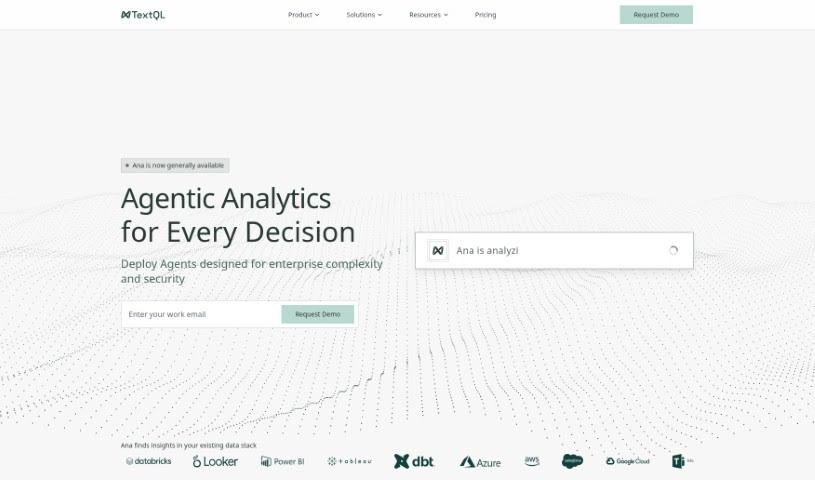
Screenshot of TextQL

TextQL

Discover TextQL in 2025: learn what this AI-powered data analyst does, how to use its features, and how it stacks up against other data analytics tools.

Screenshot

What is TextQL?

TextQL is your company’s own virtual data analyst, powered by AI. It makes getting insights from your business data super easy, letting you ask questions in plain English. It fits right in with your current data setups and tools like Slack and Teams. TextQL helps manage all your data, making sure everything follows the right rules. Its AI brain, named Ana, understands what you’re asking, runs the analysis, and even creates charts for you. You can set it up to meet specific compliance needs, protect data with strong privacy features, and customize how it works for your team.

Ana, TextQL’s AI, works within your company’s existing data systems. It’s designed to collaborate across tools like Slack and Teams. Ana keeps track of your organization’s entire data catalog. It does this by indexing where metadata is stored, showing definitions with links to verified sources, and understanding how different teams define things. TextQL’s language model is fluent in SQL and Python, which really boosts its ability to stay compliant and secure.

TextQL is useful for many industries, including Media, Telecom & Entertainment, Marketing Analytics, Manufacturing, Retail, Logistics, Healthcare, and Financial Services. It offers custom workflows and data integration to fit what different organizations need. Ana can create visual data representations, follow various compliance standards, and handle data definitions and metadata really well. The platform’s strong data integration and analysis abilities really set it apart from similar AI tools, making collaboration smoother and data exploration more precise.

Who created TextQL?

TextQL was actually developed by a company focused on data, not primarily an AI company. It first launched on December 3, 2022. The goal was to create a personal, virtual data analyst for businesses. This AI-driven platform helps improve business insights by letting users ask questions using everyday language. It also integrates smoothly into a team’s existing data platforms. Ana, the AI part of TextQL, can create data visualizations, manage the company’s data catalog, ensure compliance with standards, and handle data definitions and metadata effectively.

What is TextQL used for?

  • It helps you get better business insights by letting you ask questions in plain language.
  • It can create data visualizations and build solid data models.
  • It stops you from making duplicate dashboards.
  • It helps manage your company’s data catalog.
  • It makes sure you comply with any set of standards.
  • It handles data definitions and metadata really well.
  • It cuts down on creating the same dashboards over and over.
  • It supports teamwork across platforms like Slack and Teams.
  • It can generate visual representations of your data.
  • It ensures data privacy with top-notch guardrails for anonymizing data.
  • It manages your enterprise data catalog.
  • It helps you collaborate using platforms like Slack and Teams.
  • It indexes even messy metadata locations.
  • It shows definitions with verified links.
  • It understands when different teams have different definitions.
  • It enables data anonymization.
  • It helps you navigate the semantic layer.
  • It manages your enterprise data catalog.
  • It ensures compliance with various standards.
  • It helps you navigate the semantic layer efficiently.
  • It ensures data privacy through data anonymization.
  • It’s useful for many different industries.
  • It can adhere to any compliance standard.
  • It integrates seamlessly with your existing platforms.
  • It collaborates via Slack and Teams.
  • It gets rid of dashboard redundancy.
  • It manages your enterprise data catalog.
  • It indexes messy metadata locations.
  • It shows definitions with verified links.
  • It understands different team definitions.
  • It’s fluent in SQL and Python.
  • It offers configurable compliance adherence.
  • It enables data anonymization.
  • It enhances business insights using natural language queries.
  • It creates data visualizations.
  • It supports collaboration across platforms like Slack and Teams.
  • It helps comply with standards.
  • It recognizes different definitional uses across teams.
  • It handles data anonymization.
  • It complies with different standards.
  • It integrates seamlessly into pre-existing data platforms.

Who is TextQL for?

  • Media professionals
  • Telecom & Entertainment professionals
  • Marketing Analytics professionals
  • People in the Manufacturing Industry
  • Retail professionals
  • Logistics & CPG professionals
  • Healthcare professionals
  • Financial Services professionals
  • Data Analysts
  • Business intelligence professionals
  • Data Scientists
  • Data Managers
  • Marketers
  • Manufacturing professionals
  • Logistics professionals
  • Marketing Analysts

How to use TextQL?

To get the most out of TextQL, just follow these steps:

  1. Get to know TextQL: TextQL is an AI platform designed for data analysis, visualization, and modeling in businesses. It connects with your current data platforms and collaboration tools like Slack and Teams.
  2. Work with Ana: Ana, TextQL’s AI, is great at understanding questions asked in natural language. She runs analyses and creates data visualizations for you. She can also manage data catalogs, show definitions, and index metadata locations.
  3. Integration: TextQL connects smoothly with your existing data platforms, making collaboration and data management easy within your team’s environment.
  4. Avoid Redundancy: Ana can find existing dashboards, which helps prevent you from creating duplicate ones. This saves resources in your business intelligence system.
  5. Compliance and Security: You can configure TextQL to meet different standards, ensuring your deployments are secure and compliant. It uses special guardrails for data anonymization to keep sensitive information safe.
  6. Customization: The workflows in TextQL are highly customizable. This means your organization can tailor data analysis, visualizations, and collaboration to fit your specific needs.
  7. Industry Applicability: TextQL works well across many industries, including Media, Telecom & Entertainment, Marketing Analytics, Healthcare, Financial Services, and more. It adapts to different data requirements.
  8. Language Proficiency: TextQL is fluent in both SQL and Python. This makes its data analysis capabilities stronger and ensures it can handle various data types and structures flexibly.

By following these steps, you’ll be able to use TextQL effectively for data analysis, visualization, and management within your organization.

Related AI Tools

Discover more tools in similar categories that might interest you

Stay Updated with AI Tools

Get weekly updates on the latest AI tools, trends, and insights delivered to your inbox

Join 25,000+ AI enthusiasts. No spam, unsubscribe anytime.