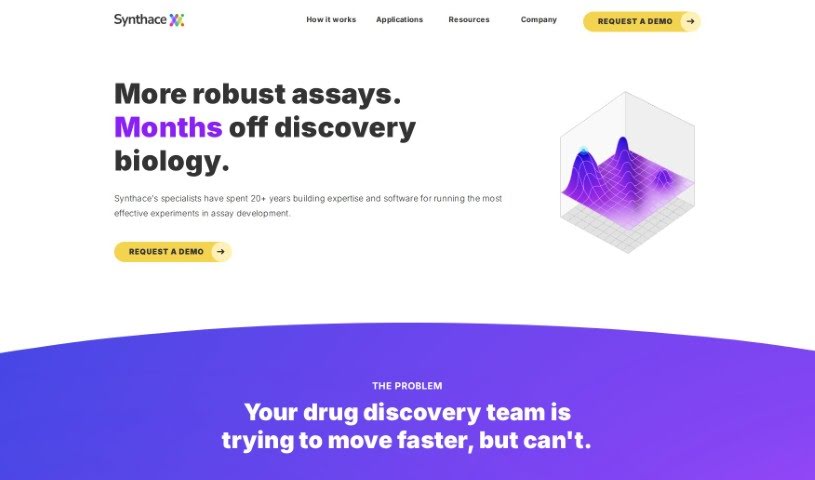
Screenshot of Synthace

Synthace

Discover what Synthace is and how to use it effectively in 2025. We'll explore its features and see how it stacks up against other automation tools.

Screenshot

What is Synthace?

Synthace offers a Life Science Experiment Platform, essentially a tool designed to make the whole process of designing, running, and analyzing experiments much smoother for R&D teams. It really empowers users by simplifying the creation of complex experiments – no coding required! This means you can set up your lab equipment to run automatically, which is great for high-throughput work and ensures your results are reproducible. Plus, it automatically creates structured datasets, making advanced data analysis a breeze. Synthace also provides learning resources like masterclasses to help you get the most out of the platform. Their main goal is to simplify the often complicated world of biotechnological research, making advanced life science experiments accessible to all R&D teams, no matter their programming skills.

So, to put it simply, Synthace lets you design experiments without code, automate your lab gear, and get well-organized data for deeper analysis. It’s a real game-changer for scientists and researchers across many life science fields.

Who created Synthace?

Synthace was brought to life by a team who shared a common vision. The whole idea started in their lab with a simple question: what if we could represent complex experiments digitally in a standard way and access them from anywhere via the cloud? That question sparked the creation of Synthace, with a clear mission to transform scientific experimentation by offering a digital platform for researchers. The company is all about helping R&D teams focus on the important scientific work they need to do, efficiently.

What is Synthace used for?

Synthace is incredibly versatile and can be used for a wide range of tasks:

  • Data Analysis: Making sense of your experimental results.
  • Design of Experiments (DOE): Planning experiments systematically.
  • Assay Development: Creating and refining testing methods.
  • Media Optimization: Finding the best conditions for cell growth.
  • Purification Process Development: Improving how you isolate molecules.
  • Molecular Biology Tasks: Including things like DNA assembly.
  • qPCR Assays: Running quantitative polymerase chain reaction tests.
  • ELISA Assays: Performing enzyme-linked immunosorbent assays.
  • Automation Masterclass: Learning how to automate lab processes.
  • DOE Masterclass: Getting skilled in experimental design.
  • High-throughput Experiments and Data Analysis: Handling large volumes of experiments and their data.
  • Design of Experiments for Assay Development: Specifically applying DOE to create better assays.
  • Design of Experiments for Media Optimization: Using DOE to perfect growth conditions.
  • Design of Experiments for Purification Process Development: Applying DOE to improve purification.
  • Design of Experiments for Molecular Biology Tasks: Using DOE for things like DNA assembly.
  • Laboratory Automation: Automating the operation of lab equipment for hands-off work.
  • Educational Resources: Accessing helpful materials like a DOE Masterclass and an Automation Masterclass.
  • Simplified Experiment Design: Creating complex experiments easily, without needing to code.
  • Structured Datasets Generation: Automatically producing well-organized data.
  • qPCR and ELISA Assays: Helping with the design and execution of these specific tests.
  • Knowledge Resources: Finding information through a blog, case studies, and webinars.
  • Molecular Biology Tasks: Including DNA Assembly.
  • Laboratory Automation: General automation for lab work.
  • High-throughput Automation: Automating experiments that need to be done in large numbers.
  • Structured Datasets Generation: Creating organized data.
  • Simplified Experiment Design: Making experiment planning easier.
  • Molecular Biology Tasks: Such as DNA assembly.
  • High-throughput Automation: Automating experiments efficiently.
  • Data Analysis and Visualization: Analyzing and visualizing structured datasets.
  • Laboratory Automation: For reproducible results in the lab.
  • Experiment Protocol Reproducibility: Ensuring protocols can be repeated consistently.
  • Dynamic Automation: Enabling automation that adapts for quicker insights.

Who is Synthace for?

Synthace is a valuable tool for:

  • R&D teams
  • Scientists
  • Researchers
  • Life Science professionals
  • Biologists

How to use Synthace?

Getting started with Synthace is straightforward. Just follow these steps:

  1. Design Your Experiments: Use the platform to plan out complex experiments. You can do this without any coding, making the planning phase really smooth.
  2. Automate Your Lab: Set up your lab equipment for hands-off operation. This is key for high-throughput work and ensures your results are consistent and reproducible.
  3. Generate Structured Datasets: The platform automatically creates well-organized datasets. This is super helpful for doing advanced data analysis and getting better insights.
  4. Access Learning Resources: Make the most of the tool by checking out educational masterclasses, like the DOE Masterclass and the Automation Masterclass.
  5. Explore Application Areas: See how Synthace can be applied in areas like Design of Experiments for assay development, media optimization, purification process development, and various molecular biology tasks.
  6. Use the Digital Experiment Platform: Move effortlessly from planning your experiments to running them and then analyzing the data.
  7. Leverage the No-Code Solution: Get access to advanced life science experimentation tools without needing to be a programmer.
  8. Check the FAQs: If you have questions about how the platform works, how to set it up, or its applications, the FAQs section is a great place to look.
  9. Enhance Your User Experience: You’ll benefit from context-rich data structuring for experiments, better protocol reproducibility, and less variability in your processes.
  10. Consider Joining the Team: If you’re passionate about scientific advancement, you might even consider joining the interdisciplinary team at Synthace to contribute to groundbreaking solutions.

Related AI Tools

Discover more tools in similar categories that might interest you

Stay Updated with AI Tools

Get weekly updates on the latest AI tools, trends, and insights delivered to your inbox

Join 25,000+ AI enthusiasts. No spam, unsubscribe anytime.