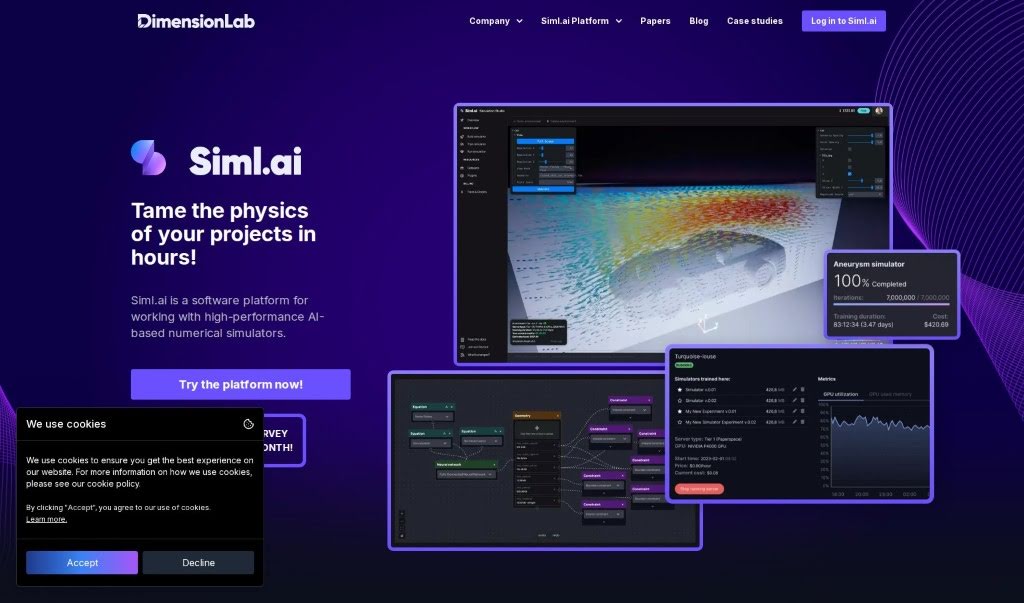
Screenshot of Siml.ai

Siml.ai

Discover what Siml.ai is and how to use it effectively in 2025. We'll explore its features and see how it stacks up against other tools for scientists.

Screenshot

What is Siml.ai?

Siml.ai is a software platform that DimensionLab developed to make AI-driven physics simulations much faster. It cleverly combines advanced machine learning with physics simulation capabilities, allowing for interactive visualization and instant responses to whatever you input. The platform is built around two core parts: the Model Engineer and the Simulation Studio.

The Model Engineer is where you can train and fine-tune physics simulators using deep learning. It’s all done through a web-based app, making it easy to manage your datasets and build your own custom model architectures. Then there’s the Simulation Studio. This part uses the AI simulator models you’ve trained to tackle engineering and scientific challenges. The big advantage? It’s significantly faster than traditional simulation software. Ultimately, Siml.ai wants to put powerful, scientific-grade simulation tools into the hands of many users, no matter their technical background, by offering a user-friendly web interface and impressive visualization features.

Who created Siml.ai?

DimensionLab is the company behind Siml.ai. They first launched the platform on May 17, 2022. DimensionLab’s main focus is creating tools that help engineers and researchers simplify the physics involved in their projects, all powered by AI-driven simulations on the Siml.ai platform. As mentioned, the platform has two key parts: the Model Engineer and the Simulation Studio. These components allow users to train and optimize physics simulators using deep learning, which leads to much quicker simulation times.

What is Siml.ai used for?

Siml.ai is great for a variety of tasks:

  • Speeding up physics simulations with AI.
  • Interactive visualization that lets you see simulations in action.
  • Real-time responses to your input, making the process feel immediate.
  • Training and optimizing models using deep learning techniques.
  • Managing datasets effectively, which is crucial for building large datasets.
  • Developing custom model architectures tailored to your specific needs.
  • Solving tough engineering and scientific problems by using trained AI simulator models.
  • Achieving significant speed-ups in simulations compared to older software.
  • Visualizing physical phenomena in real-time as it happens.
  • High-fidelity rendering thanks to its integration with Unreal Engine.
  • It helps make fast AI-driven physics simulations a reality.
  • It combines machine learning with physics simulation capabilities in a powerful way.
  • It enables interactive visualization and real-time response to user input, making complex tasks more manageable.
  • You can train and optimize physics simulators using deep learning techniques to get better results.
  • The platform supports dataset management for constructing large datasets, which is essential for many research projects.
  • You can quickly develop customized model architectures using the built-in code editor.
  • It lets you leverage trained AI simulator models for solving engineering and scientific problems, often much faster than traditional methods.
  • You can perform simulations with significant speed-ups compared to traditional software, saving valuable time.
  • It allows you to achieve real-time visualization of simulating physical phenomena, giving you immediate insights.
  • And it provides high-fidelity rendering with the Unreal Engine, ensuring your visualizations look great.

Who is Siml.ai for?

Siml.ai is primarily designed for:

  • Engineers looking for faster simulation tools.
  • Researchers who need to analyze complex physical phenomena.

How to use Siml.ai?

Here’s a straightforward guide to using the Siml.ai platform:

  1. First, head over to dimensionlab.org to access the Siml.ai platform and get started.
  2. Take a moment to get acquainted with the platform’s two main parts: the Model Engineer and the Simulation Studio.
  3. Use the Model Engineer to train and fine-tune your physics simulators. You’ll be using deep learning techniques within the web-based application for this.
  4. Make sure to use features like dataset management to build your datasets. You can do this by exporting data from simulations or using physical sensors.
  5. You can develop customized model architectures efficiently by using the code editor that’s provided.
  6. Once your models are ready, switch to the Simulation Studio. Here, you’ll use your trained AI simulator models to solve those tricky engineering and scientific problems.
  7. You’ll really benefit from accelerated simulations. This happens when you infer your trained neural network models, leading to much faster results than you’d get with traditional simulation software.
  8. Experience real-time visualization of physical phenomena with interactive “in-situ” visualization. It’s like watching things happen as they happen!
  9. For really sharp visuals, you can achieve high-fidelity rendering by using the powerful Unreal Engine that’s integrated right into the platform.
  10. If you need more help or want to connect with others, check out the community Discord server.
  11. Want a great deal? Consider filling out the Siml.ai Early Adopter Survey – you could get a 100% discount for a whole month!
  12. If you have more questions or want to help the project grow, feel free to contact the company via email.

By following these steps, you’ll be well on your way to effectively using the Siml.ai platform for your AI-driven physics simulations.

Related AI Tools

Discover more tools in similar categories that might interest you

Stay Updated with AI Tools

Get weekly updates on the latest AI tools, trends, and insights delivered to your inbox

Join 25,000+ AI enthusiasts. No spam, unsubscribe anytime.