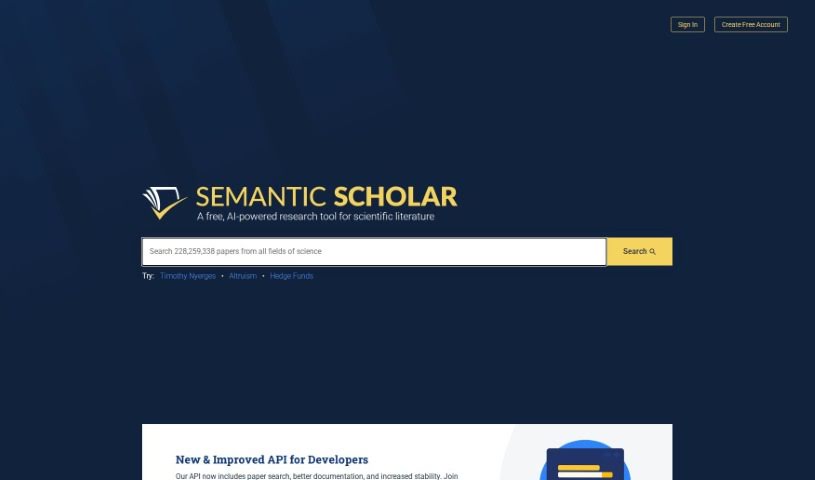
What is Semantic Scholar?
Semantic Scholar is a really smart platform, built using advanced AI and engineering. It dives deep into scientific papers, pulling out important insights and connections. This helps researchers and scholars find studies that are truly relevant and significant in their field. By looking at tons of scientific writing, Semantic Scholar uncovers subtle meanings and links between papers, giving researchers a complete picture of a topic. What makes it stand out is its ability to sort and highlight research based on how relevant and impactful it is, showing you the most influential studies first. Plus, it offers helpful tools like visual charts, quick summaries, and citation breakdowns. These features make it much easier for researchers to explore and understand scientific information, so they can make their own valuable contributions.
Who created Semantic Scholar?
The Allen Institute for Artificial Intelligence (AI2) created Semantic Scholar back in 2015. Paul Allen, who co-founded Microsoft, established AI2 in 2014. The main idea behind Semantic Scholar is to use AI to make research more accessible and impactful. It uses machine learning to organize academic papers and help researchers and scholars around the world figure out which ones are most important.
What is Semantic Scholar used for?
- It’s a free, dependable source of scholarly data that developers can use to build projects aimed at speeding up scientific progress.
- Semantic Scholar offers AI-powered tools for searching and discovering research, along with open resources for the global research community. It indexes over 200 million academic papers from many different places.
- Researchers can get a quick grasp of papers thanks to its ability to extract meaning and identify connections, helping them discover and understand research more easily.
- The platform helps you filter and prioritize research papers by relevance and impact. This means you see the most important and influential studies in your field, keeping you up-to-date with new developments.
- It helps scholars navigate scientific literature by providing features like visualizations, summaries, and citation analysis. These tools make it more efficient to explore and understand information.
- Semantic Scholar is changing how scholars interact with scientific literature. It uses AI and advanced engineering to make finding relevant research easier and improve the whole research experience.
- The platform analyzes and processes huge amounts of scientific writing, pulling out valuable insights and connections that might otherwise be missed.
- Its smart algorithms uncover hidden meanings and relationships within academic publications, allowing scholars to get a full view of research topics and areas.
- Semantic Scholar works to make scientific knowledge accessible to everyone. It also looks at the impact of choices made to help balance things out.
- It encourages teamwork by making a real effort to collaborate with colleagues to improve work quality and share the support load.
- It provides a free, reliable source of scholarly data for developers to build projects that accelerate scientific progress.
- Using advanced AI and engineering, it understands the meaning behind research papers, helping scholars and researchers find relevant and significant studies in their field.
- It analyzes and processes vast amounts of scientific literature, extracting valuable insights and connections that may have otherwise gone unnoticed.
- The platform filters and prioritizes research papers based on relevance and impact, presenting scholars with the most pertinent and influential studies in their respective fields.
- It enables researchers to stay up-to-date with the latest advancements and discoveries, ultimately enhancing the quality and depth of their own work.
- Semantic Scholar offers valuable features like visualizations, summaries, and citation analysis to empower researchers to explore and comprehend scientific information more efficiently.
- It’s revolutionizing how scholars interact with scientific literature by making it easier to discover relevant research and improving the overall research experience.
- It’s becoming an essential tool for scholars looking to navigate the ever-growing world of scientific literature.
- Semantic Scholar offers the Semantic Scholar Academic Graph (S2AG) Dataset and APIs, which provide records for research papers across all fields in an easy-to-use JSON archive.
- Through the Semantic Scholar Open Research Corpus (S2ORC), maintained by its research team, it contributes to NLP and text mining research on scientific papers.
Who is Semantic Scholar for?
How to use Semantic Scholar?
Here’s how you can get the most out of Semantic Scholar:
- Visit the site: Start by going to the Semantic Scholar website. It’s a free AI tool for scientific literature.
- Search for papers: Use the search bar to look through its massive database, which holds millions of papers from all sorts of scientific fields.
- Find key insights: Let the advanced algorithms do their work. They analyze and pull out valuable insights from research papers, revealing hidden meanings and connections.
- Filter and prioritize: Use the AI to sort and rank research papers by relevance and impact. This way, you’re sure to find the most important studies in your area.
- Stay current: Keep up with the latest developments and discoveries in your field by using Semantic Scholar to access the most recent content.
- Use the features: Take advantage of tools like visualizations, summaries, and citation analysis to better understand scientific information.
- Visualize connections: See how different research papers and topics relate to each other. This helps you get a complete overview.
- Improve your research: Make your own research better and deeper by using Semantic Scholar’s capabilities to navigate and understand scientific literature efficiently.
By following these steps, you’ll be able to effectively use Semantic Scholar to discover, understand, and contribute meaningfully to scientific research.