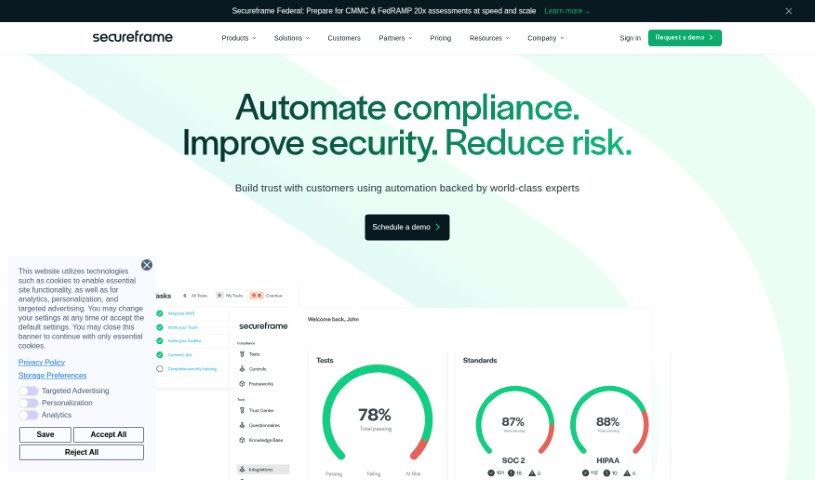
What is Secureframe?
Secureframe’s Risk Management solution is an AI-powered tool designed to automate how your organization assesses and manages risks. It is a smart assistant that streamlines the whole process, saving you time and cutting down on the costs that come with keeping a solid risk management program running smoothly. It uses the ISO 27005 methodology to really get a handle on risks, which helps you make better, more informed decisions for your security compliance efforts. You can easily assess risks, document how you plan to handle them, and make sure you’re aligned with important frameworks like SOC 2, ISO 27001, PCI, and HIPAA. The tool even includes a risk library with NIST scenarios, lets you track changes to individual risks, and offers plenty of ways to customize how you categorize them. Plus, you get intuitive dashboards that give you a real-time look at your organization’s risks, making it much simpler to share the status of your risk management program with everyone involved.
Who created Secureframe?
Secureframe Risk Management first launched on October 23, 2023. It was created by a team of experts who, combined, have over 300 years of experience in compliance and auditing. The company’s main goal is to help businesses build trust by offering complete compliance solutions that meet the highest security and privacy standards. Secureframe has received backing from well-known investors like Kleiner Perkins, Gradient Ventures, and other prominent venture capital firms.
What is Secureframe used for?
- It helps you automatically assess and manage risks within your organization.
- It saves you time and money when it comes to keeping up a strong risk management program.
- You can follow the ISO 27005 methodology for effective risk assessment.
- It helps you assess and document treatment plans to meet criteria for frameworks like SOC 2, ISO 27001, PCI, and HIPAA.
- You can track changes made to individual risks and get quick snapshots of your risk register.
- It links controls to known risks, creating coordinated risk management strategies that align with compliance needs.
- It helps you assess residual risk and spot any gaps in your risk management program.
- You can customize scoring scales, risk score groups, and use custom tags to categorize risks just the way you need.
- It offers intuitive dashboards that let you visually monitor your organization’s risks over time.
- It makes it easy to communicate the health of your risk management program to executives, auditors, and other stakeholders.
- It automates the assessment and management of risks in an organization.
- It saves time and reduces costs associated with maintaining a strong risk management program.
- It follows the ISO 27005 methodology for effective risk assessment.
- It assists in meeting criteria for frameworks like SOC 2, ISO 27001, PCI, and HIPAA.
- It contains a risk library with NIST risk scenarios for tracking various risks.
- It enables tracking changes to individual risks and snapshots of the risk register.
- It links controls to known risks for coordinated risk management strategies.
- It helps in assessing residual risk and identifying gaps in the risk management program.
- It offers customization options for scoring scales, risk score groups, and custom tags.
- It provides intuitive dashboards for visual monitoring of an organization’s risks over time.
Who is Secureframe for?
- IT professionals
- Compliance Officers
- Security professionals
How to use Secureframe?
To get the most out of Secureframe’s Risk Management tool, here’s a straightforward guide:
- Automated Risk Assessment: The tool uses AI to automatically handle risk assessment and management in your organization. This really helps save time and cut down on the costs tied to running a solid risk management program.
- ISO 27005 Methodology: Secureframe sticks to the ISO 27005 methodology, which means it assesses risks in your environment accurately. This helps you make smarter decisions for your security compliance program.
- Framework Compatibility: You can assess and document treatment plans to meet important standards like SOC 2, ISO 27001, PCI, and HIPAA. The tool also comes with a risk library that includes NIST scenarios, making it easy to keep track of various risks.
- Risk Management Strategies: Link your controls directly to the risks you’ve identified. This creates coordinated risk management strategies, which is super helpful for meeting compliance requirements and assessing your residual risk.
- Customization Options: Feel free to customize scoring scales, risk groups, and use custom tags to categorize risks exactly how your business needs them. This keeps things flexible within the tool.
- Intuitive Dashboards: You’ll find easy-to-use dashboards that visually track your risks over time. They show things like heat maps, trend charts, and summary tables, making risk monitoring and communication much more effective.
- Enhanced Security Posture: Document any changes you make to risks, get snapshots of your risk register, and clearly show how you’re improving your security posture. This brings transparency and accountability to your efforts.
- Track Progress: Keep an eye on individual risks, show the steps you’re taking to boost security, and make sure you’re meeting standards like SOC 2, ISO 27001, PCI, and HIPAA effectively.
- Demonstrate Compliance: Use the tool to link controls to known risks. This allows for a comprehensive approach to risk management that’s perfectly aligned with your compliance requirements.
- Residual Risk Assessment: Assess your residual risk levels, pinpoint any gaps in your risk management program, and make well-informed decisions to effectively reduce those risks.
By following these steps, your organization can really tap into the power of Secureframe’s Risk Management tool. It’s designed to streamline risk assessment, boost your security posture, and ensure you’re compliant with industry standards in a truly effective way.