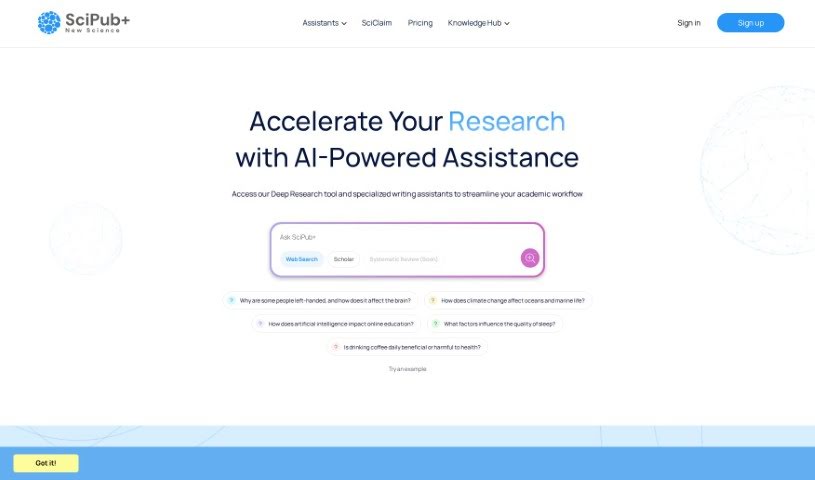
Screenshot of SciPub+

SciPub+

Discover SciPub+ in 2025! Learn what this AI academic writing assistant is, how to use its 10 specialized tools for everything from outlines to conclusions, and how it stacks up against other academic writing aids.

Screenshot

What is SciPub+?

SciPub+ is an AI-powered platform designed specifically for academic writing. It is your personal academic writing assistant, offering 10 different AI tools to help you tackle various parts of your papers. Whether you’re stuck on an outline, need help with a literature review, or want to refine your methods and results section, SciPub+ has a tool for that. It’s built to make you more productive by helping you structure your articles and get past writer’s block. The goal here is to move beyond generic writing tools and offer something much more focused and effective for academic work. In fact, the GptDemo team has given it a thumbs-up!

Who created SciPub+?

SciPub+ was actually developed by a team of researchers and scientists who are actively working in their fields. They launched it on December 14, 2023. This AI writing tool is their answer to making academic writing faster and better. It helps users write higher-quality articles more quickly, offering features like automatic editing and citation management. Essentially, it’s designed to make the whole writing process simpler, especially for researchers and academics.

What is SciPub+ used for?

SciPub+ is incredibly versatile for anyone working on academic papers. Here’s a breakdown of what it can do:

  • Academic Writing Assistance: It helps with all sorts of academic writing tasks.
  • Task Automation: It can automate those repetitive jobs that eat up your time.
  • Quality Enhancement: It’s designed to boost the overall quality of your writing.
  • Workflow Improvement: You’ll find your writing process becomes much more efficient.
  • Article Crafting: It helps you create well-structured academic articles.
  • Outline Structuring: Get a solid foundation with research outlines.
  • Thesis Drafting: It can help you generate comprehensive thesis drafts.
  • Visuals & Captions: It assists with visuals and provides fitting captions.
  • Skill Development: It can even help improve your writing skills.
  • Productivity Boost: Expect a significant increase in your writing output.
  • Task Reduction: It minimizes the need for repetitive work.
  • Writing Automation: Various writing tasks can be automated.
  • Writing Quality: It consistently improves the quality of your written work.
  • Style & Structure Guidance: Learn and apply proper academic style, structure, and language.
  • Article Structuring: Helps organize your academic articles effectively.
  • Thesis Automation: Automates the drafting process for theses.
  • Illustration Enhancement: Improves the quality of illustrations with good captions.
  • Rewriting Minimization: Reduces the amount of unnecessary rewriting needed.
  • Best Practices: Incorporates essential academic best practices.
  • Work Standard: Elevates the overall standard of your work.
  • Segment Assistance: Helps craft various parts of academic papers.
  • Repetitive Task Automation: Specifically targets repetitive tasks in academic writing.
  • Outline Structuring: Aids in structuring research outlines.
  • Abstract Crafting: Helps create professionally written abstracts.
  • Introduction Development: Assists in crafting compelling introductions.
  • Literature Reviews: Helps create comprehensive literature reviews.
  • Methodology Detailing: Provides guidance on detailing clear methodologies.
  • Results Presentation: Aids in presenting impactful results with visual precision.
  • Conclusion Drafting: Helps draft insightful conclusions.
  • Automated Drafting: Offers automated drafting capabilities.
  • Efficiency & Productivity: Enhances overall writing efficiency and productivity.
  • Illustration Quality: Improves the quality of illustrations in academic writing.
  • Caption Assistance: Assists with fitting captions for visuals.
  • Text Tuning: Refines your text with the text tune feature.
  • Thesis Drafts: Automates comprehensive thesis drafts.
  • Section Guidance: Guides you through essential sections like introduction and discussion.
  • Rewriting Reduction: Decreases unnecessary rewriting in your writing process.
  • Academic Writing Aid: Assists in academic writing by automating repetitive tasks.
  • Quality & Productivity: Enhances writing quality and productivity.
  • Outline Creation: Helps structure research outlines.
  • Abstract Generation: Generates professionally crafted abstracts.
  • Introduction & Conclusion Guidance: Provides guidance on writing compelling introductions and conclusions.
  • Review & Methodology Help: Helps create comprehensive literature reviews and methodologies.
  • Illustration Captioning: Enhances the quality of illustrations with fitting captions.
  • Scholarly Work Assistance: Guides researchers and scientists in crafting various segments of scholarly works.
  • Productivity Increase: Increases writing productivity.
  • Scholarly Segment Aid: Offers assistance in crafting various segments of scholarly works.
  • Quality & Efficiency: Enhances writing quality and efficiency.
  • Section Guidance: Guides users through essential sections of academic papers.
  • Thesis Drafting: Automates comprehensive drafts for theses.
  • Article Structuring: Aids in structuring academic articles.
  • Illustration Quality: Enhances the quality of illustrations in academic writing.
  • Comprehensive Aid: Assists in academic writing by guiding researchers and scientists in crafting various segments of scholarly works.
  • Efficiency & Workflow: Enhances writing quality and improves workflow efficiency.
  • Productivity & Blockage: Improves productivity by structuring articles and overcoming writer’s block.
  • Article Section Support: Aids in structuring academic articles, including outlines, literature reviews, methods, results, introduction, conclusion, etc.
  • Specialized Assistants: Provides specialized assistants for creating research outlines, abstracts, introductions, literature reviews, methodologies, results, conclusions, visuals, and text tuning.
  • Illustration Captioning: Enhances the quality of illustrations in academic writing through accurately fitting captions and descriptions.
  • User Benefits: Benefits users by automating writing tasks, teaching proper style and structure, structuring academic articles, and improving writing skills.
  • Productivity Guidance: Boosts writing productivity by providing guidance and structuring assistance.
  • Process Simplification: Simplifies the writing process from outlining to final proofreading.
  • Outline Assistance: Offers assistance in crafting structured research outlines.
  • Introduction Help: Helps in writing compelling introductions.
  • Literature Review Aid: Assists in creating comprehensive literature reviews.
  • Methodology Guidance: Provides guidance on detailed methodologies.
  • Results Impact: Aids in producing impactful results.
  • Conclusion Support: Supports in crafting insightful conclusions.
  • Visual Captioning: Helps with accurately fitting captions for visuals.
  • Text Refinement: Text tuning feature for draft elevation.
  • Segment Guidance: Provides guidance on different writing segments.
  • Illustration Quality: Improves the quality of illustrations with fitting captions.
  • Draft Elevation: Assists with text refinement and draft elevation.
  • Skill Improvement: Aids in gradual user writing skill improvement.

Who is SciPub+ for?

SciPub+ is designed for:

  • Researchers
  • Scientists
  • Academics

How to use SciPub+?

Using SciPub effectively is pretty straightforward. Just follow these steps:

  1. First, head over to the SciPub website. Once you’re there, look for and select the “Choose Your Assistant” option.
  2. Next, pick the assistant that best fits what you need to write. Whether it’s research outlines, abstracts, introductions, or literature reviews, there’s a tool for each.
  3. Now, start using these AI-powered assistants. They’re great for automating those repetitive tasks and will guide you through important sections like the introduction and discussion.
  4. You’ll really benefit from the tailored help. It’s all based on proven techniques and the best academic practices for every stage of your writing.
  5. Want to improve your writing skills? You can do that by working with the SciPub assistants on your outlines, drafts, revisions, and getting feedback.
  6. Make sure to explore the tool’s capabilities. You can create structured outlines, craft compelling theses, and generally improve the quality of your academic writing.
  7. It’s also worth checking out how it generates text and quickly adjusts content to match your specific needs.
  8. Finally, really engage with SciPub to streamline your entire academic writing process. From the initial outline all the way to the final proofread, it ensures efficiency and precision in all your scientific writing efforts.

By following these steps, you’ll find that using SciPub’s AI-powered features can significantly enhance your academic writing experience.

Related AI Tools

Discover more tools in similar categories that might interest you

Academic Help Free Essay Generator

Education Academic Writing
Learn More

Stay Updated with AI Tools

Get weekly updates on the latest AI tools, trends, and insights delivered to your inbox

Join 25,000+ AI enthusiasts. No spam, unsubscribe anytime.