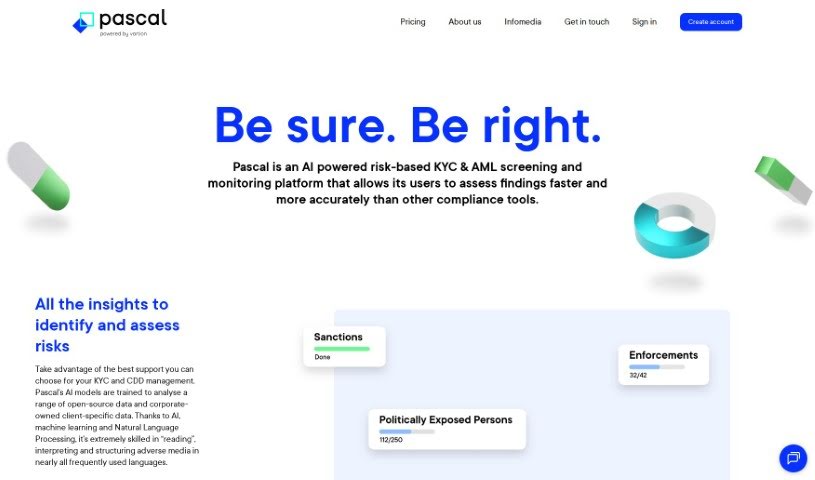
What is Pascal?
Pascal is a smart assistant for compliance, specifically built for people working in financial services. Its main job is to help with ‘Know Your Customer’ (KYC) and ‘Customer Due Diligence’ (CDD) tasks. It uses advanced AI models to look at information from the internet and data specific to your clients. By combining AI, machine learning, and Natural Language Processing (NLP), Pascal makes client onboarding much smoother. It also keeps you updated with real-time alerts about potential risks, helps cut down on those annoying false alarms, and stays current with all the latest laws and rules. Plus, it’s really easy to use, lets teams work together, and keeps a clear record of every search and decision made.
Who created Pascal?
Pascal was developed by Vartion, a Dutch company that’s really good at data analytics. They started Vartion back in 2018 with a focus on using AI and machine learning to boost what humans can do. Pascal itself was launched on June 2, 2022. People like it because it really does simplify those important KYC and CDD processes, thanks to its use of AI, machine learning, and NLP. The goal is to make things run more smoothly, catch fewer false positives, and make it easier for everyone in the organization to work together on compliance.
What is Pascal used for?
Pascal is a versatile tool that helps with a lot of different compliance needs:
- Know Your Customer (KYC) processes
- Customer Due Diligence (CDD) processes
- Screening potential clients and business partners, both within and outside the financial sector.
- Analyzing data: It digs into open-source information and your own client data using AI, machine learning, and NLP.
- Client Onboarding: It makes the process of bringing on new clients much simpler and faster.
- Continuous Monitoring: You get real-time alerts about any risks or issues that pop up.
- Reducing False Positives: It’s designed to give you more accurate predictions and fewer incorrect alerts.
- Collaboration: It helps client-facing teams, compliance managers, and external auditors work together smoothly.
- Audit Trails: It keeps detailed records of all searches and decisions, ensuring transparency and providing assurance for screening procedures.
- Streamlining Compliance: It simplifies how you manage compliance and helps make better decisions.
- Adverse Media Analysis: It can even analyze negative news in different languages.
- Automating Onboarding: It takes care of many tasks in the client onboarding process.
- Keeping Up-to-Date: It continuously monitors clients and third parties to ensure you’re always current.
Essentially, it’s about making compliance management easier, more transparent, and more collaborative.
Who is Pascal for?
Pascal is a great tool for anyone involved in financial compliance:
- Compliance Managers
- Client-Facing Staff
- External Auditors
- Legal and Compliance Experts
- Compliance Officers
- Financial Professionals
If you work in financial services and deal with compliance, Pascal is likely designed for you.
How to use Pascal?
Using Pascal effectively is pretty straightforward. Here’s a breakdown of how to get the most out of it:
- Understand Its Core Purpose: Remember, Pascal is mainly a compliance support platform. Its primary focus is on helping financial services companies with Know Your Customer (KYC) and Customer Due Diligence (CDD) tasks.
- Leverage the AI and Data Analysis: Pascal uses a powerful combination of AI, machine learning, and Natural Language Processing (NLP). This tech helps it analyze both public information and your specific client data, making it easier to understand things like adverse media, even in different languages.
- Streamline Client Onboarding: One of Pascal’s big advantages is how it speeds up and simplifies bringing new clients on board. It automates many of the usual steps, giving you clear insights quickly.
- Stay Ahead with Continuous Monitoring: The platform provides real-time alerts, so you’re always in the loop about any potential risks or issues concerning your clients or any third parties you work with.
- Minimize False Positives: Pascal is built to be smart about reducing those annoying false alarms. Its AI-based techniques and self-learning capabilities help it make more accurate predictions about what’s truly relevant.
- Enjoy the User Interface and Collaboration Features: You’ll find Pascal’s interface is designed to be intuitive, making compliance management simpler. It also really supports teamwork, allowing different people within your organization to collaborate effectively.
- Benefit from Transparency and Audit Trails: Every single search and decision you make within Pascal is logged. This creates a complete audit trail, which is crucial for transparency and gives compliance managers and auditors the assurance they need.
- Consider Cost-Efficiency and Flexibility: Pascal is offered as a Software-as-a-Service (SaaS) solution. This means you can often pay per case, adjusting the resources and monitoring frequency based on your specific needs.
- Ease of Implementation and Support: Getting Pascal set up is generally easy, and training is available for your compliance department. Plus, you can get help online or directly from people if you need it while you’re operating.
- Stay Current with Evolving Regulations: Pascal is designed to adapt as laws and regulations change. This means it keeps delivering more accurate results and helps you manage compliance more efficiently over time.
By keeping these points in mind, you can really make Pascal work for your compliance management needs in the financial services industry.