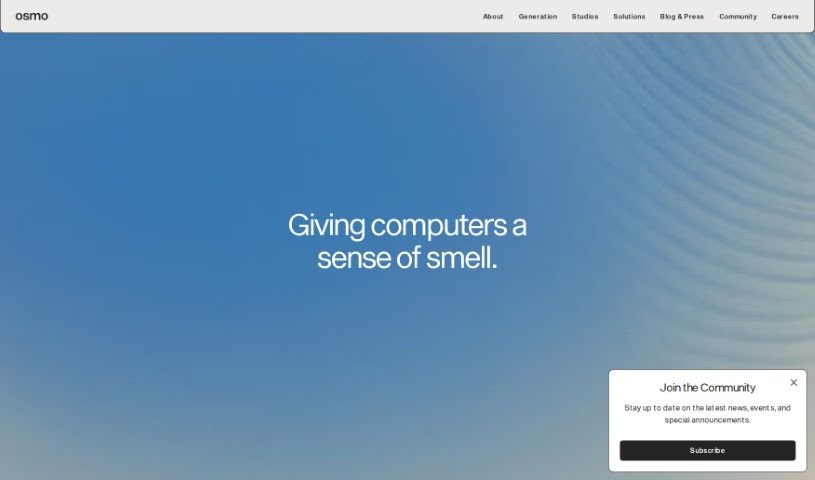
Screenshot of Osmoai

Osmoai

Discover Osmoai in 2025: learn what this innovative platform is, how to use its features effectively, and how it compares to other product design tools.

Screenshot

What Exactly is Osmoai?

OsmoAI is a really interesting platform that brings together advanced artificial intelligence with the science of smell, essentially digitizing our sense of smell. It takes odor molecules and turns them into digital signals. Then, it maps these signals to understand what makes each scent unique. Finally, it converts those digital signals back into actual scents. The whole goal is to improve our health and well-being by using smell in new ways. OsmoAI reads odor molecules, maps them to understand distinct scents, and then writes or converts these digital signals back into actual scents. It’s a bit like taking atoms, turning them into bits of data, and then turning those bits back into scents we can perceive. This platform is also a big deal in making fragrances because it digitizes scents and makes the whole fragrance creation process much smoother.

What’s more, OsmoAI has the potential to really affect our emotions, let us tap into sensory experiences, and boost our well-being, all by understanding and recreating scents with precision.

Who’s Behind Osmoai?

Osmoai was actually developed by a team at Google Research, led by Alex Wiltschko. The whole idea for Osmoai grew out of their pioneering work using machine learning to map out the sense of smell. Osmoai officially launched on January 24, 2023, with a clear mission: to digitize our sense of smell for all sorts of different uses. The team behind it is pretty impressive, bringing together experts from fields like machine learning, sensory neuroscience, data science, and even fine fragrance.

What Can You Do With Osmoai?

Osmoai opens up a lot of possibilities:

  • It can help make fragrance production better.
  • It aims to improve human well-being through the power of smell.
  • You can use it to tap into sensory experiences.
  • It has potential applications in healthcare diagnostics by analyzing smells.
  • It could help in the early detection of diseases.
  • It contributes to overall well-being and can be used in therapeutic interventions.
  • It’s capable of eliciting specific emotional responses.
  • It can trigger memories through scents.
  • It offers an end-to-end process for capturing scents.
  • It’s helping to create a global map of odors.
  • Essentially, it’s digitizing the sense of smell.
  • It’s all about improving health and well-being through smell.
  • It’s a great aid for fragrance production.
  • It helps map out the sensory world around us.
  • It can create distinct scents using digital signals.
  • It captures and reproduces scents.
  • It digitizes various aspects of how we perceive smell.
  • It produces actual scents from digital signals.
  • It shows a lot of potential in the health and well-being sector.
  • It can elicit emotions.
  • It has applications in digital signal processing.
  • It’s involved in developing the Osmograph.
  • It’s focused on improving human well-being through smell.
  • It has healthcare applications.
  • It aids in early disease detection through smell.
  • It supports therapeutic interventions by reproducing scents.
  • It’s digitizing smell to improve health and well-being.
  • It enhances precise fragrance production.
  • It can affect mood and trigger memories by reproducing scents digitally.
  • It’s used for early disease detection in healthcare diagnostics through smell digitization.
  • It digitizes the perception of odor molecules into digital signals.
  • It captures and reproduces scents through an end-to-end process.
  • It elicits emotional responses by reproducing scents digitally.
  • It’s working towards a global map of odor for universal understanding.
  • It can help design molecules with specific functions, like insect repellents.
  • It’s developing solutions for threat detection and creating immersive experiences.
  • It uses Graph Neural Networks, achieving a major breakthrough in predicting a molecule’s smell just from its structure.
  • It can create entirely new molecules that no one has smelled before, predicting them with accuracy far beyond human capability.
  • It’s designed molecules that mosquitoes dislike (like insect repellents) and these have proven more effective than DEET in human trials.
  • It reproduces captured scents.
  • It integrates olfactory science into its processes.

Who Should Use Osmoai?

Osmoai is designed for a variety of professionals and researchers:

  • People working in fragrance production.
  • Healthcare professionals.
  • Wellness practitioners.
  • Researchers specializing in olfactory science.
  • AI specialists.
  • Machine Learning Experts.
  • Sensory Neuroscientists.
  • Data scientists.
  • Engineers.
  • Fine Fragrance Experts.
  • Analytical Chemists.
  • Product Development Specialists.
  • Machine Learning experts.
  • Sensory Neuroscientists.
  • Data Scientists.
  • Engineers.
  • Fine Fragrance Experts.
  • Analytical Chemists.
  • Product Developers.
  • Fragrance production specialists.
  • Sensory scientists.
  • Those in sensory neuroscience.
  • People in Data Science.
  • Analytical chemistry professionals.
  • Those in product development.

How Do You Use Osmoai?

Here’s a simple breakdown of how to use OsmoAI:

  1. Get to Know OsmoAI: First off, OsmoAI is a really innovative platform. It blends artificial intelligence with olfactory science to digitize our sense of smell. It works by converting odor molecules into digital signals, then mapping these signals to understand what makes each scent distinct, and finally converting those signals back into actual scents. It’s a fascinating way to approach smell!
  2. Reading Odors: The process starts with OsmoAI converting odor molecules into digital signals. You can think of it like how a camera captures light or a microphone captures sound – OsmoAI does something similar for smells.
  3. Mapping Odors: Next, the platform maps these digital signals. This helps it understand how different molecules are perceived as specific scents. It’s all about understanding the unique fingerprint of each smell.
  4. Writing Scents: The final step is where OsmoAI converts the mapped digital signals back into actual scents. It’s a bit like how a printer takes digital data and turns it into a physical printout.
  5. The Osmograph’s Importance: The Osmograph within OsmoAI is a key achievement. It represents the platform’s ability to capture and reproduce scents completely. Imagine it like a photo or a song that can bring back memories and evoke emotions – the Osmograph does that for smell.
  6. Its Role in Fragrance Production: OsmoAI is super important for making fragrances. It takes the art of creating scents and turns it into a precise science by digitizing scents and building a map of odor molecules.
  7. Boosting Well-Being: OsmoAI helps improve human well-being by digitizing smell. This can really affect our mood, bring back memories, and even influence our physical responses through scent-based experiences.
  8. What Makes OsmoAI Special: OsmoAI really stands out from other AI technologies because it specifically focuses on olfactory science and aims to digitize the entire sense of smell.

By following these steps, you can really dive into OsmoAI’s advanced capabilities and explore how digitizing scent can be applied in all sorts of different fields.

Related AI Tools

Discover more tools in similar categories that might interest you

123RF AI Image Generator

Creative Image Generation
Learn More

Stay Updated with AI Tools

Get weekly updates on the latest AI tools, trends, and insights delivered to your inbox

Join 25,000+ AI enthusiasts. No spam, unsubscribe anytime.