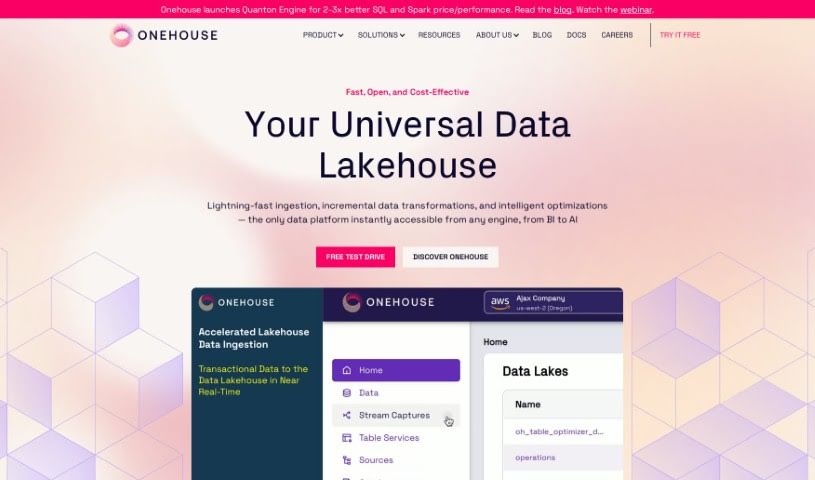
Screenshot of Onehouse

Onehouse

Discover what Onehouse is and how to use it effectively in 2025. We'll explore its features and see how it stacks up against other Data Analytics Tools.

Screenshot

What is Onehouse?

Onehouse offers a really smart Universal Data Lakehouse. It is the go-to solution for managing your data in a way that’s integrated, scalable, and just plain efficient. It’s built from the ground up to make open storage easy, keep your data pipelines running smoothly, and automatically handle optimizations no matter what table formats, engines, or cloud environments you’re using. By using great technologies like Apache Hudi, Delta Lake, and Apache Iceberg, Onehouse makes sure everything works together and your data setup is ready for the future. Businesses can really tap into their full potential for business intelligence, data science, and AI/ML thanks to Onehouse. It simplifies things with Continuous Data Delivery and what they call ‘Automagic Data Infrastructure.’ Essentially, Onehouse champions true interoperability, meaning you’re not tied to any single vendor, and it helps you save money and time as your data needs grow. It’s a really complete platform for managing data smartly.

Who created Onehouse?

Vinoth Chandar is the person behind Onehouse; he’s both the founder and CEO. Vinoth is a real trailblazer, actively shaping how we handle open data today. Onehouse itself focuses on creating innovative data solutions, with a standout being Apache Hudi. Hudi is a data lake storage platform that brings some serious advantages to data lakes, like ACID transactions (ensuring data reliability), the ability to update or delete data at the record level, and smooth streaming data ingestion. The company is also well-known for its contributions to open-source projects, including Apache XTable, which helps unify data from all sorts of different data lake formats.

What is Onehouse used for?

  • It helps you bring all your data together into one flexible, scalable, and open platform.
  • You can simplify those often annoying data management tasks because it automates a lot of them.
  • It uses managed ingestion and incremental streaming so your data is always up-to-date.
  • You get to keep your infrastructure flexible and avoid getting locked into one vendor.
  • It helps you see real performance improvements and save money.
  • It makes open storage incredibly straightforward.
  • Operations run more smoothly with continuous data delivery.
  • You can finally say goodbye to older, slower batch processing methods.
  • Managing data ingestion and syncing becomes effortless.
  • It scales easily, whether you’re doing analytics or diving into AI.

Who is Onehouse for?

  • Data Scientists
  • Business Analysts
  • Data Engineers
  • AI/ML Engineers
  • Data Architects
  • Business Intelligence Analysts
  • Cloud Data Engineers
  • Software Developers
  • Database Administrators
  • IT Consultants

How to use Onehouse?

Ready to dive into Onehouse? Here’s a straightforward guide to get you started:

  1. Getting to Know Onehouse: First off, Onehouse is a modern Universal Data Lakehouse. It’s designed to make open storage, continuous data pipelines, and automatic optimizations across different table formats, engines, and cloud setups really easy.
  2. Key Features to Use: You’ll be working with leading technologies like Apache Hudi, Delta Lake, and Apache Iceberg. These ensure everything plays nicely together and keeps your data infrastructure ready for whatever comes next.
  3. Managing Your Data: Make your work smoother by switching from old batch processing methods to managed ingestion and incremental streaming, which is what Continuous Data Delivery offers.
  4. Experience ‘Automagic’ Data Infrastructure: This feature really simplifies things. It takes care of those tedious data management jobs like clustering and syncing, and handles scaling automatically, all by using proven lakehouse technologies.
  5. Embrace Interoperability and Independence: Onehouse strongly believes in true interoperability and avoiding vendor lock-in. They offer genuinely open data services so you’re not limited by proprietary systems.
  6. Boost Efficiency and Save Money: Help your organization become more efficient by using the ‘Unlock Savings at Scale’ feature. This means you get better performance and cost advantages as your analytics and AI needs grow.
  7. Ready to Start?: Head over to the official Onehouse website at Onehouse Website. You can explore the platform in more detail and learn about all its features there.

By following these steps, you’ll be well on your way to using Onehouse effectively for integrated and efficient data management in your organization.

Related AI Tools

Discover more tools in similar categories that might interest you

Stay Updated with AI Tools

Get weekly updates on the latest AI tools, trends, and insights delivered to your inbox

Join 25,000+ AI enthusiasts. No spam, unsubscribe anytime.