20Paths
Productivity Documentation
Learn more
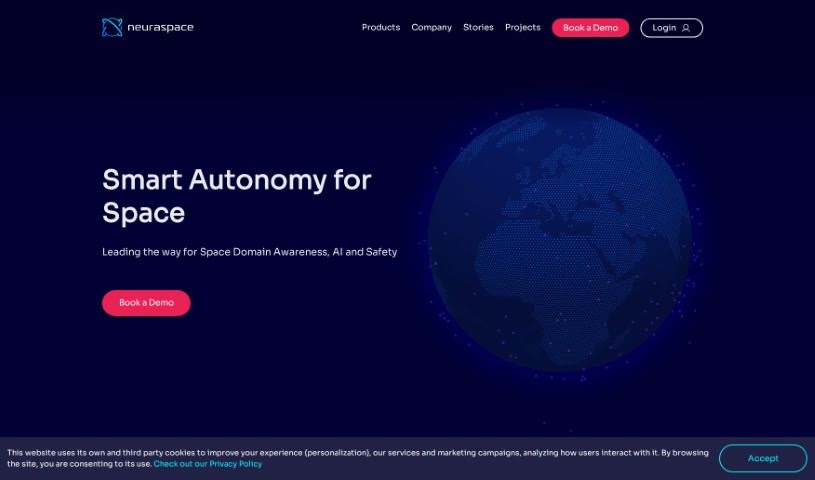
Neuraspace uses AI to automate collision risk assessment and suggest maneuvers for satellite operators, cutting alert volume, fuel costs, and collision
Neuraspace is an AI and machine learning platform for space traffic management. It streamlines space operations, automates risk assessment, suggests maneuvers, and helps satellite operators avoid collisions. The platform detects high-risk collisions earlier than conventional methods, reduces false alarms, and includes fleet management and scalable tooling.
It has limitations: it doesn’t offer instant real-time solutions, and its prediction horizon and automation have bounds. Even so, it suits smaller teams, helps optimize space operations, and supports compliance with space safety regulations by providing key data and statistics.
Chiara Manfletti founded Neuraspace. The company’s mission is to simplify space operations, automate risk assessment, and provide maneuver guidance that reduces collision risk — increasingly important as satellite constellations grow in low Earth orbit. Its team combines expertise in software engineering, data science, and aerospace engineering, working to automate satellite fleet control and address the space debris problem.
Neuraspace targets professionals across the space industry, including Space Operations Directors, Orbital Dynamics Engineers, Aerospace Engineers, Data Scientists, Machine Learning specialists, Software Engineers, Product and Project Managers, and executives, board members, and investors. Users and audience include people affiliated with organizations such as ESA/ESOC, OHB, the German Aerospace Industries Association, and the German Aerospace Center.
Neuraspace applies AI/ML to space traffic management with earlier collision detection, automated risk assessment, and maneuver suggestions up to six days ahead. Its alert filtering helps teams focus on genuinely high-risk events, and its fleet management tools scale from small constellations to larger deployments. While limited in real-time response and prediction horizon, it’s a practical option for satellite operators — especially smaller teams — looking to reduce alerts, fuel costs, and collision risk while supporting regulatory compliance.
Related
Discover more tools in similar categories
Weekly picks of the best AI tools we've researched and added — no spam, unsubscribe anytime.
Join 25,000+ AI enthusiasts. No spam, unsubscribe anytime.