20Paths
Productivity Documentation
Learn more
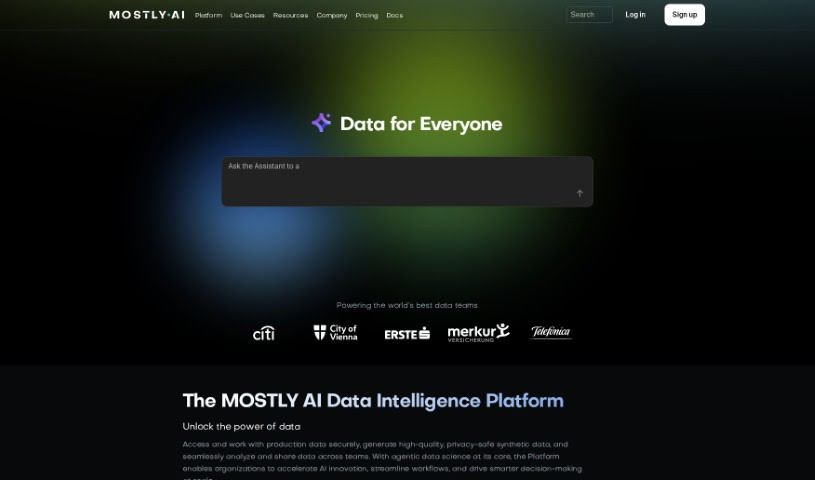
Discover what Mostly AI is, a synthetic data platform for privacy-safe data sharing, AI/ML development, and self-service analytics.
Founded in Vienna, Austria in 2017 by data scientists Michael Platzer, Klaudius Kalcher, and Roland Boubela, Mostly AI specializes in AI-generated synthetic data. Its services include generating high-quality synthetic data, ensuring data privacy and security, providing professional training, supporting AI and machine learning model development, and enabling safe cross-border data sharing.
The company’s platform, GenAI, lets users explore and share tabular data, helps make AI and ML models fairer and less biased, and supports self-service analytics. Mostly AI’s mission is to change how companies handle data by promoting smart, safe synthetic data.
The founders saw the potential of AI for generating structured business data and synthetic data, and were inspired by the data anonymization challenges companies faced, particularly with GDPR coming into effect in 2018. Their goal is to help organizations use safe synthetic data ethically and to empower everyone with data.
The tool serves AI/ML developers, data scientists, software developers, QA testers, data analysts, data engineers, and product developers — essentially anyone involved in synthetic data generation or software testing.
The platform’s AI-powered technology generates high-quality, privacy-safe synthetic datasets. You can address bias in training datasets using its algorithms to improve fairness in AI/ML models. Useful features include natural language interfaces for exploring data, a Python client for data workflows, and the ability to create tabular data from scratch or enrich existing datasets — all while keeping data private and secure.
Related
Discover more tools in similar categories
Weekly picks of the best AI tools we've researched and added — no spam, unsubscribe anytime.
Join 25,000+ AI enthusiasts. No spam, unsubscribe anytime.