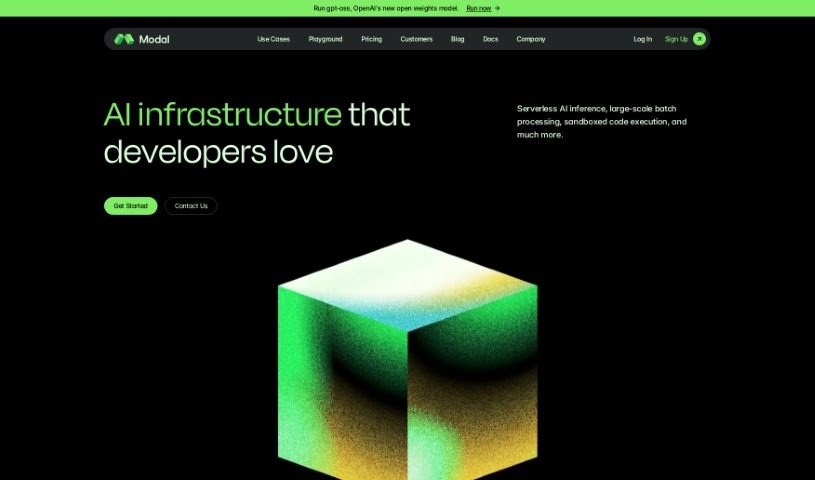
What is Modal?
Modal is a cloud platform built specifically for developers, with a strong focus on teams working with AI, data, and machine learning (ML). It is a way to run your CPU or GPU tasks for AI and data-heavy applications without ever having to worry about managing the underlying infrastructure yourself. It’s designed to be fast and scalable, thanks to its custom container system built in Rust, which means quick cold starts. Plus, it offers a serverless environment, a full suite of developer tools, and a pricing model that’s easy on the wallet, including free compute credits every month. You can use Modal for all sorts of compute tasks, like running generative AI models, handling big batch jobs, or managing job queues.
Who created Modal?
Modal was founded by a team led by Erik Jankowski. They’ve built a high-performance cloud platform that’s really geared towards developers, especially those in AI, data, and machine learning. Modal provides a serverless environment that’s perfect for running generative AI models, tackling large-scale batch jobs, and managing job queues efficiently and affordably. The whole setup is designed to handle CPU, GPU, and data-intensive compute tasks, so developers can just focus on writing their code instead of getting bogged down in infrastructure management.
What is Modal used for?
Modal is incredibly versatile for developers working with demanding computational tasks. Here’s a breakdown of what it’s great for:
- Running generative AI models: Easily deploy and run your AI models.
- Large-scale batch jobs: Process massive datasets or perform complex calculations.
- Job queues: Manage and execute tasks in a structured, ordered way.
- Data-intensive compute tasks: Handle applications that require significant data processing.
- Efficient scaling: Scale your workloads up to hundreds of GPUs seamlessly.
- Cost-effective compute: You only pay for the compute you actually use, making it budget-friendly.
- Effortless deployment: Get your functions running in the cloud quickly and simply.
- Comprehensive environments: Set up complete development and execution environments.
- Built-in storage: Manage your data directly within the platform.
- Job scheduling: Plan and automate the execution of your tasks.
- AI tasks: A broad category covering many AI-related computations.
- Machine learning tasks: From training to inference, ML workloads are well-supported.
- Custom container system deployment: Package your applications in containers for consistent execution.
- Avoiding infrastructure management: Focus on your code, not servers.
- Secure workloads: Benefit from a secure computing environment.
- Efficient and fast CPU and GPU compute tasks: Get the performance you need.
- High-performance computing: Ideal for demanding AI, data, and ML teams.
- Running massively parallel GPU finetune jobs: Train models efficiently by using many GPUs at once.
- Training hundreds of LLMs at the same time: Scale your large language model training efforts.
- Deploying models to Modal: A straightforward process for getting your trained models into production.
- Empowering infra needs with just a couple decorators: Simplify infrastructure setup with simple code annotations.
Who is Modal for?
Modal is a fantastic tool for anyone involved in building or deploying AI and data-intensive applications. Specifically, it’s a great fit for:
- AI professionals: Those working directly with artificial intelligence technologies.
- Data scientists: Individuals who analyze and interpret complex data.
- Machine learning engineers: Professionals who build, train, and deploy ML models.
- AI researchers: Academics and scientists pushing the boundaries of AI.
- Developers focused on generative AI models: Anyone building with tools like LLMs or image generation.
- Teams handling large-scale batch jobs and job queues: Groups that need to process large amounts of data or manage many tasks.
- AI Teams: Groups dedicated to AI development and deployment.
- Data Teams: Teams focused on data processing, analysis, and management.
- Machine learning (ML) teams: Groups specializing in ML projects.
How to use Modal?
Modal is a powerful cloud platform designed to help developers run CPU, GPU, and data-intensive tasks seamlessly, all without the hassle of managing infrastructure. Here’s a straightforward guide to getting started and using Modal effectively:
- Sign Up: Start by creating an account on the Modal website. You can choose a plan that best suits your needs, whether it’s the Starter, Team, or Enterprise option.
- Explore the Platform: Once you’re in, take some time to get familiar with what Modal offers. This includes its unique custom container system, its serverless environment, and the flexibility of its environments.
- Bring Your Code: Upload your own code to Modal. It’s perfect for tasks like running generative AI models, handling large-scale batch jobs, or managing job queues efficiently.
- Deploy Functions: Make the most of the serverless environment. You can deploy your functions to the cloud in mere seconds, and you won’t need to deal with complex Dockerfiles or YAML configurations.
- Monitor Performance: Keep an eye on your executions, logs, and metrics in real-time. This helps you track how your tasks are performing.
- Ensure Security: Modal uses the battle-tested gVisor runtime, which provides a secure environment for your workloads.
- Cost-Effectiveness: You’ll appreciate the pricing model. You pay only for the compute time you actually use, and Modal even gives you $30 in free compute credits each month.
- Explore GPU Computing: Modal supports a variety of compute tasks, including those that specifically require GPU power.
- Join the Community: Connect with other users on the Modal Community Slack. It’s a great place to get support and stay updated on platform news.
- Free Credits for Startups & Academics: If you’re a startup or an academic researcher, you can get up to $25,000 in free compute credits, especially for GPU compute.
By following these steps, you can really make the most of Modal’s features for your development tasks. It’s a great way to speed up your projects with computing that’s both efficient and secure.