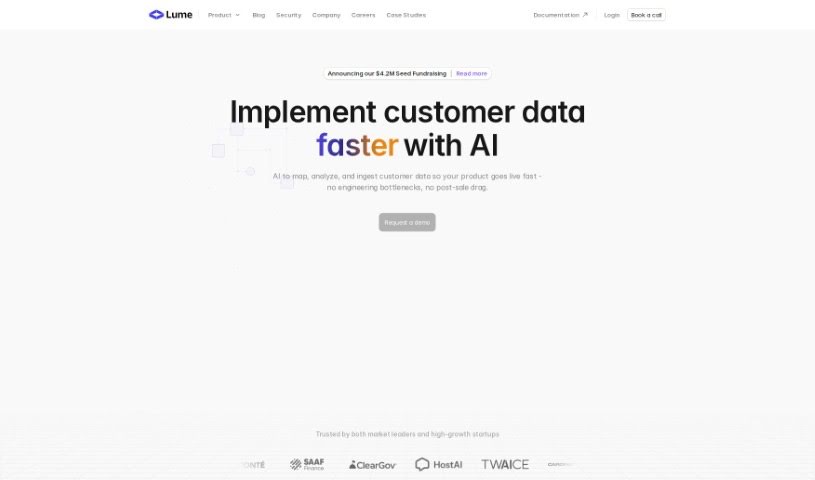
Screenshot of Lume AI

Lume AI

Discover what Lume AI is and how to use it effectively in 2025. We'll explore its features and see how it stacks up against other Data Analytics Tools.

Screenshot

What is Lume AI?

Lume AI is a smart tool that uses artificial intelligence to automate data mapping. It is a way to cut down the time you spend wrestling with data. It can help you scale up how you bring in data, clean up old data from different systems, build data pipelines really fast, and even keep your data mappings up-to-date automatically. Plus, Lume AI takes security seriously – it’s SOC2 Type-1 Certified and has Type-2 monitoring in place.

With Lume AI’s application programming interface (API), you can really get the most out of your data. It lets you weave AI-powered data mapping right into your existing systems, making all those data wrangling tasks much smoother.

Creating and managing data pipelines becomes a breeze with Lume AI. Because it uses AI for the mapping part, you can manage all your data pipelines, review them, make edits, and get your mappers ready to go in just seconds. It gives you a clear view of everything.

Lume AI offers a user-friendly graphical interface (GUI) that lets you see exactly what’s happening with your data pipelines and mappings. This means you can easily review, edit, and deploy your data mappers quickly, giving you full oversight and control.

The IntegrAI Platform, part of Lume AI, handles the whole process of building, testing, and deploying your workflows in a way that’s both easy to use and secure. It really simplifies the continuous integration and continuous delivery (CI/CD) pipeline.

Lume AI has strong security measures. It’s SOC2 Type-1 Certified, and it’s continuously monitored with Type-2 compliance. This shows they’re really committed to keeping your data safe and earning your trust.

So, to sum it up, Lume AI is a really thorough tool. It uses AI to automate data mapping, makes data integration better, and improves how efficiently you manage your data, all while keeping security and ease of use front and center.

Who created Lume AI?

Lume AI was developed with the goal of automating data mappings and first launched on December 6, 2023. While the founder’s name and specific company details aren’t provided in the information I have, the tool itself uses AI technology to quickly create data pipelines, handle data wrangling efficiently, and automatically maintain mappers. This helps solve complex data challenges with both ease and accuracy.

What is Lume AI used for?

  • It automates data mappings.
  • It helps create data pipelines quickly.
  • It makes data wrangling more efficient.
  • It gives you better visibility over your pipelines.
  • It lets you review data mappings.
  • It supports deploying mappers.
  • It handles building, testing, and deploying integrations.
  • It ensures seamless data mapping.
  • It can work with unique data forms.
  • It helps speed up data ingestion.
  • It allows for adaptable data transformations.

Who is Lume AI for?

  • Data Analysts
  • Data scientists
  • Business analysts
  • Data engineers
  • BI Developers
  • ETL Developers
  • Data Architects
  • DB Admins
  • Solution Architects
  • Integration Architects
  • Business Intelligence (BI) Specialists
  • Data Quality Analysts

How to use Lume AI?

Here’s how you can get started with Lume AI:

  1. Automating Data Mappings: Lume AI uses AI to automate data mappings. It helps you build data pipelines fast, mapping your data in seconds. It can even adjust automatically if your source or target data models change.
  2. API Functionality: You can use the Lume API to really unlock your data’s potential. Integrate AI-powered data mapping directly into your systems to make data wrangling tasks much smoother.
  3. Creating Data Pipelines: Lume AI makes it easy to create and manage data pipelines quickly. It uses AI for mapping tasks, so you can manage all your pipelines, review them, edit them, and deploy mappers in a flash.
  4. Visibility and Control: The user-friendly Lume Platform gives you a clear view of your data pipelines and mappings. This lets you oversee and control your data pipelines effectively.
  5. Mobile Version: You can even use Lume AI on the go! IntegrAI Mobile lets you track your AI integrations and manage projects from wherever you are.
  6. Data Ingestion: Need to bring in a lot of data quickly? Lume AI helps you scale data ingestion when onboarding new partners or customers. It efficiently processes unique data types in seconds, adapting to growing data volumes.
  7. Legacy Data Normalization: If you have messy legacy data from older systems, Lume AI can normalize it into a standard format. This makes processing and analysis much more efficient.
  8. Mapper Maintenance: Lume AI automatically takes care of maintaining your mappers. It detects changes in your data and adjusts the mappings accordingly, ensuring your data mapping stays accurate and current.
  9. Security Measures: Lume AI puts security first. It’s SOC2 Type-1 Certified, and ongoing Type-2 monitoring ensures it stays compliant with data security standards.
  10. Data Integration: Use Lume AI’s API to seamlessly integrate AI-powered data mapping into various systems. This really boosts how you use your data to make smarter decisions.

By following these steps, you can make the most of Lume AI for automating data mapping, integrating data, and managing it all. It’s a great way to handle data complexities accurately and efficiently.

Related AI Tools

Discover more tools in similar categories that might interest you

Stay Updated with AI Tools

Get weekly updates on the latest AI tools, trends, and insights delivered to your inbox

Join 25,000+ AI enthusiasts. No spam, unsubscribe anytime.