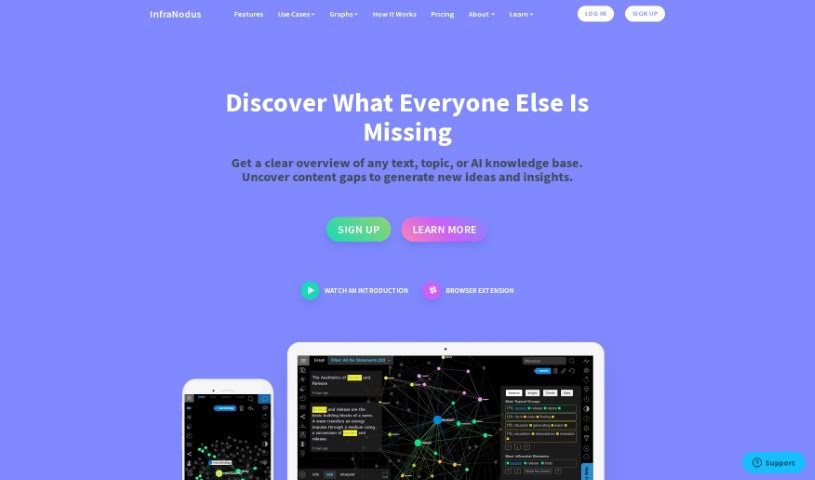
Screenshot of InfraNodus

InfraNodus

Discover InfraNodus in 2025! Learn what this text network visualization tool is, how to use its features effectively, and how it stacks up against other data visualization tools.

Screenshot

What is InfraNodus?

InfraNodus is a tool that visualizes text as a network. Developed by Nodus Labs, it’s been around in various forms since 2011, with the current version running since 2018. It’s built using the NestJs Node.Js framework, Prisma, and PostgreSQL, and uses Sigma.Js for its graph visualizations. For analysis, it taps into libraries and algorithms like Textexture (for text network analysis), Cytoscape, and Graphology. Essentially, it helps with tasks like text mining, topic modeling, and general data analysis. It’s particularly good at spotting structural gaps in information, allowing you to uncover patterns and gain deeper insights from your data. InfraNodus helps you see recurring topics, key concepts, and how different pieces of information connect. It also supports statistical analyses and offers various visualization tools.

What’s really unique about InfraNodus is how it’s designed to encourage different ways of thinking. It aims to promote cognitive variability by subtly adjusting your thought process. By balancing different states you might go through during research, it helps foster both openness to new ideas and coherence in your thinking.

The way it works is pretty straightforward: it turns your text into a network. Words are points (nodes), and when words appear together, they form connections. The tool then identifies groups of related words, highlights the most influential elements, and points out gaps in the overall discourse. It uses algorithms to generate insights and even suggests ways to fill those gaps, which can really spark new ideas.

Whether for personal projects or professional work, InfraNodus is quite versatile. It can help with summarizing text, brainstorming with AI assistance, conducting qualitative analysis, and even with SEO and market research. People use it to understand text better, boost creative thinking, analyze content, and find gaps where information is needed but not yet supplied.

Who created InfraNodus?

Dmitry Paranyushkin created InfraNodus. He’s the founder of Nodus Labs, the company that developed the tool, starting back in 2011. As mentioned, InfraNodus is a text network visualization tool designed to help with text mining, topic modeling, data analysis, and finding structural gaps. The tool is specifically developed to encourage dynamic and diverse thinking on a cognitive level. By representing ideas as a network, it makes it easier for users to discover relationships and patterns within their data.

What is InfraNodus used for?

  • Data Analysis
  • Text Mining
  • Data Mining
  • Topic modeling
  • Structural gap detection
  • Network analysis
  • Visualization
  • Pattern identification
  • Insight discovery
  • Understanding data
  • Automated topic extraction
  • Visualizing relationships between topics
  • Statistical data analysis
  • Visualization of data through graphs and charts
  • Identification of gaps in networks or data sets
  • Exploration and understanding of data through network analysis
  • Automatically extracting topics and themes from text data
  • Visualizing relationships between topics
  • Identifying influential elements within content
  • Statistical analysis of datasets
  • Identifying gaps and missing links within networks or data sets
  • Exploring, understanding, and making sense of data
  • Overview & Summarization
  • AI-Augmented Brainstorming
  • Qualitative Analysis
  • SEO & Market Research
  • Text Overview & Summarization
  • SEO and Market Research

Who is InfraNodus for?

  • Researchers
  • Marketers
  • Content creators
  • Writers
  • Marketing professionals
  • Corporations
  • NGOs
  • Associate research professors
  • Information specialists
  • E-learning specialists
  • Financial services executives

How to use InfraNodus?

Using InfraNodus is a straightforward process. Here’s how you can get started:

  1. Add Your Text or Data: You can either import your text, notes, or data from various sources, or use the live editor directly. Supported sources include Gephi graphs, Evernote, your Twitter feed, or even snippets from Google search results. Once you add your text, it’s transformed into a graph. In this graph, words act as nodes, and when words appear together, they create connections.
  2. Get a Visual Overview: After you add your text, the network visualization is generated. You’ll notice that influential words appear larger, and words that frequently occur together are grouped into distinct topical clusters, each with its own color. This visual summary tool gives you a clear overview of the main topics and how they relate to each other.
  3. Generate Insight: InfraNodus then identifies structural gaps within the network. These are places where connections could logically exist but are currently missing – think of them as blind spots. The tool offers suggestions on how to bridge these gaps, which can help you generate new ideas and discover fresh insights. You can also export your data, along with the insights InfraNodus provides, as a CSV file for deeper analysis or even as training data for neural network applications.

By following these steps, you can easily use InfraNodus for text network analysis and gain valuable insights without much hassle.

Related AI Tools

Discover more tools in similar categories that might interest you

Stay Updated with AI Tools

Get weekly updates on the latest AI tools, trends, and insights delivered to your inbox

Join 25,000+ AI enthusiasts. No spam, unsubscribe anytime.