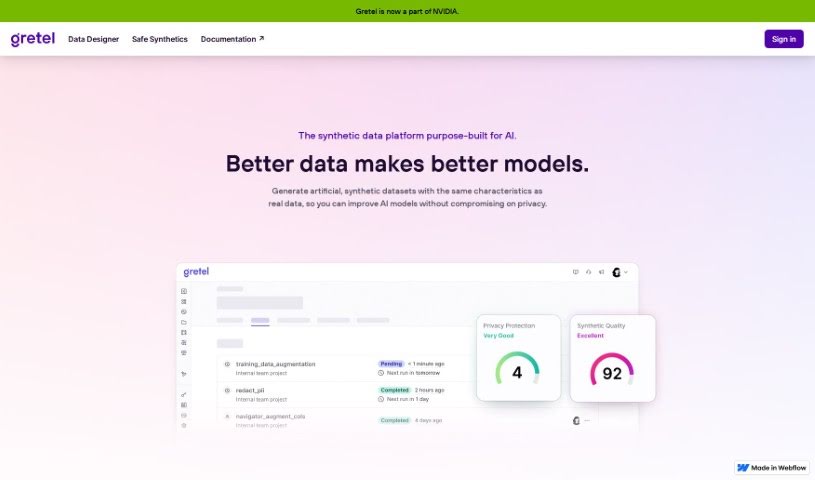
Screenshot of Gretel

Gretel

Discover what Gretel is and how to use it effectively in 2025. We'll explore its features and see how it stacks up against other Data Analytics Tools.

Screenshot

What is Gretel?

Gretel.ai is a platform that helps developers create synthetic data. It is a way to build artificial datasets that really capture the essence and characteristics of your real data, but without any of the sensitive personal information. This is super helpful for improving AI models, especially when you need to keep privacy a top priority. The platform gives you APIs so you can fine-tune your own AI models and generate synthetic data whenever you need it. It’s already being used in important areas like finance, healthcare, and government.

Gretel.ai uses AI itself to generate this synthetic data. It learns the statistical patterns from your existing data and then makes sure the new data it creates is high-quality and respects privacy. By generating anonymized synthetic data, it effectively removes any personal or sensitive details, keeping your original data private. With Gretel, you can fine-tune AI models using their APIs, generate data on demand, check how good your data is, and even work on cloud projects with your team. It’s a pretty comprehensive tool.

Who created Gretel?

Alexander Watson is the person behind Gretel. He’s the CPO and Co-Founder of the company. The platform officially launched on June 18, 2024. Gretel is essentially a synthetic data platform built for Generative AI. It provides APIs that let you create anonymized, safe synthetic data. This is great for making AI models better while also making sure data privacy is maintained. The company is really focused on providing solutions for enterprise AI, specifically by generating high-quality, safe synthetic data that works for various industries, including finance, healthcare, and the public sector.

What is Gretel used for?

Here’s a rundown of what you can do with Gretel:

  • Create synthetic data: You can generate artificial datasets that mimic your real data.
  • Customize AI models: Tailor AI models to your specific needs.
  • Keep data private: Ensure sensitive information is protected.
  • Use APIs: Train models and validate data using Gretel’s APIs.
  • Generate data on demand: Get synthetic data whenever you need it.
  • Build data pipelines: Create workflows for data processing.
  • Measure data quality: Check how good your synthetic data is.
  • Anonymize data: Generate datasets that are completely anonymized.
  • Validate models: Use scores to check your AI models.
  • Scale in the cloud: Effortlessly handle larger workloads.
  • Transform data: Use flexible rules to change data formats or content.
  • Support various industries: It’s useful for finance, healthcare, and more.
  • Keep data on-premises: You can retain data locally if needed.
  • Collaborate with teams: Work together on projects easily.
  • Use Gretel Navigator: This tool helps with data generation and pipeline building.
  • Get high-quality data: The focus is on producing excellent synthetic data.
  • Maintain privacy standards: It’s designed to meet strict privacy requirements.

Who is Gretel for?

Gretel is a valuable tool for a wide range of professionals:

  • Developers looking to build with synthetic data.
  • Finance professionals needing secure data for analysis.
  • Healthcare professionals working with sensitive patient information.
  • Public sector professionals in government and public services.
  • AI professionals and AI researchers developing new models.
  • Data professionals, Data scientists, and Data engineers who work with data pipelines and quality.
  • Team collaboration professionals managing shared projects.
  • Privacy professionals and Compliance professionals ensuring data protection.
  • AI engineers and Machine learning engineers building and refining models.

How to use Gretel?

Here’s a step-by-step guide to using Gretel effectively:

  1. Generate Synthetic Data:

    • First, you’ll train AI models to understand the statistical patterns in your existing data. This helps the system learn what your data looks like.
    • Then, you can use Gretel’s APIs to create artificial datasets that closely mimic your original data.
    • After generating, it’s important to validate the quality and privacy of this synthetic data to make sure it meets your standards.
  2. Data Transformation:

    • You can apply rule-based transformations to change the format or content of your data as needed.
    • Gretel also uses advanced NLP detection to help ensure data privacy by identifying and handling Personally Identifiable Information (PII).
  3. Custom Model Fine-Tuning:

    • Gretel’s APIs allow you to adjust model parameters, letting you fine-tune them for your specific requirements.
    • This customization can really help improve your model’s performance and accuracy.
  4. Measure Data Quality:

    • Use the tools provided to validate your AI models and measure the quality of the synthetic data you’ve generated.
    • This step is crucial to ensure the synthetic data you produce is of high quality.
  5. Collaborate and Scale:

    • You can easily collaborate with your team on cloud projects.
    • Gretel’s cloud scaling features make it simple to handle workloads of any size.
  6. Monitoring and Control:

    • Keep an eye on your monthly usage and credits through the Console.
    • If you have a Developer account, you can control your spending and manage credit limits.
  7. Access Resources:

    • Dive into the documentation, tutorials, and open-source SDKs to get a deeper understanding of how Gretel works.
    • You can also use the Gretel Navigator tool to help generate data and build your pipelines.

By following these steps, you’ll be well-equipped to use Gretel for generating synthetic data, training your models, transforming data, and collaborating effectively with your team.

Related AI Tools

Discover more tools in similar categories that might interest you

Stay Updated with AI Tools

Get weekly updates on the latest AI tools, trends, and insights delivered to your inbox

Join 25,000+ AI enthusiasts. No spam, unsubscribe anytime.