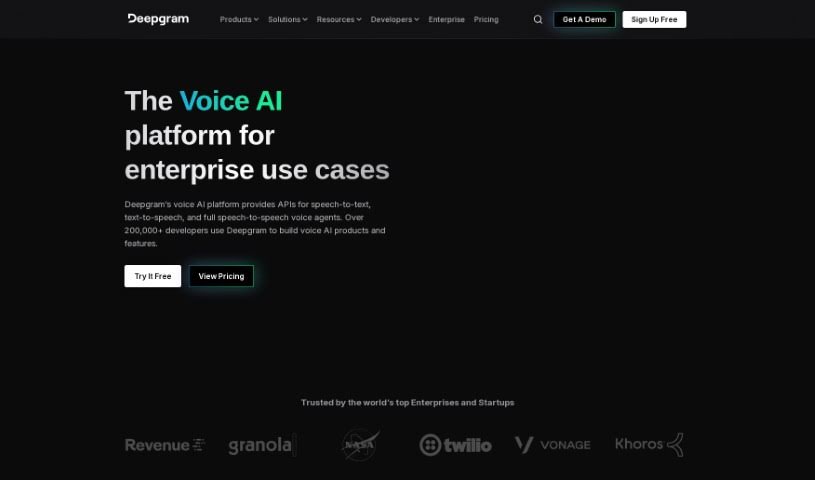
Screenshot of Deepgram

Deepgram

Discover what Deepgram is and how to use its powerful voice AI features effectively in 2025. We'll explore its capabilities, compare it to other Voice Generators, and guide you through getting started.

Screenshot

What is Deepgram?

Deepgram is a leading voice AI platform that provides developers with APIs for speech-to-text, text-to-speech, and language understanding. It is a powerful toolkit for anything involving voice. Developers use Deepgram for all sorts of applications, from transcribing medical notes with incredible accuracy to building sophisticated autonomous agents that can interact naturally. It’s a platform that top companies, leaders in conversational AI, and innovative startups trust because it consistently delivers reliable performance. Deepgram offers solutions like incredibly fast voice synthesis for real-time AI agents, highly accurate speech recognition, and efficient audio intelligence models. What really sets it apart is its speed, accuracy, and cost-effectiveness when you compare it to other vendors out there, making it a go-to choice for anyone needing top-notch speech recognition services.

Who created Deepgram?

Deepgram was actually founded by Scott Stephenson, who has a fascinating background. He started out as a dark matter physicist before pivoting to become a deep learning entrepreneur. The company’s leadership team is also quite diverse and experienced. You’ve got Shadi Baqleh, who’s great at go-to-market strategy; Jenny Draxl, who excels in organizational effectiveness and HR; and Marcel Santilli, who has a proven history of creating great digital experiences and driving revenue growth. At its core, Deepgram focuses on providing transcription and understanding capabilities through its speech-to-text, text-to-speech, and language understanding APIs, serving a wide range of clients from large enterprises to conversational AI leaders and startups.

What is Deepgram used for?

Deepgram is incredibly versatile and finds its use in many areas:

  • Contact Centers: Enhancing customer interactions and analytics.
  • Medical Transcription: Accurately capturing patient notes and consultations.
  • Speech Analytics: Gaining insights from voice data.
  • Media Transcription: Transcribing interviews, podcasts, and videos.
  • Conversational AI: Powering intelligent chatbots and virtual assistants.

Who is Deepgram for?

Deepgram is designed for a broad audience, including:

  • AI & Engineering Teams: Building and integrating advanced voice capabilities.
  • Voice AI Researchers: Pushing the boundaries of voice technology.
  • Deep Learning Researchers: Exploring new models and applications.
  • Speech-to-text Developers: Implementing accurate voice input.
  • Text-to-speech Developers: Creating natural-sounding synthetic voices.
  • Audio intelligence Developers: Extracting insights from audio data.
  • Contact Centers: Improving customer service and operational efficiency.
  • Medical Transcription Services: Streamlining healthcare documentation.
  • Speech Analytics Providers: Analyzing call data for business intelligence.
  • Media Companies: Transcribing content for accessibility and searchability.
  • Conversational AI Companies: Developing sophisticated AI agents.
  • General Developers: Integrating voice features into any application.
  • Businesses: Looking to leverage voice technology for innovation and efficiency.

How to use Deepgram?

Getting started with Deepgram is pretty straightforward. Here’s a simple breakdown of the steps:

  1. Explore the Deepgram Platform: First off, head over to Deepgram’s website. Once you’re there, check out the API Playground. It’s a fantastic place to test out speech-to-text and other features using sample audio files to get a feel for how it works.
  2. Access the Free API Playground: You can actually try Deepgram out for free! The API Playground lets you test your own audio files or play around with pre-recorded samples to see its capabilities firsthand.
  3. Choose a Pricing Plan: Deepgram offers a few different pricing options to fit your needs. You can go with “Pay As You Go” if you’re just starting, a “Growth” plan for developing projects, or an “Enterprise” plan for larger-scale operations, depending on how much you plan to use it and your budget.
  4. Sign Up or Get a Demo: Ready to dive in? You can sign up directly on Deepgram to get access to all the endpoints and models for speech-to-text, audio intelligence, and text-to-speech. If you need a more guided introduction, you can also request a demo.
  5. Integrate Speech Recognition: Once you’re set up, you can easily integrate Deepgram’s powerful speech recognition technology into your own applications. It’s designed to make adding speech-to-text functionality as smooth as possible.
  6. Utilize Domain-Specific Language Models (DSLMs): Deepgram also provides special DSLMs. These are tailored for specific industries, meaning they’re much better at understanding and generating text that’s relevant to your particular field or needs.
  7. Fast and Accurate Results: You’ll notice that Deepgram delivers results quickly and accurately. This is thanks to their advanced algorithms and robust infrastructure working behind the scenes.
  8. Consider Plan Upgrades: As your usage grows or your needs change, you can always upgrade your plan. This often gives you access to higher concurrency limits and even more features.

By following these steps, you’ll be well on your way to effectively using Deepgram’s voice AI platform for all your speech-to-text, text-to-speech, and language understanding needs.

Related AI Tools

Discover more tools in similar categories that might interest you

Stay Updated with AI Tools

Get weekly updates on the latest AI tools, trends, and insights delivered to your inbox

Join 25,000+ AI enthusiasts. No spam, unsubscribe anytime.