What is Cebra?
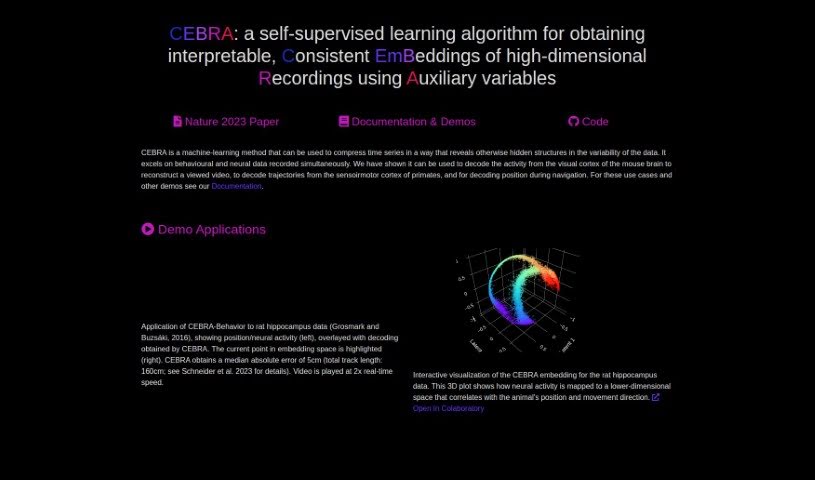
CEBRA is a smart machine-learning tool that’s really good at shrinking down time series data. It’s designed to help us spot those hidden patterns in how data changes over time. What’s particularly cool is that it can analyze both behavioral and brain data at the same time. For instance, it’s shown it can actually figure out what a mouse was seeing just by looking at its brain activity in the visual cortex, and then reconstruct the video! It uses clever, non-linear methods to blend behavioral and neural information, giving us a much deeper look into brain activity than older, linear approaches. CEBRA is super flexible, too – you can use it with all sorts of data, like calcium imaging and electrophysiology, whether it’s for sensory or motor tasks. A big plus is its label-free decoding; this means it can reconstruct complicated movement patterns and even visual experiences without needing any extra labels. Plus, it handles multi-session analysis, which helps us find consistent patterns across different datasets, making it easier to test our ideas. It can even quickly and accurately decode natural movies from the visual cortex, really boosting our understanding of how the brain represents things.
Who created Cebra?
CEBRA was developed by a talented team: Steffen Schneider, Jin Hwa Lee, and Mackenzie Mathis, all from EPFL. This algorithm is quite a breakthrough in machine learning – it compresses time series data to reveal those hidden structures, especially when looking at both behavior and neural data together. CEBRA really shines when it comes to decoding brain activity from the visual cortex, allowing us to reconstruct videos that a mouse has seen.
What is Cebra used for?
Here’s a rundown of what CEBRA helps with:
- Connecting Behavior and Brain Activity: It maps how specific actions relate to neural activity in neuroscience research.
- Modeling Brain Dynamics: It helps model how the brain changes its activity while animals are adapting to new behaviors.
- Finding Neural Representations: It uncovers how the brain represents information by creating neural latent embeddings.
- Decoding Visual Cortex Activity: It decodes what’s happening in the mouse visual cortex.
- Joint Analysis: It creates useful latent embeddings that allow for analyzing both behavior and neural data together.
- Decoding Natural Movies: It decodes what movies are being viewed based on visual cortex activity.
- Exploring Data Across Sessions: It helps you look for consistent patterns in latent spaces, whether you’re analyzing one session or many.
- Testing Hypotheses: You can use CEBRA to test your scientific hypotheses.
- Label-Free Decoding: It can decode complex movement patterns and even reconstruct visual experiences without needing any external labels.
- Reconstructing Visual Experiences: It reconstructs what someone saw based purely on neural data.
- Non-Linear Embedding Techniques: It uses advanced non-linear methods to combine behavioral and neural data, showing you the dynamic activity in the brain.
- Flexible Application: It works well with different kinds of data, like calcium imaging and electrophysiology, and for various sensory and motor tasks.
- Label-Free Decoding: You can decode complex movement patterns and reconstruct visual experiences without needing any extra labels, which really simplifies things.
- Multi-Session Analysis: It makes it easier to explore consistent latent spaces across multiple datasets, which is great for testing hypotheses.
- Rapid, High-Accuracy Decoding: It allows for fast and very accurate decoding of natural movies from the visual cortex, helping us understand neural representation better.
Who is Cebra for?
CEBRA is a great tool for:
- Neuroscientists
- Researchers focused on neuroscience
- Data analysts working in neuroscience research
- Anyone interested in both neuroscience and machine learning
How to use Cebra?
To get the most out of CEBRA, here’s a simple guide:
- Know Why You’re Using It: First off, remember CEBRA is designed to link behavioral actions with neural activity. It’s a fantastic way to explore how the brain represents things when behaviors are changing.
- Find the Official Code: Head over to the CEBRA algorithm’s GitHub repository. That’s where you’ll find the official version. It’s a good idea to watch the repository and give it a star so you don’t miss any updates.
- Connect and Stay Informed: Keep up with the CEBRA project by following them on Twitter or signing up for their mailing list. If you’re interested in working together, don’t hesitate to reach out via email.
- Put CEBRA to Work: Start using the CEBRA method to compress your time-series data. It’s especially helpful for revealing hidden patterns in variability when you’re analyzing behavioral and neural data together.
- Decode Brain Signals: Use CEBRA to decode neural activity, particularly from the visual cortex. You can reconstruct videos that were viewed and decode complex movement patterns.
- Explore Non-Linear Methods: Take advantage of CEBRA’s advanced non-linear embedding techniques. By merging behavioral and neural data, you can uncover dynamic neural activity.
- Apply it Flexibly: Feel free to use CEBRA with all sorts of datasets, including calcium imaging and electrophysiology. It works across different sensory and motor tasks too.
- Decode Without Labels: Decode complex movement patterns and reconstruct visual experiences without needing any external labels. This really streamlines the analysis.
- Analyze Multiple Sessions: Use CEBRA to explore consistent latent spaces, whether you have single or multiple datasets. This is key for solid hypothesis testing.
- Get Fast, Accurate Decoding: Experience how quickly and accurately CEBRA can decode natural movies from the visual cortex. This will really help you understand neural representation better.
By following these steps, you can really tap into CEBRA’s power. It’ll help you explore the complex links between behavior and neural activity, uncover hidden patterns, and deepen your understanding in neuroscience and machine learning.