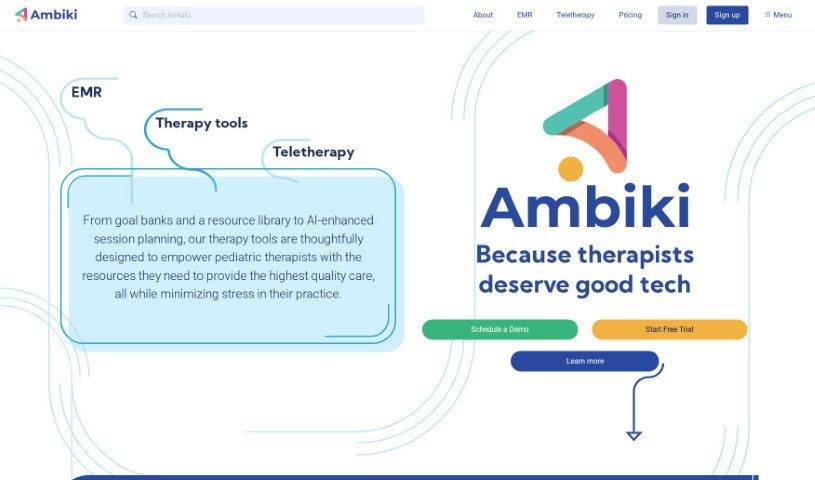
Screenshot of Ambiki

Ambiki

Discover what Ambiki is and how to use it effectively in 2025. Explore its features, compare it with other transcription tools, and see how it helps Speech-Language Pathologists.

Screenshot

What is Ambiki?

Ambiki is a smart tool built to help Speech-Language Pathologists (SLPs) by taking care of time-consuming documentation. It is your assistant for things like transcribing therapy sessions, writing up visit notes, analyzing pronunciation errors, keeping track of progress, and planning future sessions. It even creates summaries that parents can easily understand and links to helpful research based on what happened in each session. Basically, Ambiki frees up SLPs by handling many of the administrative tasks, giving them more time for what matters most – their patients.

Here’s how it works: You record your therapy sessions using Ambiki’s HIPAA-compliant recorder. The system then automatically transcribes the audio, figures out who’s speaking, and adds timestamps to the text. It also looks closely at how patients pronounce important words and phrases. From this information, Ambiki generates all sorts of useful documents: detailed transcripts, reports on pronunciation errors, visit notes, and even plans for upcoming sessions, all linked to your patient’s specific goals.

Ambiki also makes tracking progress much simpler. It pulls out key data from your sessions and shows it in easy-to-read progress charts and articulation charts. Plus, it offers “MVP Reels” – short video clips that automatically highlight a patient’s progress over time.

Just a heads-up, Ambiki is designed for one-on-one sessions and currently only supports English. It works best with a strong Wi-Fi connection for recording, and you’ll need a good microphone for the clearest results. It doesn’t currently support different dialects or group sessions, and there isn’t a specific benchmark for error scoring built-in.

Who created Ambiki?

Meet Tenalog, by Ambiki:

Tenalog is an innovative tool created by Ambiki, launched in January 2023, specifically to help Speech-Language Pathologists (SLPs) automate their documentation. Ambiki’s journey started back in 2019 in a private practice in Tennessee. The team behind Ambiki is a great mix – clinicians who understand the day-to-day challenges and developers who know healthcare inside out. This blend ensures Tenalog is perfectly suited for therapists’ needs. Tenalog offers features like automatic transcription of therapy sessions, detailed error analysis, progress tracking, session planning, and summaries that are easy for parents to understand. It’s all part of Ambiki’s goal to bring advanced technology to SLPs, OTs, and PTs, making their practice management much more efficient.

What is Ambiki used for?

Ambiki is designed to streamline the work of Speech-Language Pathologists (SLPs) by:

  • Automating Documentation: It handles many of the repetitive documentation tasks SLPs face.
  • Transcription: Automatically transcribes therapy sessions, saving significant time.
  • Visit Notes: Generates visit notes efficiently.
  • Error Analysis: Analyzes pronunciation errors in significant patient words and phrases, even at the phoneme level.
  • Progress Tracking: Extracts structured data to create goal-level progress charts and articulation charts, making it easy to see how patients are improving.
  • Session Planning: Helps plan future therapy sessions by providing recommendations and activity lists.
  • Parent Communication: Creates parent-friendly summaries of therapy sessions.
  • Resource Recommendations: Suggests relevant resources and activity lists to support session planning.
  • Editing Control: Offers full control over editing the output, including speaker labels, timestamps, and scored segments, through the Tenalog Editor.
  • Efficiency: Processes audio files very efficiently.
  • Research Links: Provides research reference links tailored to each session.
  • Support for Therapists: Assists SLPs, Occupational Therapists (OTs), and Physical Therapists (PTs).

Who is Ambiki for?

Ambiki is a valuable tool for:

  • Speech-Language Pathologists (SLPs)
  • Occupational Therapists (OTs)
  • Physical Therapists (PTs)

How to use Ambiki?

Using Ambiki (via Tenalog) is straightforward:

  1. Record Your Session: Start by recording your therapy session using Ambiki’s HIPAA-compliant recorder.
  2. Automatic Transcription: Once the session is done, let Tenalog automatically transcribe the audio. It will identify speakers and add timestamps to the transcription.
  3. Pronunciation Analysis: Tenalog then analyzes how the patient pronounces important words and phrases, looking at the phoneme level.
  4. Generate Documents: The tool creates various documents for you, including a detailed transcript, an error analysis report, visit notes, progress tracking charts, and ideas for session planning, all based on the structured data from your session.
  5. Share with Parents: Use the parent-friendly summaries to easily communicate session details to families.
  6. Edit and Refine: You have full control to edit the generated output using the Tenalog Editor. You can adjust speaker labels, timestamps, and any scored segments.
  7. Plan Future Sessions: Take advantage of Tenalog’s suggestions for session planning and activity lists.
  8. Find Resources: If you need more ideas, you can explore Ambiki’s therapy tools library for relevant resources to enhance your sessions.
  9. Track Progress: Monitor patient progress easily using the goal-level progress charts, articulation charts, and MVP Reels that Tenalog provides.
  10. Important Notes: Remember, Tenalog is designed for one-on-one sessions and currently only supports English transcriptions. Make sure you have a capable microphone, and be mindful of Wi-Fi connectivity in areas with weaker signals when recording.

Related AI Tools

Discover more tools in similar categories that might interest you

Stay Updated with AI Tools

Get weekly updates on the latest AI tools, trends, and insights delivered to your inbox

Join 25,000+ AI enthusiasts. No spam, unsubscribe anytime.