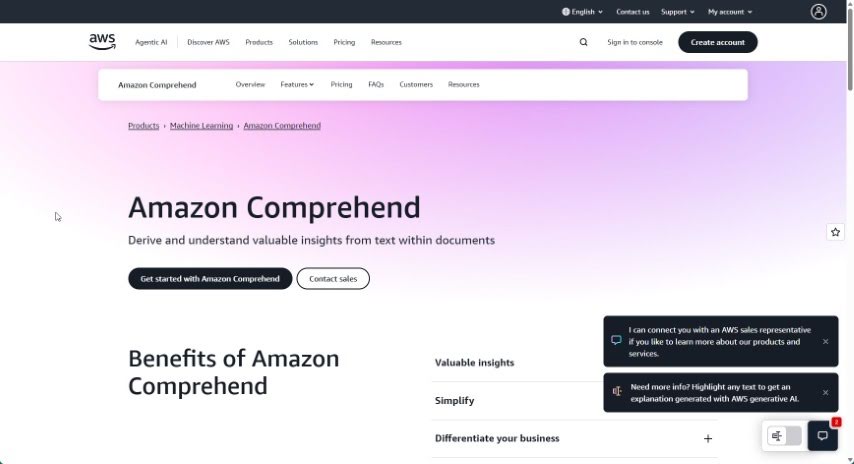
What is Amazon Comprehend?
Amazon Comprehend is a service from Amazon Web Services (AWS) that uses natural language processing (NLP) and machine learning. Its main job is to pull out valuable insights from unstructured text found in documents. It is a smart assistant for your text data. It can analyze sentence structure, spot important entities (like names, places, or organizations), and even figure out the sentiment – whether the text is positive, negative, or neutral. This helps you make smarter decisions by understanding the patterns hidden in your text.
By using Amazon Comprehend, you can make your applications and platforms much better. It’s great for things like sorting content, spotting trends, understanding customer feelings, and processing feedback. Because it runs on AWS’s robust infrastructure, it’s scalable and reliable, meaning it can handle huge amounts of text data efficiently. This really cuts down on the manual work and time you’d normally spend analyzing text, freeing you up to focus on getting those crucial insights and building smarter user experiences. In short, Amazon Comprehend is a powerful NLP tool that uses machine learning to process and analyze text, giving you significant insights for making data-driven decisions across many different uses.
Who created Amazon Comprehend?
Amazon Comprehend was developed by Amazon Web Services (AWS), the cloud computing arm of Amazon. It first launched on January 29, 2017. As a natural language processing service, it relies on machine learning to extract meaningful insights from text. AWS, which specializes in cloud computing, built this service to offer capabilities like sentiment analysis, entity recognition (finding names, places, etc.), and key phrase extraction. It’s designed to help you effectively analyze unstructured data.
What is Amazon Comprehend used for?
Amazon Comprehend is incredibly versatile and can be used for a wide range of tasks:
- Business & Call Center Insights: Analyze business data and customer calls to understand trends and performance.
- Customer Sentiment Analysis: Detect how customers feel about your products or services by analyzing their interactions and feedback. This also helps automatically categorize incoming support requests.
- Product Improvement: Extract insights from customer surveys to pinpoint areas for product enhancement.
- Search & Indexing: Equip search engines to index product reviews by focusing on key phrases, entities, and sentiment, making them easier to find and analyze.
- Legal Document Analysis: Automate the extraction of insights from legal documents like contracts and court records.
- Financial Document Processing: Classify and extract key entities from financial documents.
- Employee Feedback: Analyze employee survey responses, especially using its Targeted Sentiment feature.
- Content Moderation: Detect toxic or harmful content in website comments.
- Generative AI Safety: Identify unsafe input prompts in generative AI applications to ensure responsible use.
- Topic Modeling: Identify key terms or topics within a collection of documents, helping you understand the main themes.
- PII Protection: Detect and redact Personally Identifiable Information (PII) from documents to protect sensitive data and control access.
- Relationship Discovery: Find connections between financial events mentioned in financial articles.
- Trust & Safety: Support applications focused on trust and safety, such as detecting toxicity and classifying prompt safety.
- Document Categorization: Automatically sort documents into relevant topics.
Who is Amazon Comprehend for?
Amazon Comprehend is a valuable tool for a variety of professionals:
- Legal Professionals: Especially those managing legal briefs.
- Financial Analysts: Those who process financial documents and need to extract key information.
- Customer Support Professionals: Anyone who mines business and call center analytics, analyzes customer interactions, or categorizes inbound support requests.
- Customer Service Representatives: To better understand customer feedback and improve service.
Essentially, if your work involves understanding and extracting information from large volumes of text, Amazon Comprehend can be a significant asset.
How to use Amazon Comprehend?
Using Amazon Comprehend involves a few key steps, depending on your needs:
- Core NLP Tasks: You can use Amazon Comprehend’s APIs for common NLP tasks. This includes recognizing entities (like names and places), analyzing sentiment (positive/negative), extracting key phrases, and detecting the language of the text. Each request is generally measured by 100 characters, with a minimum charge of 3 units per request.
- Handling Personal Identifiable Information (PII): The service can find PII in your documents and help you create versions with this information removed (redacted). Similar to other tasks, requests are measured in 100-character units with a minimum charge.
- Custom Models: If you have specific needs, you can train your own custom NLP models for text categorization or entity extraction. For asynchronous inference (processing data in batches), you’ll be charged per character. Training your custom model incurs an hourly fee, and there’s also a monthly cost for managing the model.
- Topic Modeling: To find out what topics are discussed in a collection of documents, you can use topic modeling. This feature is priced based on the total size of the documents you process in a job.
- Trust and Safety Features: For detecting toxic content or ensuring safety in input prompts (especially for generative AI), you can use these features. Pricing is typically based on 100-character units with a minimum charge.
- Estimating Costs: It’s a good idea to use the AWS Pricing Calculator. This tool helps you estimate your costs based on the specific tasks you plan to do and the volume of data you expect to process.
- Free Tier: AWS offers a free tier that covers certain amounts of text and document sizes for eligible APIs. This is available for both new and existing AWS customers.
When you’re planning your usage, remember to factor in costs related to training models, running inferences (processing data), managing your models, and setting up endpoints if you need real-time classification. It’s all about understanding your specific use case and the associated pricing.