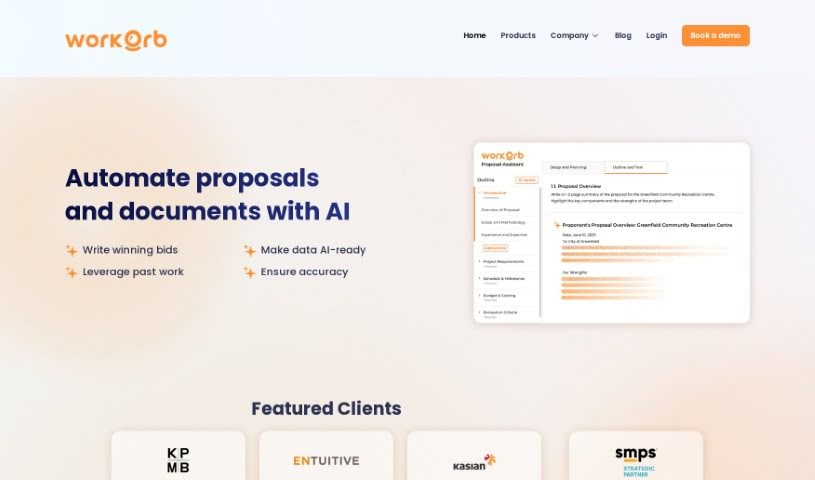
Screenshot of Workorb AI

Workorb AI

Discover Workorb AI, a powerful tool for the AEC industry in 2025. Learn its features, how it works with Graph LLMs, and how it compares to other Architect Tools.

Screenshot

What is Workorb AI?

Workorb AI is a smart solution built specifically for the Architecture, Engineering, and Construction (AEC) industry. It is a helpful virtual employee that can tackle tasks like writing proposals and RFP responses, keeping track of professional relationships, pulling out important information from documents, and handling those time-consuming, non-billable tasks. Essentially, Workorb AI is designed to make workflows in the AEC sector much smoother. It supercharges how you write proposals, keeps all your project details in one place, helps you manage compliance, and offers AI support for many business operations.

The tool uses Graph Large Language Models (LLMs) to really get a handle on and untangle the intricate relationships within large organizations. This helps customer-facing teams overcome common hurdles by automating tasks and leading to better results. Workorb AI acts like a virtual assistant that keeps a record of your interactions, automates tasks, and gives you insights into your customer relationships by connecting and analyzing conversations from various platforms. The company was founded by Nilesh Bansal and Nick Koudas, who bring a wealth of experience in machine learning and text mining. Their goal with Workorb AI is to boost the efficiency of customer-facing teams when they’re managing relationships with enterprise clients.

Who created Workorb AI?

Nilesh Bansal and Nick Koudas are the minds behind Workorb. Both hold PhDs and have extensive experience in machine learning and text mining. They launched the company on March 13, 2023. Workorb AI’s main mission is to simplify tasks for customer-facing teams by automating processes and improving sales results. The tool offers valuable insights into long-term customer relationships by carefully analyzing a wide range of conversations and interactions.

What is Workorb AI used for?

  • It’s a tool that uses Graph Large Language Models (LLMs) to understand and untangle complex relationships within enterprise organizations.
  • It automates repetitive tasks and aims to improve sales, upselling, and service outcomes for customer-facing teams.
  • It connects and analyzes both internal and external conversations—think emails, chat messages, files, and calls—to give you a complete picture of your B2B customer relationships.
  • It functions as a virtual employee, tracking interactions, providing factual details, and automating complex customer-related tasks.
  • It streamlines difficult, repetitive tasks and offers insights into long-running relationships.
  • It helps draft proposals and RFP responses.
  • It assists in cultivating and managing professional relationships.
  • It’s great for finding details and designs across past client engagements and documents.
  • It can even explain lengthy, 1,000-page documents.
  • It automates compliance obligations and extracts necessary requirements from bids and contracts.
  • It automates repetitive tasks for customer-facing teams.
  • It improves sales, upselling, and service outcomes.
  • It connects and analyzes internal and external conversations.
  • It provides a comprehensive understanding of B2B customer relationships.
  • It tracks and records interactions for customer-related tasks.
  • It streamlines complex repetitive tasks.
  • It offers insights into long-running relationships.
  • It helps draft proposals and RFP responses.
  • It extracts compliance obligations and requirements from bids and contracts.
  • It automates repetitive tasks for customer-facing teams.
  • It improves sales, upselling, and service outcomes.
  • It connects and analyzes internal and external conversations like emails, chat messages, files, and calls.
  • It provides a comprehensive understanding of multi-year, multi-person B2B customer relationships.
  • It records every interaction and automates customer-related tasks.
  • It identifies patterns and relationships by following conversation flows across platforms.
  • It streamlines complex repetitive tasks and provides insights into long-running relationships.
  • It helps draft proposals and RFP responses.
  • It cultivates and manages professional relationships.
  • It extracts compliance obligations and requirements from bids and contracts.
  • It improves sales outcomes.
  • It enhances upselling efficiency.
  • It enhances service outcomes.
  • It analyzes internal and external conversations.
  • It tracks and records every interaction.
  • It automates complex customer-related tasks.
  • It identifies patterns and relationships across platforms.
  • It connects and analyzes internal and external conversations.
  • It provides a comprehensive understanding of multi-year B2B customer relationships.
  • It tracks and records every interaction for customer-related tasks.
  • It automates complex tasks by leveraging Graph LLMs.
  • It streamlines complex repetitive tasks.
  • It provides insights into long-running relationships.
  • It tracks and records interactions.
  • It identifies patterns and relationships in conversations.

Who is Workorb AI for?

  • Architecture
  • Engineering
  • Construction

How to use Workorb AI?

To get the most out of Workorb, here’s a simple guide:

  1. Dive into Workorb AI Features:
    • Use Workorb AI to help draft proposals, manage your professional connections, find project details, and pull out key information from past client work.
  2. Draft Proposals and RFP Responses:
    • Let Workorb AI assist you in efficiently creating proposals and responding to RFPs.
  3. Relationship Hub:
    • Tap into your professional network with the Relationship Hub to discover new business opportunities, all without needing to manually enter data.
  4. Project and Details Hub:
    • Keep all your designs, communications, and documents organized in one central place for easy access and searching.
  5. Compliance Hub:
    • Manage your compliance obligations effectively. Automating these processes can help increase your bid win rates.
  6. Proposal Assistant:
    • Lean on the AI to help draft RFP responses, gather necessary background documents, and make informed, data-driven decisions.
  7. Automate Non-billable Work:
    • Automate those repetitive tasks to boost your sales, upselling, and service outcomes.
  8. AI-Powered Insights:
    • Take advantage of the Graph LLM technology to understand the complex relationships within your organization and streamline your tasks.
  9. About Workorb and the Founding Team:
    • Learn about Workorb’s mission, led by a team of AI researchers and engineers dedicated to improving productivity and workflows in the AEC industry.
  10. Contact Workorb:
    • Feel free to reach out to the team behind Workorb if you have any further questions.

By following these steps, you can really make the most of Workorb AI and improve how your Architecture, Engineering, and Construction business operates.

Related AI Tools

Discover more tools in similar categories that might interest you

Stay Updated with AI Tools

Get weekly updates on the latest AI tools, trends, and insights delivered to your inbox

Join 25,000+ AI enthusiasts. No spam, unsubscribe anytime.