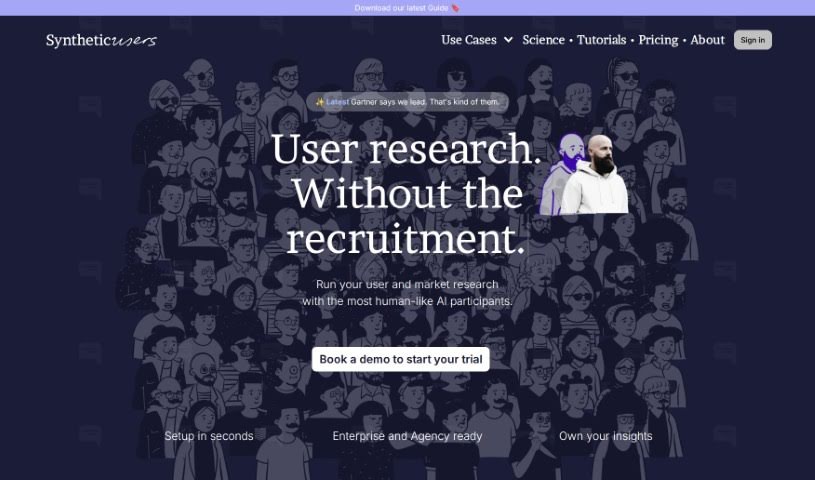
What are Synthetic Users?
Synthetic Users are essentially AI-powered participants that a platform provides to make user research much smoother. They are digital stand-ins who can mimic real users interacting with your product. They’re designed to walk through your core product flows, help you fine-tune user journeys, pinpoint what features really work well, and even help you decide what to build next. The platform uses a clever multi-agent system to dig up deep insights and boost your product’s conversion rates. Plus, they offer a way to do user research that’s both cheaper and faster than traditional methods, sidestepping common headaches like tight schedules and limited budgets. They even offer a 7-day free trial, which is a great way for teams to reduce product risks and find those winning ideas that will really resonate with the market.
This platform creates its Synthetic Users by combining a special engine for creating synthetic personas with a powerful large language model. This combination is key to ensuring the insights you get are high-quality, reportedly coming in at over 95% accuracy when compared to feedback from actual human testers. That makes them a pretty reliable option for your user research needs.
How do they work? Well, the Synthetic Users are generated using Large Language Models (LLMs). These models help build detailed personality profiles for each user. Once these profiles are set up, the users are put into a simulated environment where they can chat, make choices, and even evolve over time. Because these Synthetic Users are always learning and adapting, the data they generate stays relevant and reflects the subtle ways humans behave, offering valuable insights for all sorts of applications.
Who created Synthetic Users?
The person behind Synthetic Users is Kwame Ferreira. He’s the CEO of the company and got involved because he saw firsthand the frustrations people had with user testing and market research. That experience led him to develop Synthetic Users. His company now provides both qualitative and quantitative synthetic users to clients all over the world. It’s a really different, almost revolutionary, way to approach user research, offering AI-generated participants to test out your ideas and products.
What are Synthetic Users used for?
Here’s a rundown of what you can do with Synthetic Users:
- Test Product Flows: Simulate and test your core product flows using AI.
- Optimize Journeys: Make user journeys as smooth and effective as possible.
- Find Great Features: Discover which product features really stand out and work best.
- Prioritize Your Roadmap: Figure out what to build next to get the most positive reaction from users.
- Boost Conversions: Improve your product’s conversion rates and make your sales funnels work better.
- Understand Your Audience: Target specific groups to learn about their preferences and habits.
- Reduce Risk & Validate Ideas: Use the 7-day free trial to lower product risks and confirm your winning concepts.
- Save Time & Money: It’s a cost-effective and quick way to get around the usual challenges of traditional user research.
- Get AI Feedback: Use AI-generated participants to get feedback on your ideas and products.
- Make Faster Decisions: Speed up and lower the cost of making important decisions.
- Discover Features with AI: Harness AI to find product features and optimize user journeys effectively.
- Ship the Right Features: Determine exactly which features users will appreciate the most.
- Explore Problems: Run ‘Problem Exploration’ interviews to understand user behaviors, pain points, and context.
- Test Concepts: Start testing ideas and concepts with ‘Custom Script’ interviews and ‘Solution Feedback Interviews’.
- Continuous Improvement: Keep getting insights to boost user satisfaction and spot unmet needs.
- In-depth Interviews: Conduct deep dives with Synthetic Users to really understand their needs.
- Survey Analysis: Send out surveys and pinpoint problem areas that are worth solving.
- Early Idea Feedback: Get feedback on your initial ideas or concepts.
- Test Assumptions: Design experiments to test your assumptions.
- Market Fit Validation: Reduce product risk and find concepts that truly fit the market.
- User Resonance: Optimize your product so it connects well with users.
- Roadmap Prioritization: Plan your roadmap for shipping products that users love.
- Better Research Process: Improve your user research by using AI participants.
- Validate Market Fit: Discover winning concepts to confirm market fit.
- Targeted Optimization: Focus on specific audiences to make your product better.
- Overcome Limitations: Avoid the usual constraints of traditional user testing, like time and budget.
- Human-Level Insights: Generate insights that are as good as live human testing.
- Maintain Context: Keep context across many interactions for deeper engagement.
- Rich Outputs: Deliver more accurate and contextually relevant results for complex needs.
- Improve Conversions: Use the multi-agent system to boost conversion rates and funnel effectiveness.
- Understand Preferences: Target specific groups to tailor your product to their preferences.
- Swift Validation: Take advantage of the 7-day free trial for quick validation of product ideas.
- Consistent Engagement: Maintain context across interactions for steady engagement.
- Simulate Long-Term Behavior: Mimic long-term user behaviors and relationships.
- Simulate Core Flows: Practice simulating core product flows.
- Ship Resonating Products: Prioritize your roadmap to ship products that connect with users.
- Enhance Conversions: Boost product conversion rates.
- Improve Funnels: Make your sales funnels more effective.
- Mitigate Risk: Reduce product risk.
- Validate Fit: Confirm market fit.
- Target Audiences: Focus on specific audiences.
- Learn Habits: Understand customer preferences and habits.
- Problem Exploration: Run interviews to understand user behaviors, pain points, and context.
- Test Assumptions: Design experiments to test assumptions.
- Test Messaging: Test your marketing messages.
- Competitor Analysis: Research and analyze competitors.
- Share Findings: Share your research findings and insights.
Who are Synthetic Users for?
This tool is great for:
- User Research: Anyone involved in understanding user behavior.
- Product Discovery: Teams looking for new product ideas or improvements.
- AI Participants: Those who want to use AI in their research.
- User Journeys: Professionals mapping out user experiences.
- Multi-Agent Architecture: People interested in advanced AI systems.
- Product Conversion: Teams focused on improving sales and sign-ups.
- Funnel Efficacy: Those looking to optimize their sales or user funnels.
- User Testing: Anyone conducting tests on their products.
- Market Validation: Professionals confirming market demand for ideas.
- Tech Professionals: People working in the technology sector.
- Marketing Professionals: Marketers looking to understand customers better.
- Product Managers: Those responsible for product strategy and development.
- UI/UX Designers: Designers focused on user interface and experience.
- User Researchers: Specialists in user research methodologies.
- Market Researchers: Professionals analyzing market trends and opportunities.
- UX Designers: Designers specializing in user experience.
- Product Designers: Designers focused on the overall product.
- Tech Industry Professionals: Anyone working within the tech industry.
How to use Synthetic Users?
To get the most out of the Synthetic Users tool, here’s a simple guide:
- Understand What They Are:
- Synthetic Users are AI-generated participants for user research. They offer a way to do research that’s both cost-effective and efficient compared to traditional methods.
- Key Features & Benefits:
- You can simulate core product flows, make user journeys better, find out which product features are most effective, and help prioritize your product roadmap based on what users tell you.
- The platform uses a multi-agent architecture to provide deep insights, boost conversion rates, and improve how well your funnels work.
- Getting Started:
- Sign up for a 7-day free trial to explore what the tool can do.
- Book a demo call to learn how to set up and use the platform effectively.
- FAQs:
- You can learn all about the concept of Synthetic Users, how they impact user research, and how reliable the insights they generate are.
- Pricing & Trial:
- Check out the clear and affordable pricing models available.
- Enhance Your Data:
- Use proprietary data to make your Synthetic Users more robust and tailor your research to your specific needs.
- Why It’s Better:
- Synthetic Users provide a deeper understanding of context and continuity in interactions, offering more diverse outputs than other models like ChatGPT.
- Use Cases:
- You can conduct interviews to explore problems, test your ideas, gather feedback, and even analyze competitors using Synthetic Users.
- Keep Learning:
- Actively use the platform to refine your insights, make better decisions, and improve overall user satisfaction.
By following these steps, you can effectively use the Synthetic Users tool for detailed user research and better product development.