What is Sunoh.ai?
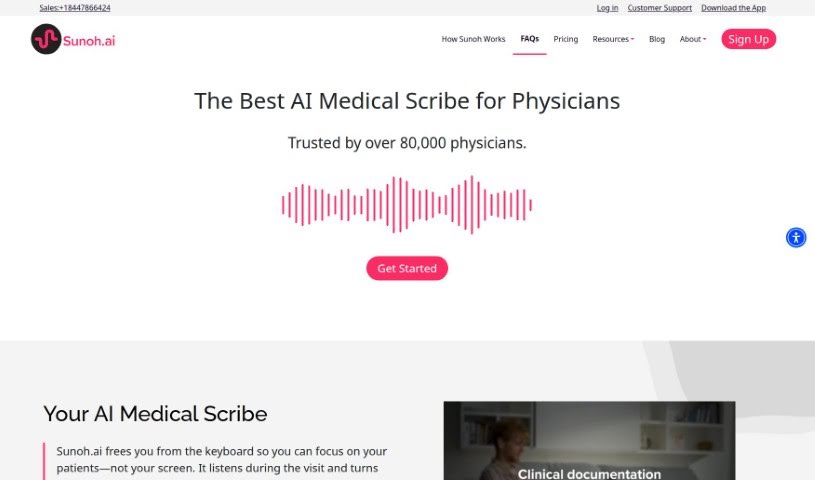
Sunoh.ai is a cutting-edge AI tool, specifically the Sunoh Medical AI Scribe, designed to completely change how healthcare documentation is handled. It uses artificial intelligence and voice recognition to effortlessly capture and turn everyday conversations between doctors and patients into accurate clinical notes. This smart tool makes the whole process smooth and interactive, freeing up doctors to concentrate on patient care instead of getting bogged down with manual note-taking. Since it works with existing Electronic Health Record (EHR) systems, Sunoh really boosts the efficiency of clinical documentation. The goal? To provide more effective and patient-focused healthcare. What makes Sunoh.ai stand out are its features like ambient listening technology, its ability to generate natural dialogue flow, organize draft clinical documentation, help with order entry, and offer a quick review process.
Who created Sunoh.ai?
Sunoh.ai was developed with a clear mission: to improve healthcare documentation by capturing the natural conversations between healthcare providers and their patients. The company’s main aim is to lighten the administrative load and enhance healthcare delivery by using AI and ambient listening technology. Sunoh.ai is designed to be EHR-agnostic, meaning it works with various systems, and it’s all about helping providers deliver top-notch patient care efficiently. As a privately held company, they can really focus on what their clients need.
What is Sunoh.ai used for?
Sunoh.ai helps in several key ways:
- Boosts productivity: It helps medical professionals get more done.
- Streamlines clinical workflows: It makes the day-to-day processes smoother.
- Enhances patient care: By letting doctors spend more time with patients and less on paperwork.
- Saves time on documentation: It cuts down the time spent on notes during patient visits.
- Relieves documentation burdens: It offers a break from complicated note-taking and eases the administrative workload.
- Improves care quality and efficiency: It helps practices run better and patient care to be of higher quality.
- Manages multi-speaker visits: It can handle conversations with several people during a single patient appointment.
- Captures info faster: It efficiently records more details in less time during patient visits.
- Standardizes workflows: It helps create consistency in how clinical tasks are done and boosts overall productivity.
- Speeds up documentation: It allows providers to focus completely on patient interactions, not the notes.
- Generates accurate charts: It creates detailed, reliable documentation for thorough patient records.
- Enhances patient care: It directly contributes to better patient outcomes.
- Saves time on clinical documentation: A core benefit, reducing the time spent on paperwork.
- Improves patient care quality: A direct result of more focused provider attention.
- Provides relief from intricate documentation: Simplifies a complex task.
- Alleviates administrative workload: Reduces the burden of non-clinical tasks.
- Fosters uniformity in clinical workflows: Creates a more consistent operational environment.
- Improves practice efficiency: Helps the entire practice run more smoothly.
- Reduces burnout: Less administrative stress leads to happier providers.
- Improves care through AI: Leverages technology to enhance the patient experience.
- Efficiently captures information: Gets the necessary details during visits quickly.
- Transforms healthcare documentation: Uses AI and voice recognition to modernize the process.
- Provides efficient results: Delivers quick and effective outcomes.
- Reduces administrative burden: Less paperwork for healthcare professionals.
- Enhances clinical documentation efficiency: Makes the process faster and more effective.
- Improves medical practice productivity: Helps practices operate more efficiently.
- Handles multiple speakers: Effectively manages conversations with several participants.
- Streamlines workflows and enhances care: Allows providers to focus more on patients.
- Helps document conversations faster: Uses AI dictation for quick note-taking during encounters.
- Improves the clinical documentation process: Makes the entire system work better.
- Captures more information: Gathers more details in less time during visits.
- Enhances care quality and practice efficiency: A dual benefit for patients and the practice.
- Fosters workflow uniformity and patient satisfaction: Creates consistency and happier patients.
- Handles multiple speakers efficiently: Manages complex conversations effectively.
- Reduces burnout, saves time, and improves care: A comprehensive benefit for providers.
- Eliminates focus split: Providers can concentrate fully on patients, not note-taking.
- Enhances provider focus: Allows providers to concentrate entirely on patient interactions.
- Improves clinical documentation efficiency: Streamlines the entire note-taking process.
- Ambient Listening Technology: Uses AI to accurately capture conversations between patients and providers.
- Dialogue Flow Generation: Transcribes conversations into a clear, structured format.
- Draft Clinical Documentation: Organizes summarized content into different note sections for easy review.
- Order Entry Assistance: Captures and summarizes orders for labs, imaging, procedures, and medications.
- Efficient Review Process: Lets providers quickly review, edit, and import their documentation.
- Accent and Dialect Recognition: It can understand various accents and dialects, making it suitable for diverse healthcare settings.
- Customization: The system can be tailored to a practice’s specific needs, including adding custom templates or fields.
Who is Sunoh.ai for?
Sunoh.ai is designed for a range of healthcare professionals and support staff, including:
- Physicians
- Nurses
- Medical Assistants
- Healthcare Administrators
- Clinical researchers
- Therapists
- Physician Assistants
- Medical transcriptionists
- Healthcare IT professionals
- Medical billing specialists
How to use Sunoh.ai?
Getting started with Sunoh.ai is straightforward. Just follow these steps:
- Request a Demo: Your first step is to request a demo directly from the Sunoh.ai website. The Sunoh team will then guide you through the entire setup and implementation process.
- Accent Recognition: Sunoh is built to recognize a wide variety of accents and dialects, ensuring it’s a great fit for many different healthcare environments.
- HIPAA Compliance: Your data’s security is paramount. Sunoh adheres to HIPAA’s Administrative, Physical, and Technical safeguards, employing industry-standard encryption and robust security protocols.
- Customization: Sunoh can be tailored to meet the unique needs of your practice. This might involve adding custom templates or specific fields to suit your workflow.
- Handling Complex Medical Terminology: The system uses advanced algorithms to effectively manage complex medical terms. It also has the capability to learn from new data and feedback, allowing for continuous improvement.
By following these steps, you can effectively use Sunoh.ai for your healthcare documentation needs, taking full advantage of its advanced AI capabilities and user-friendly features.