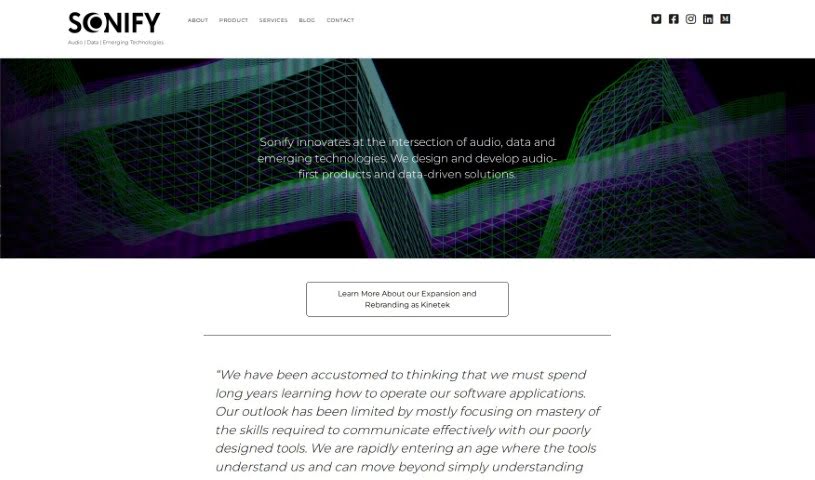
What is Sonify?
Sonify is a company dedicated to exploring and testing new ways to communicate data using sound. Their goal is to make understanding data easier by offering an audio option alongside traditional visual methods. They specifically focus on creating data-driven sonifications, which are essentially turning data into sound, to make storytelling more accessible. This is particularly helpful for people who are blind or have visual impairments.
Sonify has developed projects like TwoTone, a handy web-based tool that lets you turn data into sound without needing to write any code. They’ve also been part of important initiatives, such as “Data-Driven Storytelling: Making Civic Data Accessible with Audio.”
What’s more, Sonify received the Knight Foundation’s “Data For Civic Engagement” award. They also work on projects that help newsrooms create their own data-driven sonifications, making stories more accessible. The Sonify team is made up of talented individuals. Hugh McGrory, for instance, leads creative development and brings a background in art and technology, believing that technology should enhance human creativity, not replace it. Debra McGrory, another co-founder, is an expert in data storytelling and emerging technologies, contributing significantly to the company’s innovative work. Then there’s Cristian Vogel, the Chief Technology Officer, who’s a music producer, creative technologist, and sonic innovator – a great mix of skills for the team.
Who created Sonify?
Sonify - Audio was brought to life by Hugh McGrory and Debra McGrory. Hugh, who serves as the CEO & Co-Founder, is a real innovator at the crossroads of new media and technology. He has a background that spans film, photography, virtual reality, and artificial intelligence. Debra McGrory, also a Co-Founder, is an entrepreneur, educator, and specialist in data storytelling. She has a lot of experience using digital technologies to improve communication. Sonify itself was founded back in 2019 in New York City, but it’s now based in Vermont. The company really focuses on audio, data, and emerging technologies to create audio-first solutions for how humans interact with computers. They do this through things like data sonification, sound design, and spatial audio.
What is Sonify used for?
- Telling stories with data by turning it into sound (sonification).
- Making data easy to understand for people who are blind or have visual impairments.
- Improving user experiences with products that prioritize audio.
- Turning complicated data into meaningful sound experiences.
- Working together on projects that explore audio and data.
- Giving people tools to create immersive audio experiences.
- Focusing specifically on making things accessible for those with visual impairments.
- Being pioneers at the intersection of audio data and new technologies.
- Creating audio solutions that make user interactions better.
- Transforming data into audible stories.
- Making data accessible to the visually impaired community.
- Adding an audio option to traditional visual methods to help people understand data more deeply.
- Helping newsrooms create their own data-driven sonifications for storytelling.
- Boosting human creativity and making media production more accessible to everyone.
- Building interactive art installations for exhibitions.
- Using the TwoTone tool to turn data into sound without needing to code.
- Using sound for music and sonification based on environmental data.
- Offering services for training, production, and R&D in audio-first human-computer interaction.
- Exploring how audio, data, and new technologies can connect people more deeply.
- Using data-driven sonification for storytelling that’s accessible to the visually impaired.
- Taking an audio-first approach to improve user experiences.
- Collaborating with experts in audio and data.
- Prioritizing accessibility by making data audible for the visually impaired.
- Turning data into sound to help people understand things better.
- Empowering newsrooms to create data-driven sonifications for storytelling that’s accessible to both blind and visually impaired individuals.
- Enhancing human creativity by making media production processes more open to everyone.
- Making data accessible through sound for people with visual impairments.
- Crafting immersive audio solutions for better user interaction.
- Teaming up with experts to explore the latest in audio and data.
- Committing to accessibility by making data audible for the visually impaired.
- Innovating where audio data and emerging technologies meet.
- Leading the way in audio-first products and data-driven solutions.
Who is Sonify for?
- Experts in data visualization
- Music producers
- Sound designers
- Podcasters
- Data Analysts
- Journalists
- Financial Analysts
- Data Journalists
- Artists
- Technologists
- Data scientists
- Researchers
- Audio Engineers
- Creative Technologists
How to use Sonify?
Ready to turn your data into sound with Sonify - Audio? It’s pretty straightforward. Just follow these steps:
- Upload Your Data: Start by uploading the dataset you want to sonify. Make sure it’s in a format that works well with the tool for the best results.
- Pick Your Parameters: Next, choose the specific settings you want to use for turning your data into sound. This includes things like which variables to use, the scales, and how long the sound should be.
- Customize the Sound: Now, you can tweak the sonification settings to your liking. Play around with the pitch, tempo, and volume until you get the auditory output you’re looking for.
- Preview the Audio: Before you lock everything in, it’s a good idea to preview the sound. This way, you can check if it sounds the way you expect it to.
- Generate the Audio: Once you’re happy with all the settings, go ahead and generate the audio file. This will be based on the data and parameters you’ve chosen.
- Review and Edit: Listen to the audio file you’ve generated. If anything needs adjusting or tweaking, now’s the time to do it to make sure it perfectly represents your data.
- Save or Export: After you’ve finalized the sonification, you can save the audio file in your preferred format. Or, you can export it to use in presentations or further analysis.
- Share and Use: If you need to, share the sonified audio with others. You can also integrate it into your projects for a really unique way to present information.
By following these steps, you can effectively use Sonify - Audio to transform your data into sound, offering a fresh and engaging way to look at and present your data.