777ccc.com
Education Summarizers
Learn more
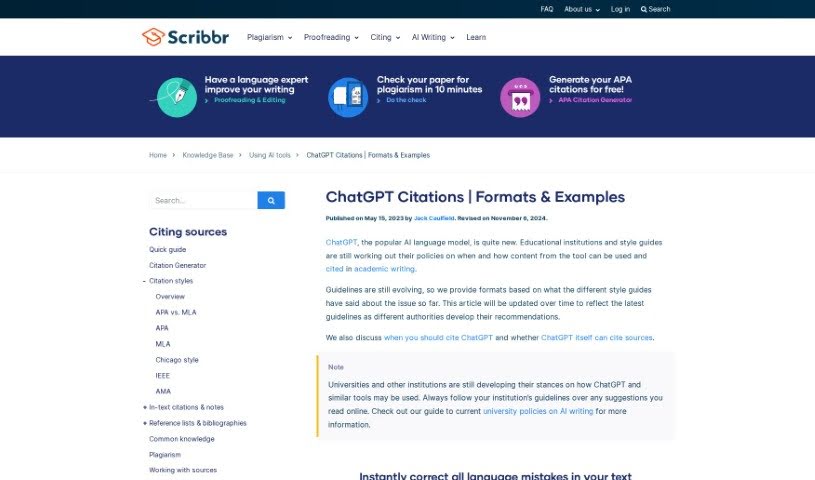
Learn Scribbr's guidelines on citing ChatGPT in MLA, APA, and Chicago style, and when citing an AI tool is appropriate in academic writing.
Scribbr’s guidelines on citing ChatGPT make a key point: ChatGPT is not a reliable source for factual academic writing. Because it is built on patterns in language rather than verified facts, it often falls short when evaluated with the CRAAP test (currency, relevance, authority, accuracy, purpose). It is generally not appropriate to cite ChatGPT for factual information.
However, if you are writing about AI language models themselves, ChatGPT can serve as a primary source. For other academic topics, it is not a suitable citation. Also important: ChatGPT is not designed to generate citations accurately, so do not rely on it for that. Use a dedicated tool like the Scribbr Citation Generator instead.
The guide was written by Jack Caulfield, a writer for Scribbr. It covers the evolving rules around using and citing ChatGPT in academic work — a complicated area, since universities and style guides are still determining how to handle AI tools. Because ChatGPT is a relatively new AI language model, questions about its credibility and proper citation remain under active discussion.
The guide is useful for anyone involved in academic or research-based writing:
MLA style:
APA style:
Chicago style:
Related
Discover more tools in similar categories
Weekly picks of the best AI tools we've researched and added — no spam, unsubscribe anytime.
Join 25,000+ AI enthusiasts. No spam, unsubscribe anytime.