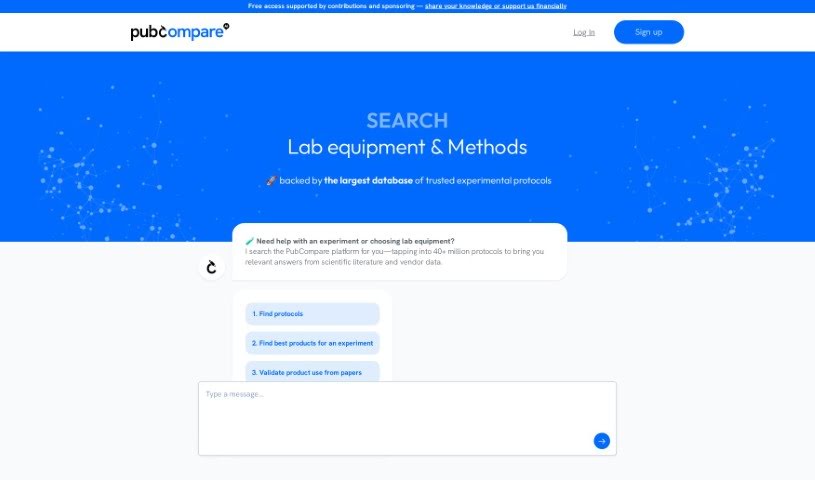
What is Pubcompare?
PubCompare is a specialized search engine built specifically for real experimental protocols. It offers a really user-friendly interface, and you get precise search results that are exactly what scientists need. The whole idea behind this platform is to make research more transparent, cut down on wasted effort, and generally make processing protocols in health sciences much more efficient.
Here are some of the cool things PubCompare lets you do:
- You can access over 26 million open access protocols that come from peer-reviewed publications. Plus, there are another 1 million open access protocols sourced from patents.
- It’s packed with powerful AI tools that can detect, compare, and really evaluate how reproducible a protocol is.
- You get advanced search capabilities, including semantic analysis. This means it can intelligently broaden or narrow down your searches based on meaning.
- It can even help you find key methods and protocols that are usually hidden behind paywalls.
Beyond just giving you access to a huge range of reliable sources and smart analytical tools, PubCompare is designed to help scientists create solid protocols and reduce the chances of experiments failing. The platform’s main goal is to completely change how scientists look for and build protocols, all while encouraging more collaboration and innovation in scientific research.
Who created Pubcompare?
Biowebspin SA actually created PubCompare back in December 2023. Their main idea was to connect research happening in industries with what’s going on in academia. They developed the platform by talking with scientists all over the world, aiming to index millions of methods and provide essential tools that save researchers time.
The team behind PubCompare is made up of data scientists, front-end and AI developers, and communication managers. They’re all really dedicated to making scientific research more reliable and efficient. PubCompare is based in Switzerland, and they’re always working to improve the platform through new ideas and by teaming up with partners in academia, industry, and other institutions.
What is Pubcompare used for?
Pubcompare is incredibly useful for a variety of research tasks:
- It helps researchers pinpoint successful protocols by looking at how often they’ve been cited.
- It makes it easier to review the latest, most up-to-date protocols used in past research.
- You can get quick access to data on approved medical and surgical protocols.
- It provides access to a massive database filled with reliable experimental protocols, especially in the Life Sciences.
- The platform helps you identify crucial steps within a protocol and assess how reproducible it is.
- Researchers save a lot of time because they can quickly find protocols directly from the Materials and Methods section – information that often gets missed by popular search engines like Google or PubMed.
- It allows you to compare several research publications side-by-side, which is great for spotting key differences in methods, how results were measured, and the actual outcomes.
- Pubcompare encourages collaboration, whether it’s within your own research team or with different institutions. You can share standardized protocols to make sure experiments are replicated effectively and results are verified.
- It boosts research integrity by promoting transparency, making sure experiments are reproducible, and generally improving how protocols are chosen for experiments.
- It really helps streamline the process of reviewing literature and keeps you informed about the newest developments in different research areas.
- You can identify relevant research articles and keep track of trends within a specific field.
- It streamlines literature review processes.
- It helps you stay current with the latest advancements in your study area.
- It’s perfect for quickly finding and comparing protocols, especially in fields like molecular biology or virology.
- It assists in developing scientific investigations and applications.
- It can help improve how patients are managed globally.
- It helps minimize the risk of experimental failures.
- It facilitates collaboration within research teams.
- It allows for efficient side-by-side comparison of protocols.
- It makes finding relevant protocols within large databases much easier.
- It helps you quickly find relevant research articles.
- It aids in tracking trends within a specific field of study.
- It supports making informed decisions about your work.
- It’s useful for identifying and comparing protocols in molecular biology and virology.
- You can find and compare protocols with the help of AI.
- It enables collaboration within research teams or across institutions, leading to efficient replication of experiments.
- It enhances the reproducibility and transparency of scientific research.
- You can access and compare approved medical and surgical protocols.
- It increases the speed and efficiency of finding protocols that match your specific research needs.
- It streamlines the literature review process and saves time when researching protocols.
- It gives you access to a database of proven protocols for various experimental fields.
- It helps you review the current state of the art regarding protocols used in previous research.
- It helps identify successful protocols by checking how often they’ve been cited.
- You can quickly find protocols from the Materials and Methods section, which are often hard to find on Google or PubMed.
- It allows you to search and compare protocols using AI.
- It adds value to the entire research, development, and innovation process.
- It helps identify the current state of the art for medical and surgical protocols.
- It enables comparing multiple research publications side-by-side.
- It facilitates collaboration within research teams or across different institutions.
- It helps you efficiently find relevant protocols within large databases.
- It provides access to a database of proven protocols for experiments.
- It helps identify successful protocols based on citation counts.
- You can search and compare protocols with AI assistance.
- It allows for quickly finding protocols from the Materials and Methods section.
- It helps in identifying critical steps and evaluating the reproducibility of protocols.
- It supports researchers and students in their research, development, and innovation efforts.
- It provides quick access to approved medical and surgical protocols.
- It allows for swift comparison of protocol sections across different publications.
- It efficiently compares multiple research publications side-by-side.
- You get quick access to data on approved medical and surgical protocols.
- It helps you save time in literature reviews and streamline research processes.
- It facilitates collaboration within research teams or across institutions.
- It helps in identifying and replicating experiments effectively.
- It minimizes the risk of using flawed or outdated methodologies in future studies.
- It allows for quickly identifying protocols that match specific research needs.
- It provides access to protocols from reputable sources to ensure the quality of your studies.
Who is Pubcompare for?
Pubcompare is a valuable tool for a wide range of individuals and groups in the scientific community:
- Clinical Psychology professionals
- Researchers in experimental fields
- Scientists
- Researchers
- Academics
- Clinical Psychologists
- Research Scientists
- Scientists
- Researchers
- Academics
- Research teams
- Students
How to use Pubcompare?
Using PubCompare is pretty straightforward. Just follow these steps:
- First, head over to the PubCompare website and sign up for an account. It’s a quick process.
- Then, dive into the powerful AI tools PubCompare offers. You can use them to analyze, compare, and really get a good look at how reproducible experimental protocols are.
- You’ll have access to a massive library – over 26 million open access protocols from peer-reviewed publications, plus another 1 million protocols from patents.
- Make the most of the advanced search features. You can find similar protocols, pinpoint crucial steps, and even discover relevant publications that might otherwise be hidden behind paywalls.
- PubCompare uses unified keyword usage and semantic analysis. This means you can intelligently broaden or filter your searches to get exactly what you need.
- If you’re working with a team or collaborating with other institutions, you can share standardized protocols. This makes it much easier to replicate experiments and verify your results.
- Save yourself time and make better choices by quickly comparing different protocols based on key metrics.
- You can explore and compare multiple research publications side-by-side. This is super helpful for spotting key differences in methodology and understanding the outcome measures.
- Take advantage of the platform’s ability to quickly find protocols from the Materials and Methods section – these are often hard to find in general searches like Google or PubMed.
- Really dig into the extensive database of reliable experimental protocols in Life Sciences. You can identify critical steps and evaluate how reproducible they are.
- Use PubCompare to add real value to your overall research, development, and innovation processes. It can even support models like the Triple/Quintuple Helix Innovation Model.
- Get quick access to data on approved medical and surgical protocols. This helps you immediately identify the current state of the art when applying new technologies.
PubCompare really shines with its user-friendly interface, its huge database, and its AI-driven features. It’s designed to completely change how you explore protocols and make your research processes much more efficient. Give PubCompare a try to optimize your experimental protocols and access valuable resources for all your research needs.