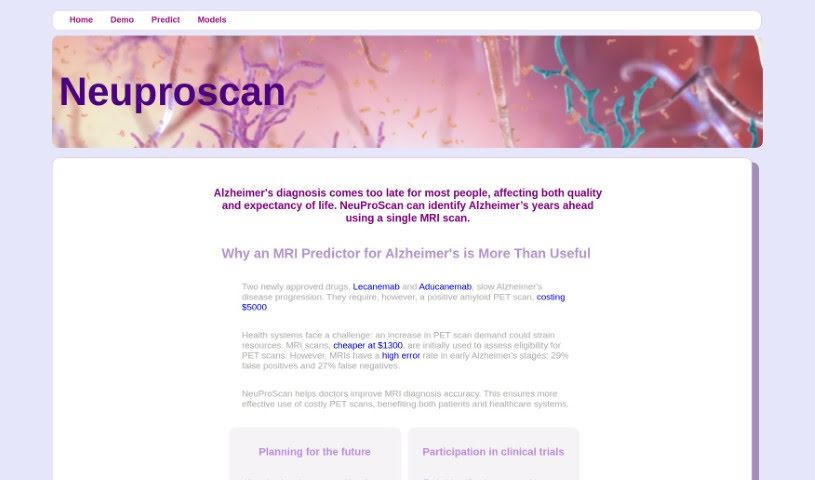
Screenshot of NeuProScan

NeuProScan

Discover what NeuProScan is and how to use it effectively in 2025. We'll explore its features and see how it stacks up against other doctor's tools.

Screenshot

What is NeuProScan?

NeuProScan is an AI platform designed to help predict if someone might develop Dementia by looking at their MRI scans. It’s particularly good at spotting early signs of Alzheimer’s disease, even before any symptoms show up. It like this: the AI has been trained on tons of MRI scans, so it can pick out really subtle patterns and hidden clues that suggest preclinical Alzheimer’s. It does this by looking at every tiny detail, or pixel, in the scans to help doctors make more accurate diagnoses, which ultimately leads to better care for patients. NeuProScan isn’t meant to replace a doctor’s judgment; instead, it acts are a helpful assistant, offering a “second opinion” that can forecast a patient’s future health and give a precise prediction of their risk for Alzheimer’s. This is a big deal because right now, there aren’t many consistent or easy ways to detect Alzheimer’s before symptoms appear. NeuProScan aims to fill that gap by offering a reliable, non-intrusive method for early detection. The main goal is to improve how early we can diagnose and manage Alzheimer’s, which could mean starting treatments when they’re most effective.

Who created NeuProScan?

Neuproscan was developed by an AI platform focused on predicting dementia from MRI scans. It first became available on October 25, 2023. While the specific founder isn’t mentioned in the available information, the company’s core is an AI model. This model was trained using a vast number of MRI scans, allowing it to analyze subtle patterns for early Alzheimer’s diagnosis. It provides doctors with precise predictions, helping them make better-informed decisions about patient care.

What is NeuProScan used for?

  • Predicting Dementia: It helps predict the onset of Dementia by analyzing MRI scans.
  • Doctor’s Second Opinion: It empowers healthcare professionals by offering a valuable second opinion.
  • Improving Early Diagnosis: It aims to enhance the early diagnosis and management of Alzheimer’s disease.
  • Forecasting Health: It helps in forecasting patients’ future health.
  • Predicting Alzheimer’s Risk: It accurately predicts the likelihood of developing Alzheimer’s.
  • Early Identification: It can identify Alzheimer’s years in advance using just a single MRI scan.
  • Boosting MRI Accuracy: It improves the accuracy of MRI diagnoses.
  • Optimizing PET Scans: It leads to more effective use of expensive PET scans, benefiting both patients and healthcare systems.
  • Future Planning: It enables patients and their families to plan for the future.
  • Clinical Trial Participation: It facilitates participation in clinical trials for new treatments.
  • Predicting Dementia Onset: It predicts the onset of Dementia from MRI scans.
  • Early Alzheimer’s Diagnosis: It diagnoses Alzheimer’s disease in its early stages.
  • Analyzing Subtle Patterns: It analyzes subtle patterns and hidden indicators of preclinical Alzheimer’s.
  • Accurate Diagnoses: It provides accurate diagnoses for better patient outcomes.
  • Doctor’s Assistant: It serves as an assistant tool for doctors and healthcare professionals.
  • Forecasting Patient Health: It offers a second opinion for forecasting patient health.
  • Precise Alzheimer’s Prediction: It predicts the likelihood of developing Alzheimer’s with precision.
  • Effective Interventions: It enables interventions at a stage when treatments may be more effective.
  • Filling a Diagnostic Gap: It fills a critical gap in the diagnostic process for early detection of Alzheimer’s disease.
  • No Symptom Detection: It diagnoses Alzheimer’s disease in its early stages with no noticeable symptoms.
  • Second Opinion for Professionals: It provides a second opinion to healthcare professionals.
  • Empowering Doctors: It empowers doctors to forecast patients’ future health.
  • Informed Decisions: It assists in making informed decisions about patient care.
  • Efficient Detection: It offers an efficient, reliable, and non-intrusive method for early detection of Alzheimer’s disease.
  • Pattern-Based Diagnosis: It makes accurate diagnoses based on subtle patterns and hidden indicators in MRI scans.
  • Timely Treatment: It potentially allows for interventions at a stage when treatments may be more effective.
  • Cost-Effective Imaging: It improves MRI diagnosis accuracy, leading to more effective use of costly PET scans.
  • Early Stage Diagnosis: It diagnoses Alzheimer’s disease in its early stages when there are no noticeable symptoms.
  • Doctor’s Second Opinion: It provides a second opinion for doctors.
  • Comprehensive Health Forecasting: It empowers healthcare professionals to forecast patients’ future health and predict the likelihood of developing Alzheimer’s.
  • Better Alzheimer’s Management: It improves the early diagnosis and management of Alzheimer’s.
  • Early Stage MRI Accuracy: It improves MRI diagnosis accuracy for early Alzheimer’s stages.
  • Future and Trial Planning: It allows patients and families time to plan for the future and participate in clinical trials.

Who is NeuProScan for?

  • Doctors
  • Healthcare professionals
  • Individual doctors
  • Hospitals (both large and small)

How to use NeuProScan?

To get the most out of Neuproscan, here’s a simple step-by-step guide:

  1. Upload Your MRI Scans: First, you’ll need to get the MRI scans for your patients. Once you have them, upload them to the Neuproscan platform.
  2. Slice Selection: Neuproscan automatically picks out about 9 key slices from the MRI scans for its analysis. These are usually taken from the central parts of the scan, looking at it from the side, front-to-back, and left-to-right views.
  3. Review the Predictions: The AI model within Neuproscan will then analyze the subtle patterns found in these MRI slices. It uses this information to predict how likely a patient is to develop Alzheimer’s in the future. Take a look at the predictions the platform provides for each patient.
  4. Boost Diagnostic Accuracy: By using Neuproscan, doctors can really improve how accurate their MRI diagnoses are for Alzheimer’s. This also means you can use more expensive PET scans more efficiently, which is a win-win for both patients and the healthcare system.
  5. Help Patients Plan: When you know the likelihood of developing Alzheimer’s ahead of time, it gives patients and their families a chance to plan. This can involve making decisions about living arrangements, sorting out financial and legal matters, and setting up necessary support systems.
  6. Enable Clinical Trial Participation: If Neuproscan helps identify Alzheimer’s early, patients might be able to join clinical trials for new drugs or treatments, opening doors to innovative therapies.
  7. Customize and Adapt: Neuproscan is designed to be user-friendly. You can customize it for your specific practice, whether you’re an individual doctor or part of a large hospital. It accepts patient MRI scans, predicts Alzheimer’s risk, and even lets you create your own AI models if you wish.

By following these steps, healthcare professionals can effectively use the Neuproscan tool to make their Alzheimer’s diagnoses more accurate and provide even better care for their patients.

Related AI Tools

Discover more tools in similar categories that might interest you

Stay Updated with AI Tools

Get weekly updates on the latest AI tools, trends, and insights delivered to your inbox

Join 25,000+ AI enthusiasts. No spam, unsubscribe anytime.