15-Minute plan AI
Professionals Entrepreneurs
Learn more
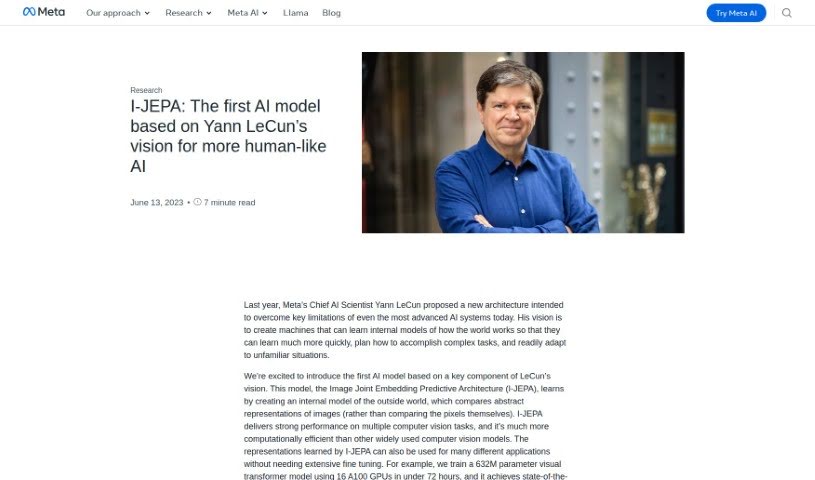
Discover Meta I-JEPA, Meta's AI model built on Yann LeCun's vision of machines learning world models through abstract image representations.
Meta I-JEPA is an AI model developed by Yann LeCun, Meta’s Chief AI Scientist. It is the first AI model built on LeCun’s approach to machine learning: having machines build internal models of the world. This approach helps models learn faster, plan tasks better, and adapt more easily.
I-JEPA learns by using abstract representations of images rather than raw pixels. This makes it effective at computer vision tasks while remaining computationally efficient, and its representations are flexible enough to be applied across different use cases without extensive adjustment.
I-JEPA suits work that requires semantic representation learning and efficient processing, such as computer vision research and applications where training efficiency matters. Its ability to produce reusable abstract representations makes it a practical option for teams building vision-based systems.
Meta I-JEPA demonstrates LeCun’s vision of self-supervised learning through world models. By predicting in abstract representation space instead of pixel space, it delivers strong performance on vision benchmarks with lower computational cost, making it a notable model for researchers and practitioners in computer vision.
Related
Discover more tools in similar categories
Weekly picks of the best AI tools we've researched and added — no spam, unsubscribe anytime.
Join 25,000+ AI enthusiasts. No spam, unsubscribe anytime.