What is Glass Health?
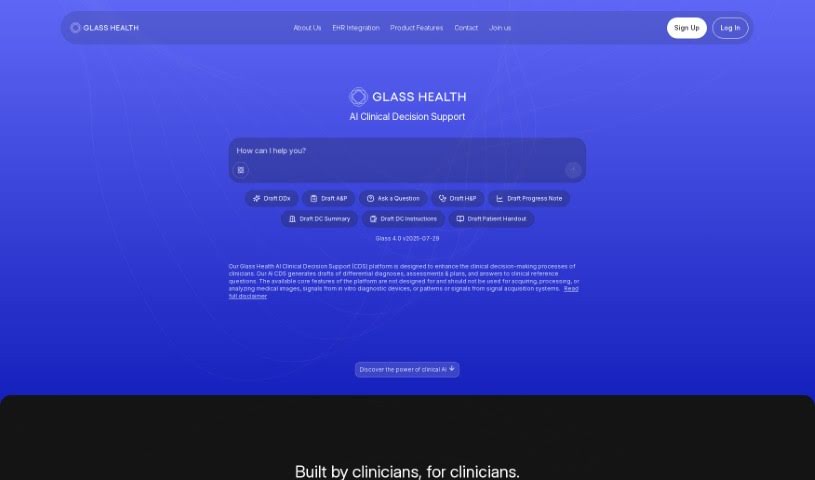
Glass AI is a smart system for managing medical knowledge, built by Glass Health specifically for doctors and those training to be doctors. It is a helpful assistant that can draft a differential diagnosis or a clinical plan. All you need to do is give it a description of the diagnostic problem you’re facing. The AI model is really the engine behind Glass AI, and the team is always working to make it more accurate through research and testing. While the tool is designed to give you useful information, remember that the quality of the diagnoses it suggests can really depend on what you put in. So, it’s super important for medical professionals to look at the outputs carefully. Just to be clear, Glass AI isn’t for everyone; it’s a specialized tool for medical pros to help them get better at diagnosing and managing their knowledge.
Who created Glass Health?
Glass Health got its start with a team who really believed in using technology to make medical practices and patient care better. They launched their AI platform on January 30, 2023. Their main goal? To give clinicians top-notch AI to help them make clinical decisions. The company is really focused on safety, doing things ethically, and making sure their AI aligns with improving how accurately doctors diagnose, how treatments are put into practice, how medical education happens, and ultimately, how patients do worldwide.
What is Glass Health used for?
Glass Health can help with a lot of things, like:
- Figuring out possible diagnoses for patients with tricky conditions.
- Creating a clinical plan based on a summary of a patient’s situation.
- Looking at patient summaries to suggest diagnoses you might want to consider.
- Using proven clinical guidelines to help shape your treatment plans.
- Giving clinicians a boost with AI for making better clinical decisions.
- Making medical practices run smoother by using technology.
- Improving how accurate diagnoses are.
- Making sure evidence-based treatments are put into practice more effectively.
- Speeding up efforts to achieve health equity.
- Helping patients get better outcomes all over the world.
- Developing differential diagnoses (that’s listing potential causes).
- Drafting clinical plans to guide treatment.
- Analyzing patient summaries to pull out key information.
- Suggesting diagnoses that need further investigation.
- Generating steps for diagnosis and treatment that are backed by evidence.
- Pinpointing diagnoses that seem to match a patient’s symptoms.
- Applying clinical guidelines directly to patient summaries.
- Creating initial drafts of clinical plans to get you started.
- Making the practice of medicine better and improving patient care overall.
- Generating clinical plans based on patient summaries.
- Identifying diagnoses that match what a patient is presenting with.
- Improving how evidence-based treatments are implemented.
- Making medical education even better.
- Helping to reduce burnout among clinicians.
- Developing both differential diagnoses and clinical plans.
- Analyzing patient summaries to get ideas for possible diagnoses.
- Combining powerful language models with established clinical guidelines.
- Identifying diagnoses that are relevant to a patient’s specific presentation.
- Empowering clinicians with a helpful AI platform.
- Optimizing the practice of medicine in general.
- Improving patient care across the board.
Who is Glass Health for?
Glass Health is designed for:
- Doctors
- Clinicians
- Medical professionals
- Trainees
- Clinicians who are currently in training
How to use Glass Health?
Here’s a straightforward way to get the most out of Glass.health:
- Log In and Share Your Patient’s Info: First, log in to Glass.health. Then, you’ll need to input what we call a “diagnostic problem representation.” This basically means providing details like the patient’s age, medical history, symptoms, and any other relevant data you have.
- Let the AI Analyze and Generate: Once you’ve entered the patient’s information, the AI system will get to work. It’ll analyze everything and then create outputs, such as a list of possible diagnoses (a differential diagnosis) or a plan for treatment. It bases these suggestions on peer-reviewed clinical guidelines and the patient summary you provided.
- Review What the AI Gives You: It’s really important to carefully look over whatever Glass.health suggests. While the AI is built to offer helpful ideas, the quality of the information you put in directly impacts how accurate and useful the output will be. So, always give it a good read.
- Use It for Medical Decision Support: You can use the output from Glass.health as a tool to help you make medical decisions. It can make the diagnostic process smoother and help you come up with effective clinical plans.
- Keep Learning and Improving: Take advantage of the fact that Glass.health is always getting better through ongoing research and testing. Make sure you stay up-to-date with any improvements to the AI model to ensure the outputs remain accurate.
- Share with Your Colleagues: If you want to discuss a diagnosis or plan with a colleague, it’s easy to share. You can just copy and paste the link that Glass.health provides. This is great for collaborative discussions or getting a second opinion.
- Remember: It’s for Medical Pros Only: Keep in mind that Glass.health is made exclusively for medical professionals and those who are training to be doctors. It’s not meant for the general public to use.
- Always Use Your Best Judgment: Even though Glass.health offers support for diagnosing, you should always rely on your own professional judgment. Interpret the AI-generated outputs with care, and think of them as guidance rather than absolute answers.
By following these steps, you can really make the most of Glass.health’s AI platform. It’s a great way to support your clinical decisions, improve how you diagnose, and ultimately provide better patient care.