777ccc.com
Education Summarizers
Learn more
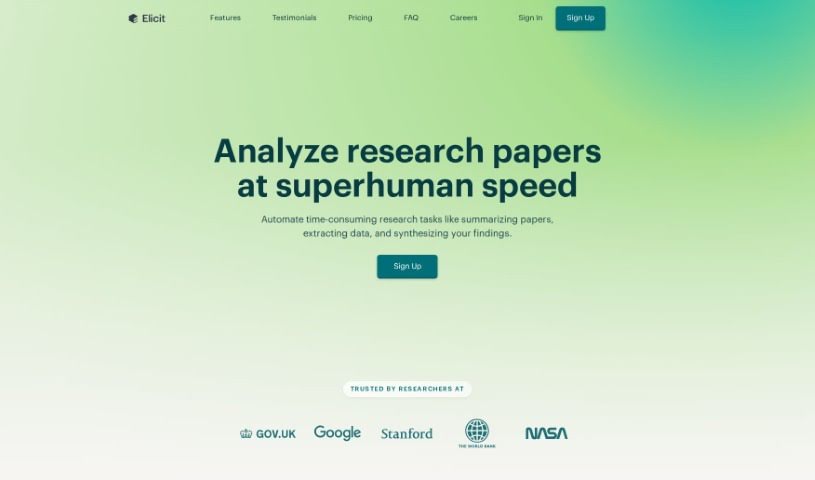
Discover what Elicit is and how it speeds up literature reviews, paper discovery, and systematic reviews for empirical research.
Elicit is a research tool designed to speed up literature reviews. It helps researchers find papers that can be difficult to track down, automates parts of systematic reviews and meta-analyses, and supports exploration of new research areas.
It works best in empirical research fields — those dealing with experiments and measurable results, such as biomedicine or machine learning. Elicit is not designed to answer questions or provide information that isn’t documented in academic papers, so it’s a poor fit for retrieving specific facts like statistics or exact numbers, or for theoretical and non-empirical subjects.
Elicit searches a collection of about 125 million academic papers drawn from the Semantic Scholar corpus, spanning a broad range of academic disciplines.
Elicit was founded by Allen Ross. His company focuses on extracting, organizing, and synthesizing data for research purposes.
Used well, Elicit streamlines the literature review process, surfaces hard-to-find papers, and supports insight-gathering across empirical domains.
Related
Discover more tools in similar categories
Weekly picks of the best AI tools we've researched and added — no spam, unsubscribe anytime.
Join 25,000+ AI enthusiasts. No spam, unsubscribe anytime.