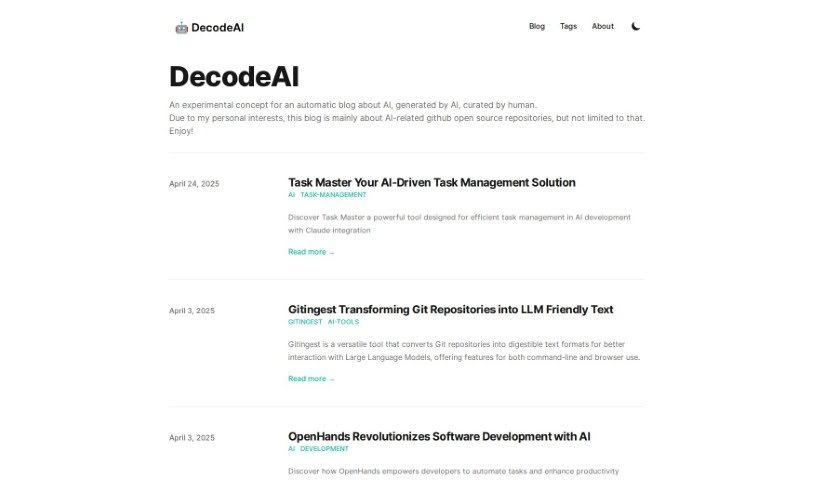
What is DecodeAI?
DecodeAI is a unique blog platform that uses artificial intelligence (AI) to help create content, but with a human touch. It is an AI-powered blog where human editors then step in to refine and polish everything. The content primarily dives into AI topics, with a special focus on open-source AI software repositories. Essentially, AI generates the initial drafts for blog posts, and then human reviewers make sure they’re high-quality and relevant. DecodeAI is great for anyone interested in AI, whether you’re just starting out or you’re already an expert. You’ll find discussions on things like AI coding assistants, AI applications you can run on your own desktop, and language models you can use locally. By combining AI’s ability to produce content quickly with human oversight, DecodeAI manages to create content that’s not only scalable but also thoughtful, adaptable, and well-controlled editorially. While it really shines when talking about open-source AI software, it also covers a broader range of AI topics and tools.
Who created DecodeAI?
DecodeAI was actually started by a single person, known online as brt, who’s also called the “AI whisperer” and runs a site called Digital Brain. The platform first went live on February 15, 2024. It’s described as a semi-automated blog about AI, where AI writes the posts, and humans oversee them. The main focus is on AI-related Github open-source repositories. The goal here is to blend what AI can do with human editing to offer really insightful content for anyone curious about AI.
What is DecodeAI used for?
DecodeAI covers a wide range of AI-related topics and tools. You can find information on:
- AI coding assistants, like Cody and Jan.
- AI applications you can run offline on your desktop.
- Language models that can be executed locally on your machine.
- Models that handle both language and vision, such as LLaVA.
- Techniques like visual instruction tuning.
- Specific AI tools, including InternLM, LLaVA, and the LangChain Visualizer.
- Different ways to deploy AI tools.
- Insights into how AI tools can be used.
- Evaluations of how well AI tools perform.
- Exploring potential ways to use AI tools.
- AI-generated blog posts that dive into AI subjects.
- Highlighting particular AI tools like InternLM, LLaVA, and LangChain Visualizer.
- Offering perspectives on how AI tools can be deployed.
- Guidance for projects involving language models that run locally.
- Discussions about language and vision models, with LLaVA being a prime example.
- Understanding the various use-cases for different AI tools.
- The features and benefits of AI coding assistants like Cody and Jan.
- In-depth details about open-source AI software repositories.
- How AI is blended with human editing to ensure quality and relevance.
- Open-source AI-related software repositories in general.
- Insights into potential use cases for AI.
- An overview of how LangChain interactions work.
- A look at the user interface’s aesthetic design.
- Quickstart guides for selected tools.
Who is DecodeAI for?
DecodeAI is a valuable resource for a variety of people interested in artificial intelligence:
- AI professionals
- Bloggers
- Developers
- Researchers
- AI researchers
- AI enthusiasts
- Content creators
- Managers working on language model projects
- Data scientists
How to use DecodeAI?
Using DecodeAI is pretty straightforward. Here’s a breakdown of how it works:
- Content Generation: DecodeAI uses AI to create blog posts on various AI topics. This includes things like open-source repositories, AI coding assistants, AI desktop apps you can run offline, and language model projects you can set up locally.
- Human Review: After the AI drafts a post, a human editor carefully reviews it. This step is crucial for making sure the content is accurate and relevant.
- Diverse Topics: The platform is designed for anyone interested in AI, no matter their current knowledge level. It offers insights into many different AI tools and applications.
- Blend of AI and Human Curation: DecodeAI combines the efficiency of AI with the careful oversight of human editors. This approach ensures the content is both high-quality and accurate.
- Specific Tools Highlighted: You’ll find posts that specifically feature AI tools like InternLM, LLaVA, and LangChain Visualizer, often with detailed explanations of what they do and how they work.
- Evaluation and Deployment: The platform also provides evaluations of how well AI tools perform and offers insights into how you can deploy them, using InternLM as an example for deployment options.
- Use-Cases and Benefits: DecodeAI shares insights into the practical uses of various tools. For instance, it discusses LLaVA for models that handle both language and vision, giving you an idea of what you can do with them.
- Local Execution: You can also find guidance on setting up and using language model projects that run locally, like Open Interpreter. This helps you interact with language models through an easy-to-use interface.